
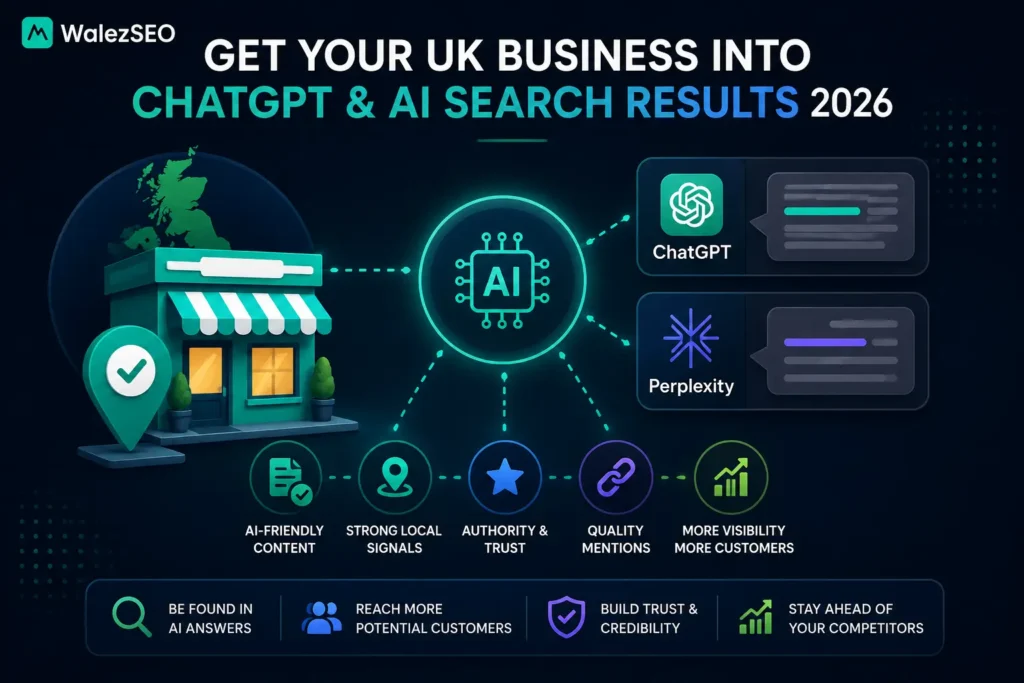
Something quietly significant happened in January 2026.
OpenAI made ChatGPT search free for all 800 million weekly active users. Every one of them can now search the web directly through ChatGPT and ask it to recommend businesses, services, and products.
Most UK business owners haven’t noticed yet. That’s actually good news for the ones reading this.
According to SOCi’s 2026 Local Visibility Index, ChatGPT recommends just 1.2% of local businesses. The same study found that strong performance in Google’s local results does not automatically translate into AI visibility. Your Google ranking and your AI visibility are two different things, measured in two different places.
That gap between businesses that appear in AI search and the overwhelming majority that don’t is the opportunity this guide covers. Here’s exactly how to close it.
Why AI Search Is Different From Google and Why It Matters
Understanding the mechanism matters before optimising for it. ChatGPT search, Perplexity, and similar systems work differently from traditional search in one crucial way: rather than returning a ranked list of links, they retrieve relevant pages, read them, and generate a summary response citing sources they’ve determined are authoritative and trustworthy.
Google ranks pages. AI systems cite sources.
That distinction changes everything about how you optimise. You’re not trying to rank position one for a keyword. You’re trying to become the source that an AI system confidently references when someone asks a question relevant to your business.
A 2025 study found that AI-driven recommendations had a 30% higher conversion rate than traditional search results. Consumers are more likely to skip verification after a ChatGPT answer they don’t cross-check with Google, they simply act. This collapses the decision-making funnel. Instead of discovery → research → comparison → action, users jump straight from question → action.
For UK small businesses, this means appearing in AI results isn’t just a visibility metric. It’s a conversion shortcut.
The 4 AI Platforms UK Businesses Need to Care About
The four platforms with the most relevance for UK businesses right now are Google AI Overviews, ChatGPT, Google Gemini, and Perplexity. Google AI Overviews reaches the largest audience because it sits directly inside Google Search. ChatGPT has the largest standalone user base globally. Perplexity and Google Gemini are both growing rapidly.
The good news: the same content optimisation work improves your visibility across all four. The foundations are shared well-structured content, strong E-E-A-T signals, consistent NAP data, and good schema markup.
You’re not building four separate strategies. You’re building one solid foundation that feeds all of them.
Step 1 Check Whether You Already Appear (Takes 5 Minutes)
Before optimising, find out where you currently stand.
Search for your service and location the way a customer would. On Google, look for an AI Overview box at the top of the results. Check whether your business is mentioned there and whether the details are accurate.
Then open ChatGPT and Perplexity and ask the questions your potential customers would ask:
- “What’s the best local SEO agency for small businesses in the UK?”
- “Recommend an affordable SEO service in Derby”
- “Who are the most trusted SEO consultants in the East Midlands?”
Manually query the major AI search platforms using your target keywords and look for citations of your brand or content.
For most UK small businesses, the answer will be that you don’t appear anywhere. That’s the baseline and now you know what you’re working toward.
Step 2 Fix the Technical Access Layer First
Three things need to be in place. Your pages must be properly crawlable and indexed. If Googlebot cannot read your content, Google AI Overviews will not cite it. If you block AI crawlers like OAI-SearchBot in your robots.txt, ChatGPT will not include your content in its answers.
Check your robots.txt file (yourdomain.co.uk/robots.txt) and make sure you haven’t accidentally blocked AI crawlers. The ones to check for:
OAI-SearchBot— ChatGPT’s crawlerPerplexityBot— Perplexity’s crawlerGoogleOther— Google’s AI crawlers
If any of these are blocked, AI systems literally cannot read your website. No amount of content optimisation will help until that’s fixed.
97% of UK business websites aren’t visible to ChatGPT search because they lack the AI discovery files the system requires. One of the most impactful technical additions you can make is an llms.txt file a simple text file at your domain root that tells AI systems what your business does, what pages exist, and how to interpret your content. Think of it as a sitemap, but for AI rather than search engines.
A basic llms.txt for WalezSEO would look something like:
# WalezSEO

WalezSEO is a UK SEO agency offering local SEO, technical SEO,
ecommerce SEO, and AI search optimisation services to small
businesses across the UK.

## Key pages
- /local-seo-services/
- /technical-seo-services/
- /ai-seo-services/
- /free-seo-audit/
Simple. Unglamorous. Genuinely impactful for AI visibility.
Step 3 Structure Your Content So AI Can Actually Use It
Generative Engine Optimisation (GEO) is the practice of making your business visible in AI search results. It builds on traditional SEO but requires specific techniques like structured data, citable passages, and authoritative content that AI models can confidently reference.
The key difference from traditional SEO: AI systems don’t skim for keywords. They read for answers. Content that directly answers a specific question in a clear, self-contained way is far more likely to be cited than content that buries answers in paragraphs of preamble.
Answer-first structure
Every section of your content should answer its heading question in the first one or two sentences not three paragraphs later. An AI system reading your page is looking for passages it can confidently extract and reference. If the answer to a question takes too long to find, the AI moves to a source that makes it easier.
Use specific, question-based headings
Instead of: “Our SEO Services” Use: “What does a local SEO service include for UK small businesses?”
Instead of: “About Us” Use: “Why do UK small businesses choose WalezSEO?”
Write pages or blog posts that match what your ideal customer might ask. This improves your AI search visibility and helps your content get picked up by tools like ChatGPT.
Include citable statistics and specific claims
AI systems cite content that contains specific, verifiable information. Generic claims (“we deliver great results”) are uncitable. Specific claims (“our clients typically see first map pack appearances within three to four months”) give AI systems something concrete to reference and attribute.
FAQ sections on every page
Every service page and blog post should include a FAQ section with genuine questions your customers ask answered directly and completely. AI visibility audits consistently show that FAQ schema and structured Q&A content is one of the highest-impact additions for getting cited in AI-generated answers.
Step 4 Build the Entity Signals AI Systems Trust
ChatGPT does not have a UK business directory and it does not pull results from Google in real time. Instead, it builds answers based on patterns it has learned from public information. When a UK business is clearly explained on its website, with consistent information about services, location, and purpose, ChatGPT is more likely to mention it when relevant. When that information is vague, outdated, or contradictory, ChatGPT usually avoids naming the business at all.
This is called entity optimisation making sure that AI systems have a clear, consistent, confident understanding of who your business is and what it does.
Consistent NAP across every platform
Your business name, address (or service area), phone number, and website URL must be identical across your website, Google Business Profile, Yell, Trustpilot, LinkedIn, Clutch, and every other platform where you appear. Inconsistency signals uncertainty to AI systems and uncertain sources don’t get cited.
A clear, specific business description everywhere
“We’re a small accountancy firm in Reading helping businesses with tax, payroll and growth planning” is far more citable than “we offer a wide range of professional services.” Specificity is what AI systems can work with. Vagueness is what they skip over.
Apply this principle to your website About page, your GBP description, your LinkedIn About section, and your Trustpilot profile. Each one should clearly state: who you are, what you do, who you serve, and where you operate.
Schema markup the structured data layer
Schema markup is code you add to your website that explicitly tells search engines and AI systems what type of content is on each page. For a UK service business, the most important schemas are:
LocalBusiness— tells AI systems your business type, location, and service areaService— describes individual services with names, descriptions, and areas coveredFAQPage— marks up your FAQ sections so AI systems can extract and cite them directlyOrganization— establishes your business as a defined entity with a consistent identity
Schema markup implementation is one of the highest-impact additions for AI search visibility AI systems use structured data to understand content with far more confidence than unstructured text alone.
Step 5 Get Mentioned on Third-Party Sources
The two biggest factors determining whether AI cites your content: how directly you answer specific questions, and how many authoritative third-party sources mention you. Traditional SEO still matters AI models read the web. But GEO requires additional tactics that traditional SEO ignores.
For AI systems, third-party mentions are proof. They’re the difference between a business claiming to be good and a business that other credible sources confirm is good. A small business that publishes genuinely useful, well-structured, locally specific content and builds real reviews and directory presence can get cited ahead of a large brand that hasn’t optimised for AI.
Reviews on multiple platforms
Google reviews are the most important. But AI systems also draw from Trustpilot, Clutch, Facebook, and industry-specific platforms. A business with 60 Google reviews and nothing else is less verifiable to an AI system than one with consistent reviews across four or five platforms.
UK directory presence
Relationships with local journalists or bloggers help significantly. Find “best [service] in [city]” type posts and ask to be included offer a case study, review or expert quote in return. These third-party listicles and recommendation posts are exactly what AI systems reference when generating “best X in Y” type answers.
Claim your Foursquare listing
This one surprises most UK businesses. ChatGPT uses Foursquare’s business data for local recommendations in some query types. Claiming and completing your Foursquare listing business name, category, website, description takes fifteen minutes and adds your business to a data source ChatGPT actively draws from.
Guest posts and expert features
Being quoted as an expert on another credible UK website is a strong AI citation signal. Relationships with local journalists or bloggers can go a long way. A mention in a regional business publication, a quote in an industry roundup, or a guest post on a relevant UK blog all contribute to the third-party signal layer that gives AI systems confidence to recommend you.
Step 6 Monitor Whether It’s Working
Manually query the major AI search platforms ChatGPT, Perplexity, Claude, Google AI Overviews using your target keywords and look for citations of your brand or content. Some SEO platforms are beginning to track AI citations, but manual monitoring remains the most reliable method for small businesses.
Set a monthly reminder to run these searches:
- “Best [your service] in [your city] UK”
- “Affordable [your service] for small businesses UK”
- “Who should I hire for [your service] in [your region]?”
Track which AI platforms mention you, what they say, and whether the information is accurate. Inaccurate AI mentions wrong phone number, outdated service description, incorrect location need to be corrected at source (your website and directory listings) since you can’t edit AI outputs directly.
Check your Google Search Console for AI Overview appearances. The Performance report now shows clicks from AI Overviews separately from organic clicks in some account configurations giving you direct visibility into whether your content is being cited in Google’s AI answers.
The Honest Timeline How Long Does AI Visibility Take?
Faster than traditional SEO in some respects, slower in others.
Technical fixes robots.txt, llms.txt, schema markup can take effect within weeks of implementation as AI crawlers re-index your content. Content restructuring for answer-first format shows results within one to three months as AI systems encounter and process your updated pages.
Third-party presence reviews, directory listings, press mentions builds more gradually, typically three to six months before it meaningfully affects how often AI systems cite you. This mirrors the timeline of traditional local SEO, because the underlying signals are similar.
You don’t need to choose between SEO and GEO the businesses winning in 2026 are doing both. GEO strengthens your SEO, and strong SEO makes GEO easier. They’re complementary, not competing strategies.
Every piece of content you write for traditional SEO structured around questions, with clear answers and specific claims also builds AI visibility. The work is largely the same. The payoff is in two places instead of one.
Related Reading
AI SEO Services — WalezSEO Our dedicated AI search optimisation service covering GEO, AEO, entity optimisation, and schema implementation for UK businesses serious about visibility across both traditional and AI search.
What is GEO SEO UK A deeper dive into Generative Engine Optimisation what it involves, how it differs from traditional SEO, and why UK businesses investing in it now are building a significant competitive advantage.
Technical SEO Services Robots.txt configuration, schema markup implementation, crawlability the technical foundation that determines whether AI systems can read and cite your content at all.
Google Business Profile Optimisation UK 2026 Your GBP feeds directly into Google’s Gemini AI and influences local AI recommendations. A complete, active profile is one of the most impactful AI visibility improvements a local UK business can make.
Free SEO Audit Not sure whether your site is currently accessible to AI crawlers, or whether your content is structured in a way AI systems can use? A free audit covers both including a review of your current AI search visibility and specific recommendations for your business.
Frequently Asked Questions
Does my Google ranking affect whether I appear in ChatGPT?
Not directly. Strong performance in Google’s local results does not automatically translate into AI visibility. Your Google ranking and your AI visibility are two different things, measured in two different places. However, the signals that improve both quality content, consistent entity information, third-party mentions overlap significantly.
How does ChatGPT decide which businesses to recommend?
ChatGPT builds answers based on patterns learned from public information. When a UK business is clearly explained on its website, with consistent information about services, location, and purpose, ChatGPT is more likely to mention it when relevant. When that information is vague, outdated, or contradictory, ChatGPT usually avoids naming the business at all.
Do I need to pay for ChatGPT to appear in its results?
No. Appearing in ChatGPT’s recommendations is earned through content quality, entity consistency, and third-party presence not through any paid placement. ChatGPT search became free for all users in January 2026, meaning any business can appear in its recommendations without paying for access.
What’s the single most impactful change I can make today?
Add an llms.txt file to your website and check that AI crawlers aren’t blocked in your robots.txt. These two technical fixes are free, take under an hour to implement, and immediately make your website accessible to AI systems that may currently be unable to read it.
Is AI search replacing Google for UK users?
Not replacing supplementing. Google AI Overviews now appear in roughly 60% of search results pages. ChatGPT processes over 1 billion queries weekly. Both channels matter and both reward the same core signals. Businesses optimising for AI search aren’t abandoning Google they’re expanding their visibility into a channel their competitors haven’t reached yet.