
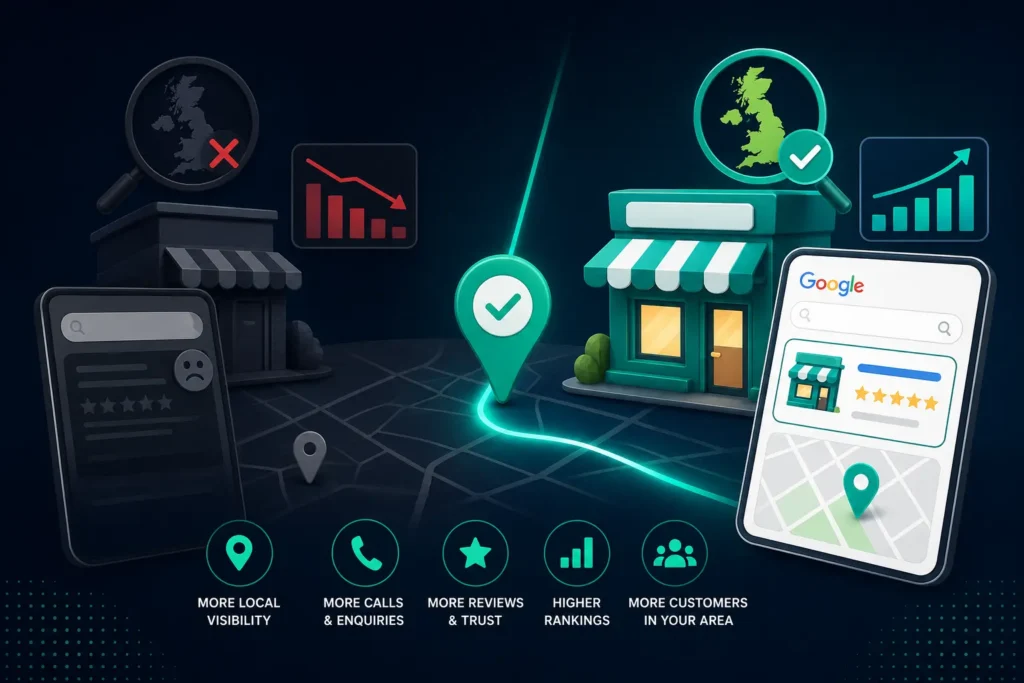
Here’s something nobody in the SEO industry likes to admit.
You can rank on page one of Google. You can appear in the map pack. You can be getting hundreds of impressions every month and still have your phone sitting completely silent.
Over 60% of local searches now end without a single website click. Users get the phone number, directions, hours, and reviews directly from the search results page and make their decision right there. That means the old way of measuring local SEO success traffic, rankings, sessions is telling you the wrong story entirely.
This is the part most agencies skip when they pitch you. Because if they told you the full picture upfront, the conversation gets more complicated. So instead, they show you ranking reports, impress you with position numbers, and quietly hope you don’t notice that the leads haven’t arrived.
This guide is the conversation they’re not having with you. It covers every real reason local SEO fails for UK small businesses in 2026 not the surface-level stuff you’ve read before, but the specific, fixable problems that sit between decent rankings and an actual ringing phone.
First Understand What “Failure” Actually Means in Local SEO
Before diagnosing why local SEO isn’t working, it’s worth being precise about what failure looks like. Because different problems have different causes.
Type 1 failure No visibility at all You’re not appearing in local searches, the map pack, or Google Business Profile results. Nobody is finding you. This is a foundational problem technical issues, no GBP, weak citations, or a brand new domain still in Google’s sandbox period.
Type 2 failure Visibility without clicks You’re appearing in results. Impressions are growing in Google Search Console. But click-through rates are low and website traffic isn’t moving. This is a presentation problem: your listing isn’t compelling enough to earn the click over competitors.
Type 3 failure Clicks without calls Traffic is arriving. People are finding your website from local searches. But enquiry forms sit empty and the phone doesn’t ring. This is a conversion problem and it’s the most common, most misdiagnosed failure mode in local SEO.
Each type needs a different fix. Most businesses and most agencies treat all three as the same problem and apply the same solution. That’s why the results don’t come.
The 10 Real Reasons Local SEO Fails for UK Small Businesses
1. You’re ranking for keywords nobody actually buys from
One of the most common reasons local SEO fails is targeting keywords without buyer intent expecting results too fast, skipping technical foundations, treating SEO as a one-time project.
This one is harder to spot than it sounds. An agency can show you a ranking report with your business sitting at position 3 for a dozen keywords and every single one of those keywords can be useless for generating business.
The difference between ranking keywords and buying keywords is intent. “What is local SEO” gets searched by people learning about SEO. “Local SEO agency near me” gets searched by people ready to hire one. They might both have your business ranking but only one of them makes the phone ring.
The real opportunity in UK local search lies in longer, more specific phrases known as long-tail keywords. “Shoreditch limited company accountant” or “freelance accountant Hackney” are far less competitive and much more likely to attract people ready to enquire or buy.
The fix: Open Google Search Console and look at which queries are actually driving clicks to your site. Are they informational or transactional? Do they include location + service + intent (“emergency plumber Derby available now”) or are they generic research queries? Your SEO strategy should be optimising specifically for the queries that your actual customers type when they’re ready to spend money.
2. Your Google Business Profile is incomplete and Google knows it
Google’s GBP data now feeds directly into Google’s Gemini-powered AI Overviews. Make sure your Google Business Profile is 100% complete.
Most UK small businesses claim their GBP, fill in the basics, and never touch it again. That’s not how it works in 2026.
An incomplete or inactive GBP sends signals to Google that your business isn’t actively serving customers. No recent posts, no photos added in six months, no Q&A section populated, services not properly listed all of these suppress your map pack visibility relative to competitors who are actively maintaining their profiles.
One of the biggest reasons local SEO fails is that businesses only update things when they remember. Local SEO rewards consistency. Regular posts on GBP, fresh photos, up-to-date hours, and new reviews all signal to Google that your business is alive and serving real customers.
The fix: Treat your GBP like a social media profile that directly affects your revenue because it does. Post weekly. Add new photos monthly. Answer every review within 24 hours. Populate the Q&A section with the questions your customers actually ask. Complete every service listing with a proper description. The businesses winning map pack positions in competitive UK markets are almost always the ones with the most actively maintained profiles.
3. Your citations are inconsistent and it’s quietly destroying your local authority
Consistency is key for building trust with Google. If your address is listed as “123 High Street” on your website but “123 High St.” on a local directory, it can cause a “trust gap.” While it seems minor to a human, search algorithms look for exact matches to verify that a business is legitimate and active.
This is one of the most invisible local SEO problems. Your business name, address, and phone number your NAP data needs to be absolutely identical everywhere it appears online. Not approximately the same. Not close enough. Identical.
A “Ltd” on your website and no “Ltd” on Yell. A different phone number in an old directory you forgot about. A slightly different business name on a Facebook page from 2019. Every inconsistency creates a small trust signal against you. Enough of them and Google quietly deprioritises your local rankings.
The fix: Audit every place your business appears online Google, Bing Places, Yell, Trustpilot, Facebook, LinkedIn, industry directories, old listings. Make every single one match exactly: same business name, same address format, same phone number, same website URL. It’s tedious work. It’s also one of the highest-impact technical fixes available for local SEO.
4. Your website is slow on mobile and you’re losing rankings and customers simultaneously
Over 50% of traffic is mobile. A clunky site kills your search rankings.
Most UK small business websites were built to look good on a desktop. The majority of their local traffic arrives on a phone. These two facts sit in direct conflict and the consequences show up in both rankings and conversion rates.
Google uses mobile-first indexing, meaning the mobile version of your website is what it evaluates for ranking purposes. A site that loads slowly, has text too small to read without zooming, or has buttons too close together to tap accurately Google sees all of this and ranks you accordingly.
To improve performance, compress all images before uploading, limit scripts to essentials, and consider upgrading to a reliable UK hosting provider. A fast, responsive site not only pleases Google it keeps potential customers engaged and reduces bounce rates.
The fix: Test your site on Google PageSpeed Insights (pagespeed.web.dev) specifically on the mobile tab. Your LCP Largest Contentful Paint should be under 2.5 seconds. If it isn’t, the most common culprits are uncompressed images, unnecessary plugins, and a slow hosting provider. Fix the images first; it’s the highest-impact change most small business websites can make in an afternoon.
5. You have no reviews or worse, you have bad ones you’re ignoring
According to BrightLocal’s 2026 Local Consumer Review Survey, 41% of consumers now “always” read reviews before choosing a local business (up from 29% the year before), and 31% will only consider businesses with 4.5 stars or above.
Reviews aren’t just a trust signal for potential customers. They’re a ranking signal for Google. A business with 47 recent, detailed reviews will almost always outrank an equivalent business with 6 reviews and a three-year gap since the last one.
AI now performs sentiment analysis on review language. A business with 4.3 stars and reviews that mention specific positive experiences can outperform a 4.8-star business with generic reviews.
The second review problem ignoring negative ones is equally damaging. An unanswered one-star review doesn’t just put off potential customers. It signals to Google that you’re not actively engaged with your customers online.
The fix: Build a review generation system, not a one-off request. After every completed job or service, send a direct link to your Google review page. Most happy customers will leave a review if simply asked at the right moment. Aim for at least one new review per week. Respond to every review positive and negative within 24 hours. For negative reviews, respond professionally and move resolution offline. Your response is read by every future customer who sees that review.
6. Your local landing pages are thin and Google can tell
Generic service pages with 200 words and recycled copy simply will not rank in 2026. Each page should offer genuine value, aim for 600 to 1,200 words per service, including specific details about the service, your process, and relevant local examples. Mention neighbourhoods, types of clients, and case scenarios to show expertise and relevance.
Most UK small businesses have one service page that mentions their town once or twice. Maybe a “we serve the following areas” list. That’s not local SEO, that’s a placeholder.
A proper local landing page demonstrates genuine relevance to a specific location. It talks about the local area specifically. It references local landmarks, neighbourhoods, or business districts. It includes local schema markup. It has content that could only have been written by someone who actually operates in that area.
The difference between a local landing page that ranks and one that doesn’t is almost always the depth and specificity of local relevance. Google has seen thousands of templated “we serve Birmingham” pages. It knows what genuine local content looks like and it rewards it.
The fix: For each location you serve, build a dedicated page of at least 800 words that goes beyond name-dropping the city. Talk about the specific types of customers you serve there, local challenges relevant to your industry in that area, any local partnerships or history, and genuine reasons why you’re the right choice for someone in that specific location. Include LocalBusiness schema markup, embed a Google Map, and add locally relevant FAQs.
7. You stopped too early right before the compounding started
The biggest mistake? Quitting before SEO compounds. Results take time, but consistency wins.
This is the failure reason nobody charges a consultation fee to diagnose because the solution is simply to keep going. But it’s also the most common reason UK small businesses conclude that “SEO doesn’t work.”
Local SEO has a compounding curve. The first two to three months produce almost nothing visible. Months three to five produce early signals impressions, map pack appearances, occasional clicks. Months five to eight is where results become real. Most businesses that “tried SEO and it didn’t work” stopped somewhere in months two to four.
The math is brutal: a business that invests six consecutive months in local SEO and then stops is often closer to results than one that never started but they’ll never know it.
The fix: Set milestone expectations before you start, not after you’re frustrated. Define what month two should look like (impressions growing in GSC, GBP views increasing), what month four should look like (clicks growing, GBP interactions measurable), and what month six should look like (enquiries arriving from organic search). Judge your strategy against milestones not against whether your phone is ringing in week three.
8. You’re measuring the wrong things entirely
Over 60% of local searches now end without a website click. Users get the phone number, directions, hours, and reviews directly from the search results page. If you’re measuring success purely by website traffic, you’re missing the majority of the value local SEO delivers.
This is the 2026 local SEO blindspot. The entire paradigm of “more traffic = more success” is breaking down in local search because increasingly, the customer journey from search to call never involves your website at all.
Someone searches “emergency electrician Manchester,” sees your GBP in the map pack, checks your reviews, gets your phone number from the listing, and calls you without ever visiting your website. Your Google Analytics shows zero sessions from that customer. Your website traffic report says nothing happened.
Track phone calls, direction requests, and GBP interactions not just website sessions. Use Google Business Profile Insights and call tracking to measure actual customer actions.
The fix: Set up GBP call tracking (a forwarding number that records call volume from your profile). Monitor GBP Insights monthly specifically the number of calls, direction requests, and website clicks generated from your listing. These are your real local SEO metrics in 2026. Traffic is a proxy. Calls are the point.
9. Your content is AI-generated and Google has noticed
One of the biggest failures in 2026 is the overuse of generative AI to produce large volumes of generic content. While AI has made publishing easier, it has also flooded the web with low-value pages that lack real insight, experience, or differentiation. Search engines are now better at identifying this type of content and often ignore it entirely.
This one is uncomfortable to write in a guide produced by an SEO agency. But it’s too important to skip.
The UK businesses that are winning local SEO in 2026 are producing content that demonstrates genuine experience, real local knowledge, and authentic expertise. Not because Google has some mystical ability to detect AI but because AI-generated content, at scale, tends to be generic. It says what’s already been said. It lacks the specificity, the case studies, the local context, and the honest perspective that makes content genuinely useful.
Your content needs clear author attribution. Show your credentials. Demonstrate real expertise. Share original insights from actual experience. For small businesses, this is actually good news; you have real experience serving real customers. That authentic expertise is something bigger competitors can’t fake. You just need to showcase it.
The fix: Write content that only you could write. Include real examples from your own business. Reference specific local customers or situations (anonymised where necessary). Share opinions, not just information. Explain things the way you’d explain them to a customer in person. AI can help you structure and edit but the experience, the specificity, and the genuine point of view need to come from you.
10. You’re invisible in AI search the channel that grew 600% in 12 months
In January 2025, only 6% of consumers used ChatGPT to find local businesses. By January 2026, that number hit 45% making it the third most popular way people discover local businesses, right behind Google and word-of-mouth. That shift happened in twelve months.
This is the reason local SEO in 2026 requires more than it did in 2023. The game has genuinely changed.
Implement schema markup especially LocalBusiness, FAQ, Service, and HowTo types. Make sure your Google Business Profile is 100% complete, because GBP data now feeds directly into Google’s Gemini-powered AI Overviews.
A UK small business that’s well-optimised for traditional local search but invisible in AI-generated answers is already missing nearly half of its potential discovery channel. And that number will only grow.
The fix: Structure your content to directly answer questions. Use H2 headings that are questions your customers ask. Follow each heading immediately with a clear, concise answer. Add FAQ schema markup to your pages. Make sure your GBP is completely filled out AI systems use GBP data directly when generating local business recommendations. Get cited on credible third-party sites in your industry AI systems are more likely to recommend businesses with external validation.
The Conversion Problem Nobody Talks About
Here’s the thing that brings all of these failure reasons together.
The reason 90% of UK websites fail at SEO isn’t because SEO doesn’t work, it’s because it’s often done incorrectly.
But even correct SEO can fail if the conversion layer doesn’t work. Rankings bring people to your door. Your website, your GBP listing, your reviews, your response speed these are what actually turn them into customers.
A business that ranks number one in the map pack but has three unanswered negative reviews, a slow-loading website with no clear phone number above the fold, and no recent photos on their GBP that business will lose the enquiry to the business ranked number four that has 47 positive reviews, a fast mobile site, and a click-to-call button at the top of every page.
Local SEO is not just about getting found. It’s about being the obvious choice when someone finds you.
The conversion checklist every UK small business needs:
- Phone number visible at the top of every page not in the footer
- Click-to-call button on mobile (not just a number that needs to be manually dialled)
- Google reviews of 4.5 stars or above with recent activity
- Response to every review, positive and negative
- Clear, specific description of what you do and who you serve not generic “quality service” copy
- A specific offer that reduces the risk of the first contact free consultation, free quote, free audit
- GBP profile with recent photos, posts, and complete service listings
What Good Local SEO Actually Looks Like A Realistic Framework
If you’ve identified your failure reasons above, here’s what a properly functioning local SEO strategy looks like for a UK small business in 2026:
Month 1–2: Technical foundation — site speed, mobile optimisation, GSC setup, GBP fully completed and verified, citation audit and cleanup, NAP consistency established.
Month 2–3: Content and visibility — location-specific landing pages built properly, blog content targeting informational local keywords, GBP posts weekly, review generation system active.
Month 3–5: Authority building — consistent citations growing, first backlinks from legitimate UK sources, GBP interactions measurable and growing, first enquiries arriving from local search.
Month 5–8: Compounding returns — map pack rankings stabilising, organic traffic growing, AI search visibility building through schema and structured content, cost per lead from organic search falling month on month.
This isn’t a sales pitch timeline — it’s what the data consistently shows for UK small businesses that implement local SEO properly and don’t stop before the compounding starts.
Go Deeper on What Matters Most
If this guide identifies specific gaps in your current local SEO, these pages go deeper into the fixes that matter most for generating leads from local search.
Local SEO Services UK If you’ve identified multiple failure reasons above and want professional support fixing them, This is where to start. See exactly what our local SEO service covers and what realistic results look like.
Technical SEO Services Site speed, mobile usability, schema markup, crawl issues the technical foundation that determines whether everything else works. If your local SEO has a slow site underneath it, no amount of content or citations will fully compensate.
AI SEO Services Local visibility in ChatGPT, Perplexity, and Google AI Overviews the channel that grew from 6% to 45% of local business discovery in twelve months. If you’re not optimising for AI search, you’re already behind.
On-Page SEO Services Thin location pages, weak service page content, missing schema on-page failures are among the most common reasons local SEO produces rankings without leads. See how proper on-page optimization fixes the conversion gap.
Free SEO Audit Everything in this guide is general. Your business is specific. A free audit tells you which of these failure reasons apply to your site, what the priority fixes are, and what a realistic timeline looks like for your market. No commitment required.
Frequently Asked Questions
Why is my local SEO not working? The most common reasons are: targeting keywords without buyer intent, an incomplete or inactive Google Business Profile, inconsistent NAP data across directories, thin location pages, stopping too early before results compound, and measuring website traffic instead of actual customer actions like calls and direction requests. Run through each section of this guide to identify which failure reasons apply to your business specifically.
How long before local SEO starts generating leads?
For most UK small businesses, the first enquiries from local search arrive between months three and six. The exact timeline depends on your competition level, your starting domain authority, and how consistently the strategy is implemented. Businesses in lower-competition areas or niches often see results faster sometimes within eight to ten weeks.
Why am I getting impressions but no clicks from local SEO?
This is a presentation problem. Your listing is appearing in results but not compelling enough to earn the click. Common causes: low review count, poor review rating, incomplete GBP profile, weak meta descriptions, or a listing that looks less trustworthy than competitors. Focus on reviews, complete your GBP profile fully, and write meta descriptions that give searchers a specific reason to choose you.
Why am I getting clicks but no enquiries?
This is a conversion problem, not an SEO problem. Traffic is arriving but your website isn’t converting it into action. Check: is your phone number prominent on mobile? Is there a clear call to action above the fold? Do your reviews build enough trust? Is your page speed fast enough that visitors stay? Is your service description specific enough that visitors immediately understand you’re right for them?
Can local SEO work without a physical address?
Yes — service area businesses that operate from home or without a customer-facing location can still rank in local search. Set up your GBP as a service area business, define your service radius, and focus on citations, reviews, and content that demonstrates genuine local relevance. You can rank in the map pack without a shopfront.
Does AI search affect local SEO?
Significantly, and increasingly so. ChatGPT, Perplexity, and Google’s AI Overviews are now major local business discovery channels. Businesses with complete GBP profiles, strong structured data, external citations on credible sites, and content that directly answers customer questions are the ones appearing in AI-generated local recommendations.