
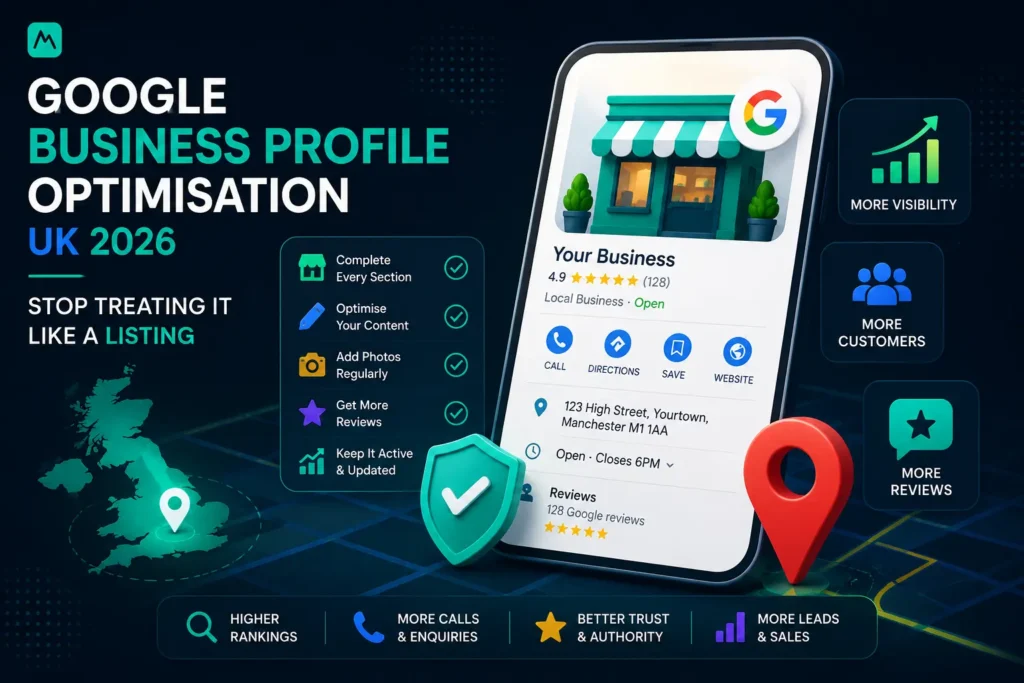
Most UK small businesses have a Google Business Profile. Most of them set it up once, forgot about it, and occasionally wonder why their competitors keep appearing above them in local searches.
Here’s what those competitors understand that most don’t: in 2026, Google Maps generates more leads for local service businesses than their actual website. Your GBP isn’t a directory listing. It’s the place where your potential customers make their decision before they’ve ever visited your site, before they’ve read a single word you’ve written, and often before they’ve even heard your business name.
A well-optimised GBP is the closest thing to a 24/7 salesperson that a UK small business can have for free. One that answers questions, shows social proof, demonstrates availability, and gives people a reason to choose you over the four other options sitting next to you in the map pack.
This guide covers how to make yours actually work, not just exist.
Why GBP Matters More in 2026 Than It Did 12 Months Ago
Two things changed significantly in the last year that make GBP optimisation more important than it’s ever been.
Google’s AI is now reading your profile. Google’s Gemini AI now generates automatic answers to customer questions using information from your GBP, your reviews, and your website. If your profile lacks detail or accuracy, AI systems may provide incomplete or incorrect information about your business to potential customers. That means a sparse GBP doesn’t just hurt your map pack rankings, it actively creates bad first impressions through AI-generated summaries you never wrote and can’t directly control.
AI search platforms are using GBP data. ChatGPT, Perplexity, and other AI tools increasingly pull local business data from sources that include GBP information. A complete, active, well-reviewed profile doesn’t just affect Google results it feeds the data layer that AI-powered search uses to recommend local businesses across multiple platforms.
The baseline for “good enough” moved. Here’s what it looks like now.
Part 1 — The Foundation: Getting the Basics Absolutely Right
Before any advanced optimisation is worth attempting, the foundational layer needs to be correct. Not approximately correct. Exactly correct. Because even small mismatches in your business information can silently damage your map rankings.
Business name — exactly as it appears everywhere else
Your GBP business name should be your actual trading name, nothing else. No keyword stuffing (“WalezSEO Best SEO Agency UK”), no location additions (“Smith Plumbing Manchester”), no extra descriptors. Google’s guidelines prohibit these and they risk suspension. More importantly, your business name must match exactly how it appears on your website, your Yell listing, your Trustpilot profile, and every other place online.
Categories — most businesses get this wrong
Your primary category is one of the most important ranking signals in your entire GBP. It tells Google what type of business you are and determines which searches your profile is eligible to appear for.
Choose your primary category as specifically as possible. “Plumber” ranks for plumbing searches better than “Home Services.” “Search Engine Optimization Agency” ranks for SEO searches better than “Marketing Agency.”
Secondary categories expand your eligibility further. A local SEO agency might use:
- Primary: Search Engine Optimization Agency
- Secondary: Internet Marketing Service, Marketing Consultant, Business Management Consultant
Adding secondary categories for every legitimate service you offer means you’re eligible to appear for a broader range of local searches without diluting your primary category’s relevance.
Service area vs physical address
During GBP setup, Google asks whether you have a physical location customers visit, operate as a service area business, or both. If you work from home or don’t want to display a home address which applies to a huge number of UK freelancers, consultants, and service businesses set up as a service area business and define your coverage by cities or regions.
The important thing: be accurate. Claiming service areas you genuinely don’t cover to expand your radius is a violation of Google’s guidelines and tends to backfire through poor engagement signals from irrelevant impressions.
NAP consistency more important than most guides acknowledge
Your Name, Address, and Phone number must be identical across all platforms GBP, website, directories, social media. This is known as NAP consistency and it’s a critical local ranking factor.
“123 High Street” and “123 High St” look identical to a human reader and are different strings to a machine. “Ltd” versus no “Ltd.” “+44” versus “0.” These small variations exist across most UK businesses’ online presences without the owner ever realising and they quietly suppress local rankings.
Part 2 — Photos: The Part Most Businesses Rush Through
Photo quality standards in 2026 are higher than ever. Google recommends a minimum 720×720 resolution, though 1080×1080 or higher is preferred. Photos should be sharp, well-lit, and properly exposed. But the photo strategy that moves rankings goes beyond quality.
What to actually photograph
For service businesses, the most effective photos are ones that demonstrate genuine activity: a tradesperson at work, a team member on-site, before-and-after results, your actual workspace rather than a stock image. User-generated photos from customers are powerful social proof encourage customers to tag you in their photos. Google treats photos contributed by real customers as strong engagement signals.
For professional service businesses (SEO agencies, consultants, accountants), photos of real people your actual team, not stock photography build the kind of trust that a perfectly composed brand photo doesn’t. People buy from people. Showing yours makes your GBP listing feel like a real business rather than a faceless brand.
The filename and metadata angle nobody mentions
Before uploading any photo to GBP, rename the file descriptively. “team-walezSEO-manchester-seo-agency.jpg” sends a clearer signal than “IMG_4782.jpg.” This is a small optimisation but it sits inside a broader pattern of consistent signals that collectively build local authority.
Photo volume and recency
GBP profiles with more photos get more views. Profiles with recently added photos get more engagement. The mechanism isn’t mysterious Google surfaces profiles to users that appear actively maintained, because an actively maintained profile is more likely to have accurate, current information.
Add at least one new photo per month. It takes minutes and the compounding effect over twelve months is measurable.
Part 3 — Reviews: Your Single Highest-Impact Local Ranking Factor
Reviews do more work in local SEO than any other single signal. They affect your map pack ranking. They determine whether someone clicks your listing. They influence the AI-generated summaries Google writes about your business. And they either convert or repel potential customers who are actively ready to buy.
Building a review generation system
Most UK businesses that have few reviews aren’t getting fewer, they’re just not asking. A customer who had a great experience won’t leave a review unless prompted. A customer who had a bad experience often will without any prompting at all. That asymmetry is why businesses with no active review strategy tend to accumulate a disproportionate number of negative reviews over time.
The simplest review generation system that works:
After every completed job or service, send a direct SMS or WhatsApp message not email with a one-click link to your Google review page. The message should be short, personal, and sent within 24 hours of completing the work when the experience is fresh. Something like: “Hi [name], really glad we could help with [job]. If you have a moment, it would mean a lot if you could leave us a quick Google review [direct link]. Thanks so much.”
That’s it. No incentives (against Google’s guidelines), no complicated forms, no follow-up sequences. Just a timely, personal task with a frictionless path to the review page.
Responding to reviews the part most businesses skip
Responding to every review positive and negative is a ranking signal and a conversion signal simultaneously. Google sees active review engagement as evidence of a responsive, trustworthy business. Potential customers read your responses to negative reviews specifically to understand how you handle problems.
For positive reviews: a brief, personalised response. Not “Thanks for your kind words!” on every single one which looks automated but something that references the specific service or situation.
For negative reviews: respond professionally, acknowledge the concern without admitting liability where it isn’t warranted, and move resolution offline. Something like: “Thank you for your feedback. This isn’t the experience we aim to deliver and we’d like to understand what happened. Please contact us directly at [email] so we can resolve this properly.”
What you should never do: argue, get defensive, or ignore a negative review. Every future customer who sees that listing will read your response.
Review quality matters as much as quantity
Google’s AI now performs sentiment analysis on review language. A business with 4.3 stars and reviews that mention specific positive experiences can outperform a 4.8-star business with generic five-star reviews.
Encourage specificity without scripting. When asking for a review, you might add: “If you have time, it’s really helpful if you can mention what service you had and what you found most useful.” Specific, detailed reviews are worth significantly more in Google’s evaluation than “Great service, would recommend.”
Part 4 — GBP Posts: What Actually Gets Clicks vs What’s Just Noise
GBP posts appear in your profile and, for branded searches, in the knowledge panel on the right side of desktop results. Most businesses either post irregularly or publish posts that generate no engagement at all.
The posts that actually work have a few things in common.
Offer posts outperform update posts. A post announcing a free audit, a seasonal discount, or a specific call to action consistently generates more clicks than a general “we’re great at what we do” update. Give people a concrete reason to take action.
Include a clear, specific call to action. GBP posts have a button option — Book, Call, Learn More, Get Offer. Use it. A post without a CTA button is a missed conversion opportunity.
Link to a specific relevant page. Don’t link every post to your homepage. Link to the service page, the blog post, or the landing page most relevant to what the post is about. This drives more qualified traffic and reduces the chance that someone clicks through and immediately leaves because the destination doesn’t match their expectation.
Post frequency matters. GBP posts expire after seven days unless they’re event posts. Posting weekly keeps your profile looking active and maintains consistent visibility in the profile view. Monthly posting is better than nothing. Weekly posting is measurably better than monthly.
Part 5 — Q&A: The Most Underused Section on Most GBP Profiles
The Q&A section of your GBP allows anyone to ask questions about your business and anyone to answer them. Including you.
Most UK businesses either don’t know this section exists or check it so infrequently that questions sit unanswered for months. Both situations are problems: unanswered questions look neglected, and wrong answers submitted by members of the public remain visible unless you correct them.
Seed your own Q&A
You don’t have to wait for customers to ask questions. Log in to Google Maps on a device not associated with your business account and ask the questions your customers most commonly ask. Then log back into your business account and answer them properly.
Good seed questions for a local SEO agency:
- “Do you offer SEO services for small businesses with limited budgets?”
- “How long does it take to see results from local SEO?”
- “Do you work with businesses outside Derby/your area?”
- “Do you offer a free consultation or audit?”
These answers appear in your profile and can appear in local search results as direct answers to similar queries. They’re also fed into the AI systems that generate summaries about your business.
Monitor regularly
Set a monthly reminder to check your Q&A section. Answer any new questions within 48 hours. Flag any incorrect answers from other users using the “Report” option. This is particularly important if you’re in a competitive space where a disgruntled competitor or customer might post misleading information.
Part 6 — The GBP Insights Dashboard: What Your Data Is Actually Telling You
The revamped GBP Insights dashboard in 2026 offers advanced analytics including more detailed performance breakdowns and conversion tracking.
Most business owners glance at the impressions number and move on. The data is actually far more useful than that.
The metrics worth monitoring monthly
Search queries What specific searches are causing your profile to appear? This is keyword research in reverse real data showing what your actual local customers are typing. If you’re appearing for searches you don’t serve, adjust your service description. If you’re appearing for terms you want to rank more strongly for, those should feature prominently in your profile content.
Direction requests People requesting directions to your business from Maps are extremely high-intent. A rising direction request count is one of the clearest signals that your local visibility is genuinely building.
Phone calls If your GBP shows call data and calls aren’t rising alongside impressions, your listing is being seen but not converting. This is usually a reviews problem or a category mismatch you’re appearing for searches that aren’t quite right for your business.
Photo views vs competitor photo views GBP Insights shows how your photo view count compares to similar businesses. If you’re significantly below average, your photo volume and quality is likely suppressing your visibility in map results.
Part 7 — Dealing With Competitor Spam and Fake Listings
This section doesn’t exist in most GBP guides. It should.
Keyword stuffing in business names is against Google’s guidelines and is rampant in many UK local markets. If your competitors are appearing above you with names like “Best Plumber Manchester 24hr Emergency” or “Top SEO Agency London Affordable,” they’re almost certainly violating Google’s policies and those violations are reportable.
How to report a competitor GBP violation
Find the listing in Google Maps. Click “Suggest an edit” you don’t need to be the owner. Flag the business name if it contains keywords that aren’t the genuine trading name. You can also use the Business Redressal Complaint Form to report more serious violations.
This isn’t gaming the system it’s enforcing the rules that Google has set and your competitors are ignoring. Businesses removed from the map pack for guideline violations often see their positions taken by legitimate businesses with properly optimised profiles. Yours could be one of them.
Part 8 — GBP and AI Search: The 2026 Connection
Google’s Gemini AI generates automatic answers to customer questions using information from your GBP, reviews, and website. If your profile lacks detail or accuracy, AI systems may provide incomplete or incorrect information about your business to potential customers.
Beyond Google, your GBP data feeds into the broader local business data layer that AI search platforms use. ChatGPT plugins, Perplexity, Apple Maps, and other AI-powered discovery tools all draw from structured local business data and GBP is one of the primary sources.
The practical implication: every section of your GBP that’s incomplete or inaccurate is a gap that AI systems fill in with assumptions or ignore entirely. A completely filled out, actively maintained profile doesn’t just help your Google Maps ranking it builds the data foundation that determines whether you exist as an entity in AI search.
Complete every section. Services, products where applicable, attributes (women-led, LGBTQ+ friendly, accessible entrances whatever applies to your business), hours including holiday hours, and a business description that reads naturally and covers your main services and service areas.
The GBP Optimisation Checklist Complete This Before Anything Else
Work through this in order. Each item builds on the previous one.
Foundation
- Business name matches trading name exactly no keyword additions
- Primary category is as specific as possible
- Secondary categories cover all legitimate services
- Service area accurately defined (service business) or address verified (physical location)
- NAP data matches website, Yell, Trustpilot, and all other directory listings exactly
Content
- Business description is complete 750 characters, covers services and service areas naturally
- All services listed with individual descriptions
- Products section used where applicable
- Attributes completed every relevant one selected
- Holiday hours and special hours kept current
Visual
- Minimum 10 photos uploaded logo, cover, team, work examples
- Photos are high resolution (1080×1080 minimum) and named descriptively before upload
- At least one new photo added in the last 30 days
Reviews
- Active review generation system in place (post-job SMS/WhatsApp with direct link)
- Every existing review responded to
- Average rating 4.0 or above if not, review generation is the priority
Engagement
- GBP post published in the last 7 days
- Q&A section seeded with 5+ common questions and proper answers
- Q&A section checked for unanswered or incorrect questions
Monitoring
- Monthly check of GBP Insights search queries, calls, direction requests
- Monthly photo addition scheduled
- Competitor profiles checked quarterly for guideline violations
What to Read Next
Why Local SEO Fails for UK Small Businesses A complete GBP is necessary but not sufficient. This guide covers the ten failure reasons that stop local SEO from generating leads even when rankings are good.
On-Page SEO Services Your GBP and your website work together. A well-optimised GBP profile driving traffic to a slow, thin, or poorly structured website loses the lead at the last moment. On-page SEO closes that gap.
Ecommerce SEO Services Running an online store alongside a local presence? GBP optimisation for ecommerce businesses with both physical and online channels has specific considerations covered in our ecommerce SEO service pages.
Free SEO Audit Not sure whether your current GBP setup is working or holding you back? A free audit includes a review of your local presence, GBP health, and citation consistency with specific recommendations for your business.
Frequently Asked Questions
How long does it take for GBP optimisation to affect rankings?
Changes to your GBP new photos, updated services, added attributes typically take one to four weeks to influence your map pack rankings. Review accumulation has a more gradual effect that compounds over months. The fastest gains usually come from completing previously empty sections and fixing NAP inconsistencies.
How often should I post on Google Business Profile?
Weekly is optimal. Monthly is the minimum to maintain an appearance of activity. Posts expire after seven days (except event posts), so a weekly posting cadence ensures your profile always has current content visible. The quality of posts matters more than frequency; a compelling offer post once a week outperforms five generic update posts.
Does GBP help with regular Google search results, not just Maps?
Yes. For local searches, GBP signals influence both map pack placement and organic results. Strong GBP engagement reviews, posts, photos, Q&A activity contributes to overall local authority that benefits your website’s organic performance as well as your map pack visibility.
Can I have a GBP without a physical address?
Yes. Service area businesses that operate from home or don’t receive customers at a physical location can set up a GBP without displaying an address. You define your coverage by service area instead. Many UK freelancers, consultants, and mobile service businesses operate this way successfully.
What’s the most common GBP mistake UK businesses make?
Setting it up once and never returning. GBP rewards consistent activity, regular posts, fresh photos, new reviews with responses, and updated information. A profile that was complete twelve months ago and hasn’t been touched since is actively losing ground to competitors who maintain theirs.
How do I know if my GBP is actually generating leads?
Check your GBP Insights monthly, specifically the call, direction request, and website click metrics. These are direct indicators of leads generated from your profile. Also consider setting up a call tracking number specifically for your GBP so you can attribute inbound calls directly to your Maps presence.