
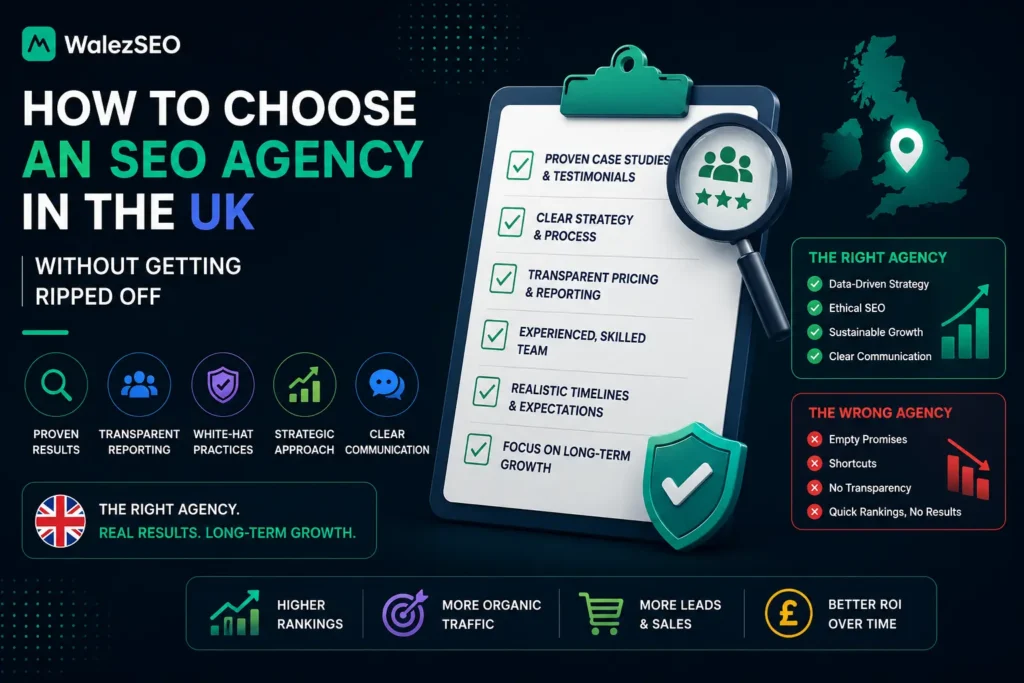
More UK businesses get burned by bad SEO agencies than almost any other professional service. Not because the owners are naive. Because the bad agencies have gotten very good at sounding exactly like the good ones.
They use the right terminology. They show polished case studies. They talk confidently about Google’s algorithm, E-E-A-T, topical authority, and AI Overviews. They send proposals with impressive-looking graphs and competitive analysis. And then six months later, your rankings haven’t moved, your invoice has been paid twelve times, and the agency goes quiet when you ask difficult questions.
This guide won’t tell you which agency to hire. What it will do is give you everything you need to make that decision yourself without relying on the agency’s own marketing to do it.
Why This Decision Is Harder Than It Should Be
The UK digital agency market is worth over £20 billion and growing with more than 8,500 agencies competing nationally. Every single one of them says they deliver results. Most of them have testimonials. Plenty of them have case studies showing dramatic traffic growth.
The problem is that impressive-looking results are easy to manufacture in SEO. An agency can show you a traffic chart that doubled without mentioning the traffic came from keywords nobody buys from. They can show you “page one rankings” for terms with 10 searches a month. They can claim a 300% traffic increase that happened because a penalty was lifted one they caused in the first place.
More than almost any other service category, SEO attracts agencies and freelancers who make promises they cannot keep, use tactics that damage your site long-term, and charge money for work that either doesn’t happen or actively hurts you.
The only protection is knowing what to look for before you sign anything.
The Red Flags Walk Away From Any Agency That Does These
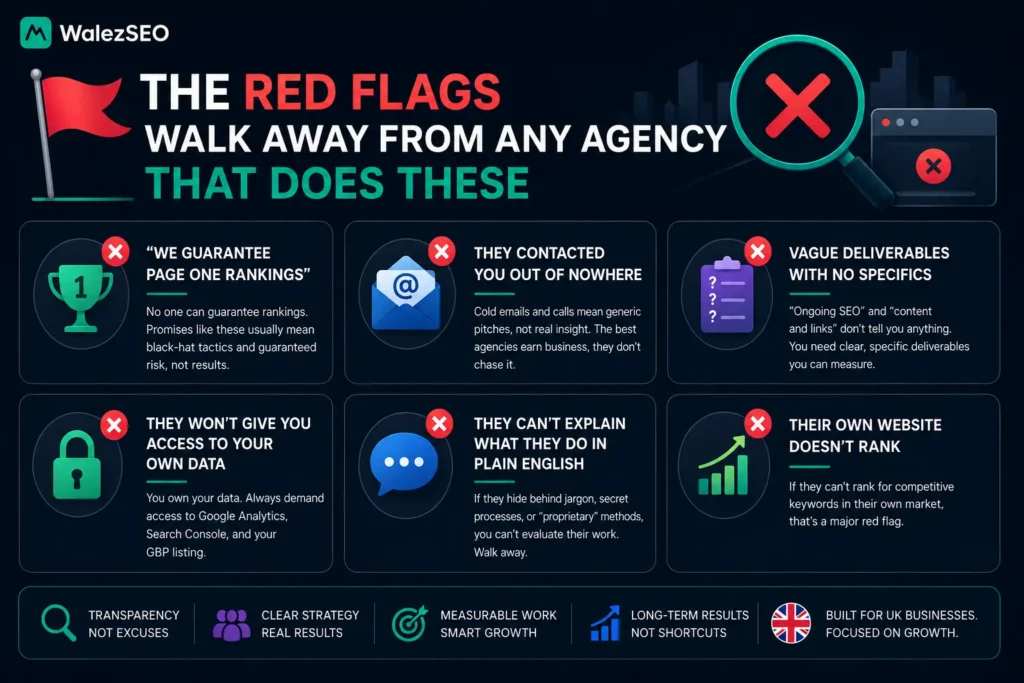
“We guarantee page one rankings”
The biggest red flag is any agency that guarantees specific Google rankings. Google’s own guidance explicitly warns businesses to “beware of SEOs that claim to guarantee rankings” because no one controls the hundreds of signals that determine search positions. An agency making this promise is either being dishonest or planning to use black-hat techniques that risk penalties.
This applies to any variation of the guarantee: “top three in 30 days,” “page one within 60 days,” “guaranteed first page results.” The promise itself tells you everything about how the agency operates.
They contacted you out of nowhere
One of the most common SEO scams targeting small businesses is cold email or phone outreach claiming “we noticed your website is not ranking for [keyword] we can fix this.” These agencies target thousands of businesses with the same generic pitch. They have not analysed your site. They do not have specific insight into your rankings. Reputable agencies generate business through referrals, content, and their own search presence, not mass cold outreach.
If an agency found you through a cold email campaign, that’s worth noting. The best agencies have more work than they can handle through word of mouth and inbound leads.
Vague deliverables with no specifics
If a proposal says “monthly SEO work,” “ongoing optimization,” or “content and links” without specifying exactly what that means, how many pieces of content, what kind of links, which pages are being optimized you don’t have a proposal. You have a vague commitment to do something that can’t be measured.
Legitimate agencies are specific. They tell you exactly what will be done, by whom, in what timeframe, and how success will be measured.
They won’t give you access to your own data
Always demand access to your own Google Analytics and Search Console accounts. An agency that controls your data is holding your business hostage.
This is non-negotiable. Your GSC account, your GA4 property, your GBP listing these belong to you. Any agency that insists on creating accounts on your behalf and retaining admin access is building leverage over you, not serving you.
They can’t explain what they do in plain English
Ask any agency to explain their strategy in language a non-technical business owner can understand. A good agency will do this clearly, specifically, and without jargon. A bad agency will use technical terms as a shield because if you can’t understand what they’re doing, you can’t evaluate whether it’s working.
If the explanation includes phrases like “proprietary algorithm,” “secret link sources,” or “a process we can’t fully disclose,” walk away.
Their own website doesn’t rank
One question every small business owner should ask: does your agency rank for competitive SEO keywords in their own market?
An SEO agency that can’t rank its own website for relevant terms is either new, incompetent, or relies entirely on referrals and paid ads. Before any discovery call, search “SEO agency [their city]” or “affordable SEO services UK” and see if they appear. It’s not a disqualifier on its own but it’s a relevant data point.
The Green Flags — Signs You’re Talking to Someone Genuine
They ask about your business before talking about their services
The first call with a good agency should feel more like a consultation than a pitch. They want to understand your goals, your current situation, your competition, and what success looks like for you specifically. If the first call is mostly them talking about their services and results that’s a sign they’re selling, not solving.
They’re honest about timelines
Any agency telling you SEO delivers results in weeks is either targeting very low-competition keywords or overpromising. A good agency will tell you that meaningful results typically take three to six months, that competitive industries take longer, and that month one is mostly groundwork that won’t look impressive yet.
Honesty about timelines is one of the clearest signals of an agency that intends to stay with you long enough for the results to arrive.
They show you verifiable results not just traffic graphs
Traffic is the easiest metric to inflate. Leads and revenue are harder to fake. When reviewing case studies, ask:
- What was the conversion rate of that traffic?
- Did leads or revenue increase alongside the traffic?
- Which specific keywords drove that growth?
- Can you speak to the client directly?
The best SEO agencies share verifiable case studies with specific metrics and treat the relationship as a genuine partnership rather than a transaction.
They tell you what they won’t do
A trustworthy agency will proactively tell you what tactics they avoid and why. They’ll explain that they don’t buy backlinks, don’t use PBNs, don’t guarantee rankings, and don’t promise overnight results not because they’ve been asked, but because it’s part of how they position themselves.
An agency that only talks about what they will do without acknowledging what responsible SEO avoids is missing something important.
They have a clear reporting framework
Before signing, ask what your monthly report will contain. It should include:
- Which pages were worked on and what was done
- Keyword position changes for specific tracked terms
- Organic traffic and lead volume trends
- Google Search Console impressions and click data
- What’s planned for next month and why
If the answer is “we’ll send you a rankings report” that’s not enough. Rankings are a means to an end, not the end itself.
The Questions to Ask on Your First Call
Most agencies prepare for generic questions. These ones tend to reveal more:
“Can you walk me through a campaign where results took longer than expected and how you handled it?” Good agencies have this story. They’re honest about it. Bad agencies will either pivot to a success story or give you a vague answer about “every campaign being different.”
“What’s the first thing you’d do with my site and why?” If they haven’t looked at your site before the call, that’s a problem. If they have, they should be able to give a specific answer. “We’d probably start with a full technical audit because we noticed your site speed is quite slow on mobile” tells you they’ve done the work. “We’d start with a comprehensive discovery phase” tells you almost nothing.
“How do you build backlinks and can you show me examples?” Links are where corners get cut. Ask specifically. If they say “high-quality link building” without being able to show you real examples of where links have been placed on real, relevant websites that you can verify, push harder.
“What would you do if rankings dropped in month four?” You want to hear a process: diagnosis, adjustment, communication. If the answer is defensive or vague, that’s what you’ll get when it actually happens.
“Who specifically will be working on my account and what’s their experience?” Agencies often pitch senior staff and deliver junior execution. You’re entitled to know exactly who will be responsible for your campaign and what their background is.
Contract Terms You Should Never Accept
Long lock-in with no performance clauses
The red flag is a long contract with no exit clause tied to performance, no defined milestones, and no accountability mechanism. Agencies that require long lock-ins without performance benchmarks are protecting their revenue, not your investment. A fair contract structure includes clear deliverables each month, defined KPIs reviewed at regular intervals, and a mechanism to exit if agreed-upon benchmarks are consistently missed.
Six and twelve month contracts aren’t inherently wrong, SEO does take time. But a contract that locks you in without any performance milestones or exit conditions is a contract designed to benefit the agency, not you.
Ownership clauses on your content or data
Anything created for your website content, meta data, structured data, landing pages is yours. Any contract that claims agency ownership over work product created for your site should be renegotiated or rejected.
Reporting that’s entirely in their platform
If you can only see your results through the agency’s own dashboard, you have no independent verification of what’s happening. You want direct access to Google Search Console, GA4, and any rank tracking platform not a filtered view through their reporting tool.
Auto-renewal with short cancellation windows
“Contract auto-renews unless cancelled 60 days before renewal date” is a clause designed to trap distracted business owners into another year. Read every contract for renewal terms and set a calendar reminder well in advance.
How to Verify an Agency’s Real Results
Beyond case studies, here’s what you can actually check independently.
Check their own rankings. Search the services they claim to offer in their city. Do they appear? If a Manchester SEO agency can’t rank in Manchester, ask why.
Run their domain through Ahrefs or Ubersuggest. Both have free tiers. Enter their domain and check: Is their traffic growing or declining? Do they have real backlinks from real sites? Are their rankings trending upward?
Ask for a live GSC walkthrough. Not a screenshot. A live share of a client’s Search Console (with the client’s permission). Anyone can screenshot a good month.
Talk to a real past client not a provided reference. Ask for the name of a client you can find independently on their website or Clutch profile, then contact that client through their own business contact details rather than through a number the agency provides.
Check their Clutch or Google reviews carefully. Look at the detail level genuine reviews from real businesses mention specific results, timelines, and people. Generic five-star reviews that say “great agency, highly recommend” with no specifics are easier to manufacture.
Pricing Red Flags — Both Directions
Too cheap
Agencies charging below £500 monthly for comprehensive services frequently rely on automated tools, cookie-cutter strategies, or black-hat techniques that risk long-term penalties.
At £200–£400 a month, the economics of professional SEO simply don’t hold. Someone is either doing very little work, automating most of it, or operating from a region where costs are dramatically lower and UK market knowledge is limited.
Suspiciously expensive with no clear justification
The opposite problem also exists. An agency charging £8,000 a month for a small local business with modest competition isn’t necessarily better than one charging £1,500. Premium pricing needs to be backed by premium deliverables. Ask specifically what additional work justifies the higher cost.
Pricing that never changes regardless of your needs
A genuinely bespoke agency will price based on your specific situation, competition level, website size, goals, starting authority. If every client gets the same three-tier package at the same price points, the strategy is templated and a templated strategy rarely fits anyone particularly well.
UK Agency vs Offshore Agency The Real Difference
This is more nuanced than most guides suggest.
The case for a UK agency: genuine understanding of the UK market, British English content that sounds natural to UK readers, knowledge of UK-specific directories and link sources, familiarity with the competitive landscape in your city or region.
The case against assuming UK = better: plenty of UK-registered agencies outsource the actual work to teams in cheaper markets and charge a domestic premium for the account management layer. You can pay UK prices and receive offshore execution without realising it.
What actually matters more than geography: Who writes your content? Where do your links come from? Who performs your technical audits? Ask these questions directly. “All our work is done in-house by our UK team” is a claim you can verify by asking to speak with the content writer or link builder who’ll work on your account.
The One Test That Cuts Through Everything
Here’s the simplest filter for evaluating any SEO agency before spending a penny.
Ask them: “What would you find if you audited my site right now, and what would you prioritise first?”
A genuine agency that has looked at your site will answer specifically. They’ll mention something real: a technical issue, a content gap, a local SEO problem that you can independently verify. They’ll explain their thinking clearly.
An agency that hasn’t looked at your site will give you a generic answer about their process. That tells you exactly what kind of attention your account will receive after you sign.
What to Do Before You Sign Anything
Run through this checklist before committing to any SEO agency:
- You have direct access to your own GSC, GA4, and GBP accounts not through their platform
- The contract has defined monthly deliverables, not vague “ongoing optimisation”
- There are performance milestones and an exit mechanism if they’re missed
- You’ve spoken to at least one past client you found independently
- You’ve verified their own site’s traffic and rankings using a free tool
- They’ve given you a specific answer about what they’d prioritise on your site
- Nobody has guaranteed rankings, promised overnight results, or avoided explaining what they do
- The pricing reflects your specific situation, not a one-size package
Related Reading The Full Picture Before You Decide
Once you’ve found an agency you’re confident in, these pages help you understand exactly what good SEO looks like in practice so you can hold any provider accountable to the right standards.
Why Local SEO Fails for UK Small Businesses The most common reasons local SEO produces rankings without leads and how to recognise whether a campaign is genuinely building momentum or quietly going nowhere.
The Honest Local SEO Timeline Month-by-month expectations for UK small businesses, industry breakdowns, and the early signals that tell you results are coming before the leads arrive.
Technical SEO Services The foundation layer that determines whether everything else works. Understanding what technical SEO involves helps you evaluate whether an agency’s proposal is taking it seriously.
Free SEO Audit See What Your Site Actually Needs Before committing to any agency, it helps to know your site’s current state independently. A free audit gives you a baseline so you can evaluate any proposal against what you already know, not just what you’re told.
Frequently Asked Questions
How much should a UK small business pay for SEO?
Most UK small businesses pay between £500 and £2,500 per month for professional SEO, depending on competition level, website size, and goals. Below £400 a month, the economics of genuine strategic work don’t hold up. Above £3,000 a month should be justified by specific deliverables and a genuine need for that level of resource.
How long should an SEO agency contract be?
Three to six months is a reasonable starting commitment long enough for results to begin materialising, short enough to exit if the work clearly isn’t being done properly. Any contract longer than six months should include defined performance milestones and an exit mechanism if those milestones are consistently missed.
Should I choose a local SEO agency or one based elsewhere in the UK? Geography matters less than who actually does the work. A London-registered agency outsourcing to a team with no UK market knowledge is worse than a strong regional agency with genuine local expertise. Ask specifically where your content will be written and by whom that question reveals more than any location.
What’s the single biggest red flag when hiring an SEO agency?
A guarantee of specific rankings. Google explicitly warns against any SEO provider making this promise. An agency guaranteeing page one rankings is either planning to use tactics that risk a Google penalty, or targeting keywords so obscure the guarantee is meaningless.
Can I verify an SEO agency’s results before hiring them?
Yes, and you should. Check their own domain’s traffic and backlinks using Ahrefs or Ubersuggest (both have free tiers). Ask to speak with a past client you found independently, not a reference they provided. Ask for a live Search Console walkthrough rather than screenshots. These three steps reveal more than any case study.
What should be in a monthly SEO report?
At minimum: which pages were worked on and what was done, keyword position changes for tracked terms, organic traffic trend, Google Search Console impressions and clicks, and the planned work for next month with reasoning. A report that only shows rankings without explaining the work behind them isn’t adequate accountability.