
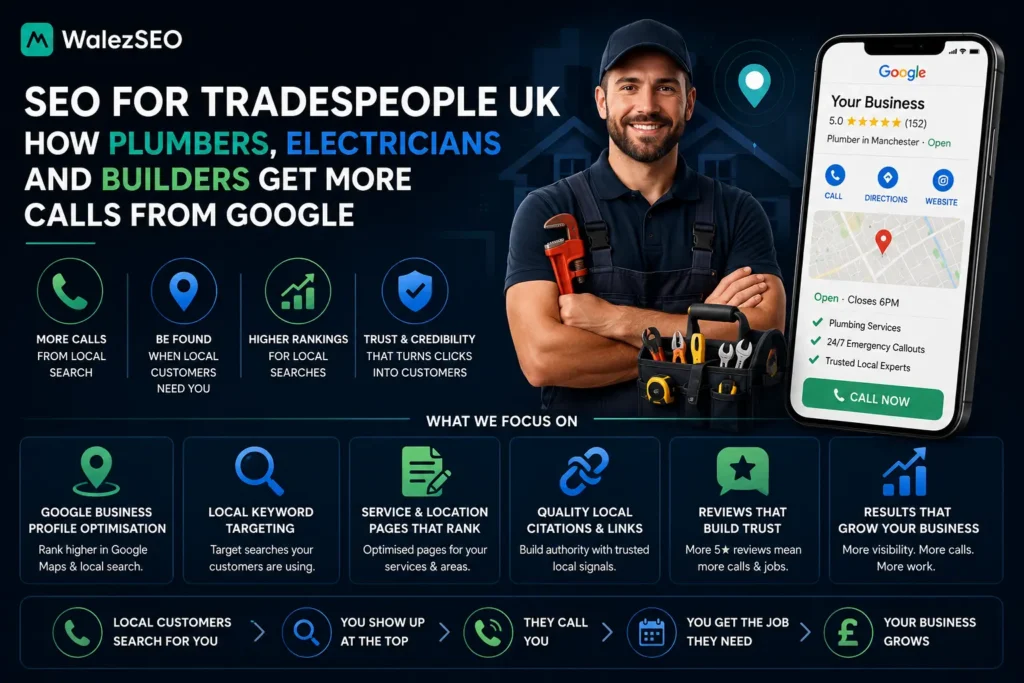
Word of mouth built your business. But it won’t scale.
The UK tradesperson who gets consistent work in 2026 isn’t necessarily the best at their trade, they’re the most visible one. When a pipe bursts at 10pm, a homeowner doesn’t ask their neighbour for a recommendation. They grab their phone, type “emergency plumber near me,” and call whoever shows up first. That decision isn’t made on your website. It’s made on your Google Business Profile and increasingly, by AI.
This guide is written for tradespeople who want to understand exactly what SEO involves, what it delivers, and what to prioritise first without wading through marketing jargon.
Why Trades SEO Is Different From Regular SEO
Most SEO guides are written for ecommerce stores or national brands. The advice isn’t wrong, it’s just not built around how trade businesses actually work.
When someone searches for a plumber at 8pm on a Tuesday, they’re not browsing. They have a problem, they need it solved, and they’re going to call one of the first results they see. There’s very little consideration. Either you appear in front of them, or a competitor does.
That urgency is what makes trades SEO both simpler and more urgent than most other types. You’re not trying to build brand awareness over months. You’re trying to be the visible option when someone has an immediate need. Local search, specifically the Google map pack is where that happens.
The good news is that trades tend to sit in a mid-competition bracket. You’re not competing with national brands or established media. You’re competing with other local tradespeople, many of whom haven’t invested seriously in SEO.
That gap is your opportunity.
The Map Pack The Only Ranking That Matters for Tradespeople
When someone searches “plumber in Manchester” or “electrician near me” on Google, the results they see are determined by local SEO signals. Google looks at three things: relevance (do you offer what they’re searching for?), distance (are you near them?), and prominence (how well-known and trusted is your business online?).
The three businesses that appear in the map pack at the top of those results get the vast majority of clicks and calls. Position four onwards including organic results below the map gets a fraction of the attention.
Everything in this guide is aimed at getting you into that map pack and keeping you there.
Step 1 Your Google Business Profile: The Foundation of Everything
Your Google Business Profile is the single most important factor for local SEO. It powers the map results that appear at the top of Google for local searches.
Most tradespeople either haven’t claimed theirs or set it up years ago and never touched it again. Both situations are costing them jobs.
Category selection be specific
Your primary GBP category determines which searches you’re eligible to appear for. “Plumber” is a category. So is “Emergency Plumber Service,” “Heating Contractor,” and “Boiler Installation Service.” The more specific your category matches the actual search, the more likely you are to appear for it.
Add secondary categories for every service you legitimately offer. A plumber might use: Plumber (primary), Emergency Plumber Service, Boiler Installation Service, Bathroom Remodeler. Each secondary category expands the searches you can appear for without affecting your primary category’s relevance.
Services section where most tradespeople leave money on the table
Build dedicated targeting for your specific services in specific locations “emergency plumber Nantwich,” “electrician Crewe,” “builder Cheshire” capturing high-intent local searches.
Your GBP Services section lets you list every individual service with its own description. Don’t list just “plumbing.” List: boiler installation, emergency callouts, bathroom fitting, leak detection, central heating repair. Each one is a separate signal that helps Google match your profile to specific queries.
Photos trades businesses consistently underestimate this
Adding LocalBusiness schema to your site tells Google clearly what you do and where. But photos on your GBP do something even more immediate: they show potential customers what your work looks like before they’ve called you.
Before-and-after photos from real jobs are the most effective content a tradesperson can post. A boiler replacement, a bathroom refit, a rewired consumer unit, real job photos build trust instantly and make your profile look active and credible. Add a minimum of two new job photos per month. Label the files descriptively before uploading (“boiler-installation-derby-2026.jpg” not “IMG_4782.jpg”).
Step 2 Reviews: The Ranking Signal You Can Control Directly
Encouraging more customer reviews from past clients boosts your credibility and reputation as a local trader and is one of the most effective ways to rank higher in the map pack.
For tradespeople specifically, reviews work harder than for almost any other local business type. Homeowners hiring a tradesperson are making a trust decision letting someone into their home to work on their plumbing, electrics, or roof. Reviews are the primary trust signal that converts a searcher into a caller.
The simplest system that consistently works: send a WhatsApp message within 24 hours of completing a job. Something like: “Hi [name], great working on your [job] today. If you have a moment, it would mean a lot if you could leave us a Google review [direct link]. Really helps the business.”
That’s the entire system. No complicated follow-ups. No incentives. Just a timely, personal ask at the moment the customer is most satisfied.
Encourage customers to mention specific services and locations in their reviews. A review mentioning “boiler replacement in Derby” sends a direct local relevance signal to Google for that specific service in that specific area.
When responding to reviews which you should do for every single one mention what the job was. “Thank you for trusting us with your bathroom renovation in Nottingham” signals real experience in that location to both Google and future customers reading the response.
Step 3 Your Website: Simple, Fast, and Built for Phone Calls
According to Google, 78% of local mobile searches result in an offline purchase. If your site is slow or difficult to use on a phone, you’re losing calls.
Most tradespeople don’t need a complex website. They need a fast, clear website that makes it easy to call them and tells Google exactly what they do and where.
Phone number everywhere, always
Your phone number should be in the header, footer, and on a dedicated contact page. Make it as easy as possible for someone to call you.
On mobile, your phone number should be a tap-to-call link not a number someone has to manually dial. This sounds basic. It’s still missing from a surprising number of trade websites.
One page per service not everything crammed together
A plumber should have separate pages for boiler repair, emergency plumbing, bathroom installations, and so on. Each page can rank for its own keyword rather than cramming everything onto one page.
“Plumbing services” as a single page competes for one keyword. Separate pages for boiler installation, emergency plumbing, bathroom fitting, and leak detection compete for four — each with their own targeted content, their own title tag, and their own ranking potential.
Location pages how you rank in multiple towns
If you serve multiple areas, each town needs its own page. “Plumber in Nottingham” and “Plumber in Derby” are different searches. A single page trying to rank for both will rank well for neither.
Each location page should be at least 400 to 600 words of genuinely local content, not just the town name swapped into a template. Mention local areas you cover within that town, the types of jobs you commonly do there, and anything locally specific. Pages that could only have been written by someone actually working in that area consistently outrank templates.
Step 4 Keyword Strategy for Trades: Target Problems, Not Services
This is where most trade businesses miss a significant opportunity.
Forget competing for “plumber” or “electrician.” Those terms are incredibly competitive. Target what customers actually search when they have an urgent problem.
The keywords that generate trade enquiries are almost always problem-first:
- “boiler not working Derby”
- “no hot water Nottingham emergency”
- “fuse box tripping keep going off”
- “roof leak after rain UK”
- “kitchen socket not working electrician near me”
These long-tail, problem-specific searches have lower competition, higher urgency, and much higher conversion rates than generic trade terms. A homeowner searching “no hot water Sunday morning” is calling the first result immediately. A homeowner searching “plumber” might be browsing.
Build service pages around these problem queries. Write content that describes the problem, explains the cause, and makes clear that you solve it with your phone number prominent and a clear call to action.
Step 5 Seasonal SEO: The Advantage Most Tradespeople Ignore
This section exists in almost no local SEO guides and is genuinely one of the highest-impact strategies available to UK tradespeople.
Search volume for trade services is heavily seasonal. Boiler searches spike in October and November when the heating goes on for the first time and problems emerge. Roofing searches rise after heavy rain. Garden and landscaping searches peak in spring. Air conditioning installation surges in June and July.
Most tradespeople don’t update their websites or GBP profiles seasonally which means the ones that do capture a disproportionate share of seasonal demand.
Practical seasonal SEO for tradespeople:
Update your GBP description seasonally. In October: “Now taking boiler service bookings before the winter rush limited slots available.” In spring: “Garden room builds and landscaping projects now booking for summer.” Fresh, timely descriptions signal profile activity and match seasonal search intent.
Publish seasonal service pages. A page specifically targeting “boiler service before winter UK” published in September, with locally relevant content and your service area mentioned, can rank for that exact search at exactly the moment people are looking.
GBP posts for seasonal offers. A weekly post in October promoting your boiler servicing availability with a booking link costs nothing and reaches people actively looking for exactly that service.
Checkatrade vs Google SEO Where Should Your Budget Go?
Today, customers Google everything, trust is checked before contact, and visibility matters more than volume. Google decides.
Checkatrade, MyBuilder, and similar platforms generate leads but you pay for every one of them, the leads are shared with competitors, and the moment you stop paying, the inquiries stop. SEO builds something you own. Rankings that keep generating calls without an ongoing cost per lead.
Google Ads can bring in leads quickly but you pay for every click, and the moment you stop, the leads stop too. Many tradespeople use both together Ads for quick wins while SEO builds for the long term.
For most UK tradespeople, the smart approach is: use Checkatrade and paid platforms while SEO is building, and reduce dependence on them as organic rankings establish. The goal is a pipeline where the majority of enquiries cost you nothing per lead because Google is sending them without a transaction attached.
What Good Trades SEO Actually Looks Like Month by Month
Months 1–2: GBP fully optimised, review generation system active, website pages built for each service and each location, LocalBusiness schema implemented.
Months 2–4: GBP impressions growing, first map pack appearances for lower-competition local searches, reviews accumulating, first organic calls arriving.
Months 4–6: Map pack positions stabilising for primary service keywords, location pages ranking for area-specific searches, review velocity sustaining rankings.
Months 6+: Consistent weekly enquiries from organic search, reducing dependence on paid platforms, seasonal content capturing demand at peak periods.
Related Reading
Brands aiming for stronger organic rankings and sustainable SEO growth may also explore:
- Advanced On-Page SEO Services
- Technical SEO Audit Services UK
- Affordable Website Design Woking UK
- Website Design Wolverhampton Affordable & SEO Friendly Web Solutions
Frequently Asked Questions
How long does SEO take to work for a tradesperson?
Most UK tradespeople see their first map pack appearances between months two and four. Consistent enquiries from organic search typically begin between months three and six. The timeline depends on how competitive your trade is in your area. A plumber in central London faces more competition than a roofer in a smaller market town.
Do I need a website for trading SEO or is GBP enough?
Your GBP alone can generate calls particularly from map pack results. But a website with dedicated service pages and location pages significantly expands what you can rank for. GBP handles “near me” searches. Your website handles the specific service and location queries that don’t trigger a map pack. Both together produce more enquiries than either does alone.
Should I be on Checkatrade and do SEO?
Yes while your SEO is building. Checkatrade and similar platforms generate leads immediately. SEO takes months to build but eventually generates leads at no cost per enquiry. Using both together during the building phase, then gradually reducing paid platform dependence as organic rankings establish, is the most practical approach for most UK tradespeople.
What’s the most important thing to fix first?
Your Google Business Profile specifically, making sure it’s fully complete with the right categories, all your services listed, recent photos, and an active review generation system in place. This is the single highest-impact improvement most trade businesses can make, and it costs nothing except time.
Can I do trades SEO myself?
Yes, for the basics GBP optimisation, requesting reviews, and writing service pages are all manageable without specialist help. Location page creation and technical SEO (schema markup, site speed, crawl health) benefit from professional support, particularly if you’re covering multiple areas and competing against established local trades businesses.