
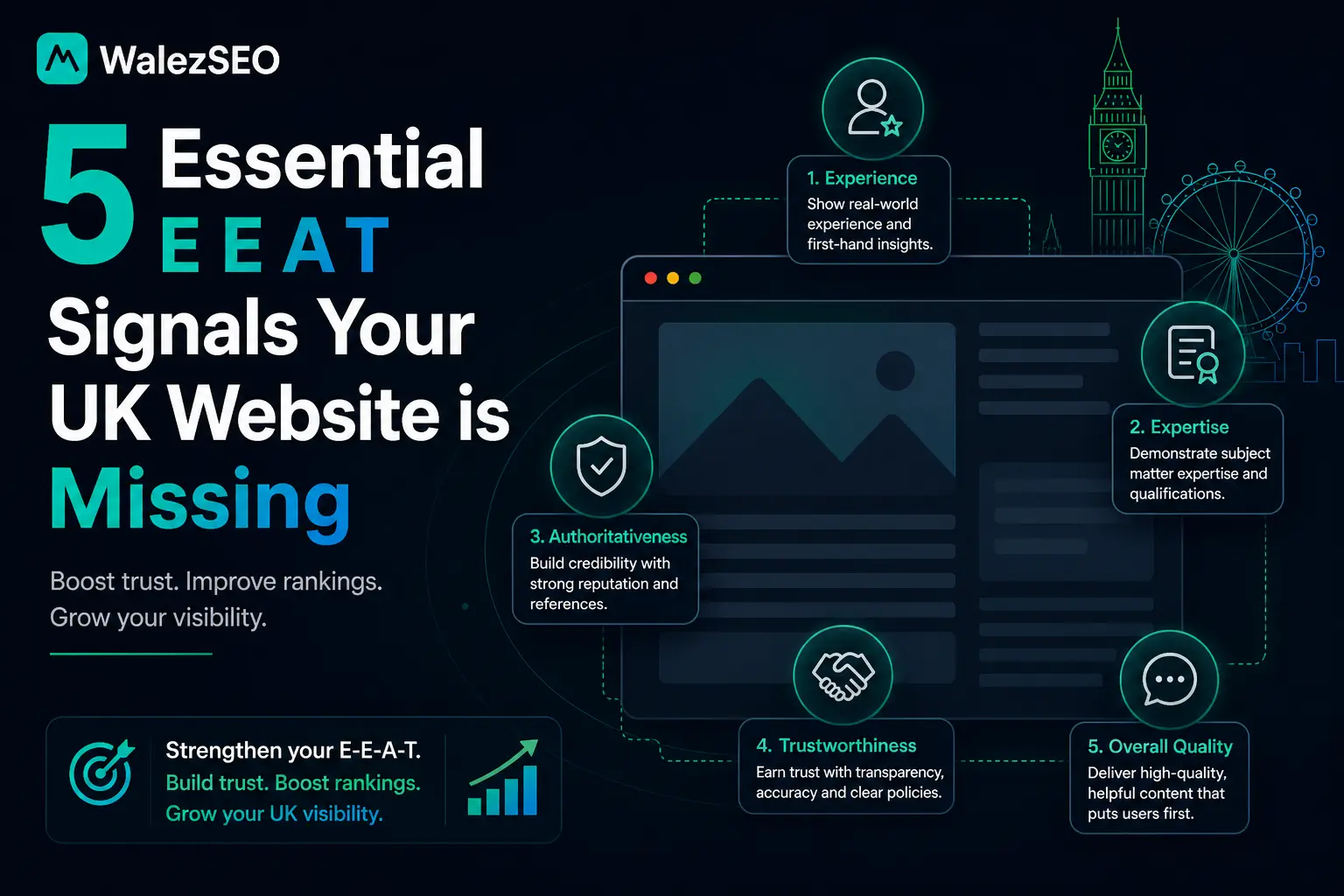
Excited to rank your website but not seeing results yet. You are not alone. Many UK websites struggle because they miss important trust signals. These signals help Google understand if your content is real, helpful, and reliable. This is where E E A T becomes important for your success.
E E A T stands for experience, expertise, authoritativeness, and trustworthiness. It comes from search quality ideas used by Google. If your website lacks these signals, your rankings may stay low even with good content. In this guide, you will learn the missing E E A T signals that stop UK websites from growing and how to fix them in a simple way.
Essential E E A T Signals
Many websites think content alone is enough. It is not. Google also checks who is writing, why they are qualified, and if users can trust the information. These signals decide your visibility in search results.
One major missing signal is real experience. Content written without real use or proof feels weak. You need to show actual knowledge from doing the work, not just reading about it.
Another missing signal is author clarity. Websites often hide who wrote the content. This reduces trust and authority.
A third missing signal is proof of expertise. Without qualifications, case studies, or clear background, your content looks generic.
Trust is also often weak. Missing contact details, unclear policies, and no business identity reduce ranking power.
Finally, many UK websites lack authority signals. No mentions, no backlinks, and no recognition from other trusted sites slow growth.
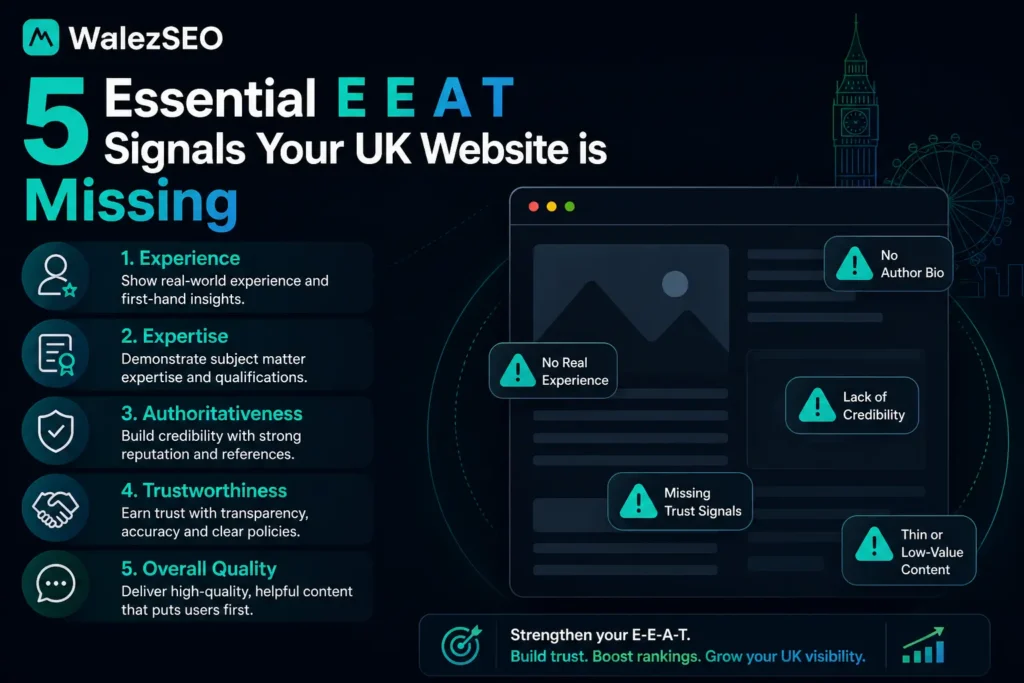
5 E E A T SEO signals UK websites must improve
To understand E E A T better, think about how search engines judge quality. Search Engine Optimization focuses on making content useful and trustworthy for users. Here are common E E A T signals UK websites miss.
Experience signals matter. Show real results, real stories, and real usage. This helps users believe your content. Expertise signals matter. Add author bios that show knowledge in your topic. Authority signals matter. Build mentions from trusted websites and industry pages.
Trust signals matter. Add secure website setup, clear contact pages, and transparent policies. These signals work together. Missing even one can reduce your visibility.
1. No Real Experience (Everything Feels Theoretical)
A lot of content sounds like it was copied from 10 other blogs. No real examples. No results. No “we actually did this”. That’s a problem. Because users and search engines can tell.
If you’re writing about SEO, show real outcomes.
If you’re offering services, show real scenarios.
Even a simple shift like:
“we helped a local business increase leads by 2x” feels more real than 1000 words of theory.
2. No Clear Author Behind the Content
This is a big one. You land on a page… but there’s no name. No face. No background. So the natural question is:
“Who wrote this and why should I trust it?” When that answer is missing, credibility drops instantly. Adding a basic author section with real context changes everything. Not fancy. Just real.
3. Weak Proof of Expertise
Saying “we are experts” doesn’t work anymore. Everyone says that. What actually works is showing it. That could be:
- real case studies
- before/after results
- specific insights others aren’t sharing
If your content sounds like everyone else, it won’t stand out. And if it doesn’t stand out, it won’t rank.
4. Low Trust Signals Across the Website
This part is often ignored but it matters a lot. If your website doesn’t clearly show:
- who you are
- how to contact you
- what your business does
…it creates doubt. And small doubts kill conversions. Things like a proper contact page, clear business details, and transparent policies aren’t just “nice to have” they directly affect trust.
5. No Authority From Outside Sources
You might have great content. But if no one else is referencing or linking to you, your authority stays limited. Search engines look beyond your website. They check:
“Do other trusted sites recognise this brand?” If the answer is no, growth becomes slow. Even a few relevant mentions can make a difference.
The Real SEO Gap (No One Talks About)
Most UK websites focus on:
- keywords
- blog posting
- basic optimisation
But they ignore credibility signals. That’s the gap. And that’s why they get stuck. Because in today’s SEO, ranking is not just about relevance.
Secondary E E A T variations and long tail SEO gaps
Most UK websites only focus on keywords. They ignore semantic SEO and trust building. This is a big mistake.
Secondary SEO gaps include:
- Weak content depth that does not answer user intent fully
- No proof of real experience in content
- Missing structured author information
- No external references or citations
- Poor internal linking between pages
Long tail search queries people use include:
- How to improve E E A T for UK website
- What are E E A T signals in SEO
- Why is my website not ranking in Google UK
- How does Google decide website trust
- How to build authority for a new website
These queries show real user intent. Your content must answer them clearly.
If your website isn’t building trust or authority, these resources will help you strengthen your SEO foundation:
- Bad SEO agency warning signs →
- Real SEO case study results →
- SEO copywriting services →
- White label SEO services →
FAQs
What are E-E-A-T signals in SEO?
E-E-A-T stands for Experience, Expertise, Authoritativeness, and Trust. These are quality signals used by Google to evaluate whether your content is reliable and worth ranking.
It’s not a single ranking factor you can “add” to your site. It’s something your website demonstrates over time through the quality of your content, the credibility of your authors, and how trustworthy your overall site feels.
Why is E-E-A-T important for UK websites?
The UK search space is highly competitive, especially in industries like finance, health, and services. That means Google needs stronger trust signals before ranking a site higher.
If your website clearly shows real expertise and credibility, it stands out. If it doesn’t, even good content can struggle to rank. E-E-A-T helps search engines decide:
“Can this website be trusted?” And in competitive markets, that decision makes a big difference.
How can I improve E-E-A-T on my website?
It’s less about tricks and more about proof. You improve E-E-A-T by showing that your content comes from real experience and knowledge. That can include:
- Adding author names and credentials
- Sharing real examples or case studies
- Keeping content accurate and up to date
- Getting mentions or links from trusted websites
The goal is simply to make it clear who is behind the content and why they should be trusted.
Does Google really use E-E-A-T for ranking?
Yes but not in a direct, measurable way like keywords.E-E-A-T is part of how Google evaluates content quality overall. It influences how your site is perceived in terms of credibility and reliability.
If your site lacks trust signals, rankings can be harder to achieve especially for important topics.
What is the fastest way to build website trust?
There’s no instant shortcut but you can start with the basics. Make your website transparent.
Show who you are. Add clear author information. Publish helpful, accurate content. Keep your site professional and easy to use. When users trust your website, they stay longer and engage more. And over time, that trust is exactly what helps your rankings grow.