
A real-world example of how a small UK business achieved massive traffic growth using affordable SEO strategies without a large marketing budget.
SEO Case Study: Small Budget, Big Results
Most businesses don’t fail at SEO because it’s difficult. They fail because they don’t fully understand what’s actually going wrong. Traffic gets stuck, rankings keep fluctuating, and even after publishing content regularly, nothing really improves. It feels confusing. Frustrating too. That’s exactly what we saw with a UK-based business in this case study. On the surface, everything looked fine; they had blogs, they were targeting keywords, and basic optimization was already in place. But still, growth wasn’t happening.
The real issue? No clear direction. No alignment with what users actually wanted. And more importantly, no understanding of how Google works. SEO has changed. It’s no longer about doing more, it’s about doing the right things in the right order.
In this case study, we’ll walk you through what was broken, what we fixed, and how those changes led to a 150% increase in traffic. Simple, practical, and based on real results.
Client Overview
This case study is based on a UK-based service business operating in a highly competitive local market. They offer essential home services across multiple cities, targeting customers who are actively searching with strong buying intent. The demand was there. The problem wasn’t the market.
The business had already invested time and money into SEO. They had a decent-looking website, published blog content regularly, and were targeting common industry keywords. On paper, things looked “okay.” But the performance told a different story.
Traffic had been flat for months. Rankings were inconsistent. Some keywords would appear on page 2 or 3, then disappear again. Even worse, the traffic they were getting wasn’t converting into actual leads. Users were visiting but not taking action.
They were also competing against stronger domains and local competitors who, honestly, didn’t always have better websites but had better SEO structure and intent alignment.
The client’s main goal was clear: Increase qualified traffic and generate more leads from search. Not just numbers, but real business results.
They didn’t need more random blog posts. They needed a strategy that actually worked in 2026.
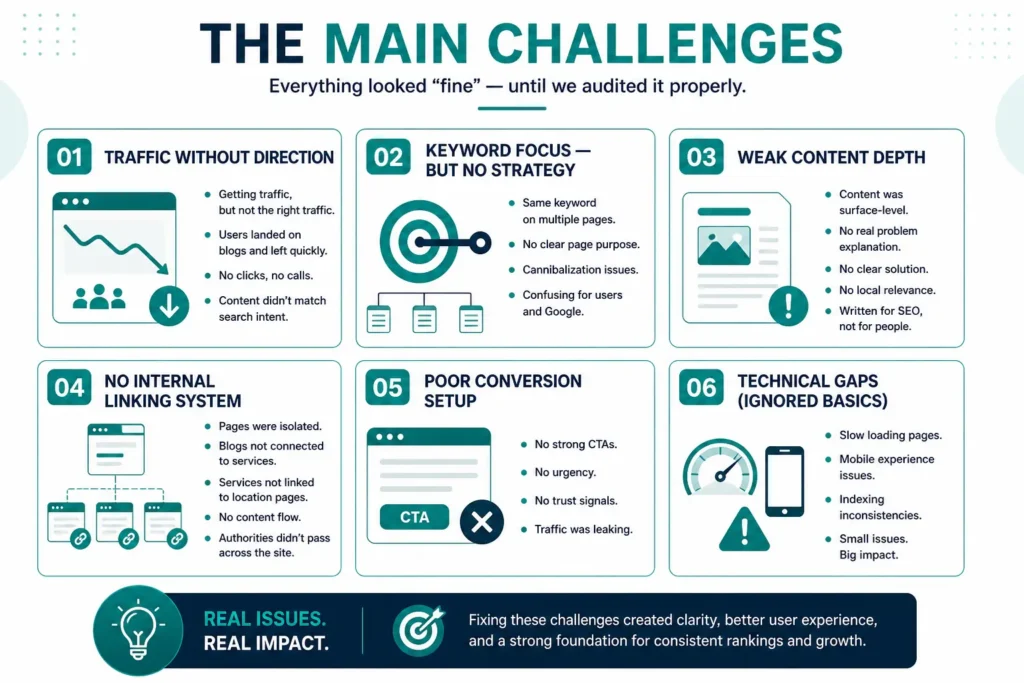
The Main Challenges
At first glance, everything looked “fine.” The website was live. The content was there. Keywords were being used.
But once we audited things properly… real issues started showing up. And these were the kind of problems most businesses don’t even realize they have.
1. Traffic Without Direction
They were getting some traffic. But it wasn’t the right traffic.
- Users were landing on blog posts
- Leaving quickly
- No clicks, no calls
Because the content didn’t match the intent. People searching with urgency were getting generic information.
2. Keyword Focus — But No Strategy
They had keywords. But no structure.
- Same keyword targeted on multiple pages
- No clear page purpose
- Cannibalization issues
This confused both users and Google. Result? Rankings kept fluctuating.
3. Weak Content Depth
Content existed… but it was surface-level.
- No real problem explanation
- No clear solution
- No local relevance
It looked like content written for SEO, not for people. And users can feel that instantly.
4. No Internal Linking System
Pages were isolated.
- Blogs not connected to services
- Services not linked to location pages
- No content flow
So even if one page is ranked…Authorities didn’t pass across the site.
5. Poor Conversion Setup
Even when users landed…Nothing pushed them to act.
- No strong CTAs
- No urgency
- No trust signals
Traffic was leaking.
6. Technical Gaps (Ignored Basics)
Nothing major, but enough to hurt:
- Slow loading pages
- Mobile experience issues
- Indexing inconsistencies
Small issues. Big impact.
The Reality
Individually, these problems don’t seem huge. But together? They completely block growth.
And that’s exactly what was happening here. Good effort. Wrong execution.
SEO Strategy We Used
We focused on affordable, high-impact SEO actions.
1. Keyword Research with Buyer Intent
We identified keywords people actually search before buying. Instead of generic terms, we focused on:
- Service + location keywords
- Problem-based searches
- High-intent queries
This helped attract ready-to-convert users.
2. On-Page SEO Fixes
We improved:
- Page titles
- Meta descriptions
- Headings structure
- Internal linking
- Content clarity
This helped search engines understand each page better.
3. Content Expansion
We added new SEO-focused pages including:
- Service pages
- Location pages
- Supporting blog content
This increased keyword coverage and visibility.
4. Local SEO Optimization
We strengthened local visibility by:
- Optimising Google Business Profile
- Building local citations
- Improving NAP consistency
This helped the business appear in local searches.
5. Authority Building (Backlinks)
We built high-quality, relevant backlinks from:
- Local directories
- Industry sites
- Relevant blogs
This improved domain trust.
Results After 4–5 Months
After 4–5 months of consistent SEO work, the results weren’t just visible in analytics, they were reflected in actual business performance. Before this, growth felt random. Some weeks were quiet, others unpredictable. There was no clear pattern.
Now, everything started to stabilize. Traffic improved. Rankings held. Leads became consistent. And most importantly, it all made sense.
Organic Traffic Increased by 150%
This wasn’t just a spike in numbers. It was a shift in traffic quality. Previously, most visitors landed on blog content that didn’t match what they were really looking for. They skimmed, then left. Low engagement, high bounce rates.
Once we reworked the content around real search intent, things changed:
- Users started landing on service and location pages
- Engagement increased across key pages
- Visitors explored more than one page
These are strong signals for Google, especially with how its algorithm evaluates user behaviour. As a result, rankings improved naturally and traffic followed. That 150% increase came from relevant visibility, not just broader reach.
Website Enquiries Doubled
This was where the real business impact showed. Before, traffic didn’t convert. Visitors had no clear direction. No urgency. No strong reason to take action. We focused on fixing that:
- Clear, visible calls-to-action on every key page
- Messaging aligned with real-life situations (urgent repairs, immediate help)
- Simple, direct language no unnecessary jargon
Now, when users landed on the site, they knew exactly what to do next. Call. Book. Request a quote. The result? A noticeable increase in enquiries without increasing ad spend.
Rankings Improved for Multiple Keywords
Earlier, rankings were unstable. A keyword might appear on page 2 one week… then disappear the next. This usually happens when:
- Multiple pages target the same keyword
- Content lacks depth
- Site structure is unclear
We fixed that by:
- Assigning a clear focus to each page
- Resolving keyword cannibalisation
- Building structured topic clusters
Now, search engines could clearly understand what each page represented. The outcome:
- Over 20 keywords moved to page 1
- Long-tail keywords ranked faster and more consistently
- Ranking fluctuations reduced significantly
It wasn’t just improvement, it was stability.
Local Visibility Improved Significantly
For a service-based UK business, local visibility is critical. Before optimisation, the site struggled to appear in:
- City-specific searches
- “Near me” queries
- High-intent local results
We addressed this by:
- Creating and refining location-specific pages
- Including real, local context in content
- Targeting geographically relevant keywords
This helped the business appear in searches where users were actively looking for nearby services. And that kind of traffic converts quickly.
Most Importantly — Leads Became Consistent
Before SEO improvements, lead flow was unpredictable. Some days brought enquiries. Others didn’t. There was no reliability. After implementing the changes:
- Traffic became steady
- User intent aligned with page content
- Conversion paths became clear
This led to a consistent flow of enquiries. Not just more leads but better quality ones. People reaching out were ready to take action.
Why This SEO Strategy Worked
The success came from:
- Focus on high-intent keywords
- Consistent monthly improvements
- Local SEO optimisation
- Quality over quantity approach
No shortcuts were used. Only steady, structured SEO work.
Why This SEO Strategy Worked
This wasn’t luck. And it definitely wasn’t a “quick win”. The growth came from doing the right things consistently.
Focus on High-Intent Keywords
Instead of chasing high-volume keywords, we focused on what actually brings business. There’s a big difference between:
- “what is boiler repair” (informational)
- “boiler repair near me” (high intent)
Before, the site was attracting curious visitors. After the shift, it started attracting ready-to-act users. That’s the kind of traffic Google prioritises now especially with its intent-focused updates in recent years. Less traffic sometimes. But far better results.
Consistent Monthly Improvements
No big spikes. No random experiments. Just steady, structured work every month:
- Content updates
- Internal linking improvements
- Technical fixes
- Page enhancements
Most businesses quit too early. This client didn’t. And that consistency compounded over time. Each small improvement built on the last one.
Local SEO Optimisation
For UK service businesses, local SEO isn’t optional, it’s everything. We didn’t just “add locations”. We made them meaningful:
- Real area-based content
- Service + location combinations
- Clear local relevance
This helped the site appear in searches where users were actually looking for nearby help. And those users convert fast.
Quality Over Quantity Approach
We didn’t publish 50 new blogs. We improved what already existed.
- Added depth
- Answered real questions
- Made content easier to read
- Focused on clarity, not length
quality signals matter more than volume. And Google is very good at detecting that difference.
No Shortcuts — Just Structured SEO
No spammy backlinks. No AI-generated bulk content. No tricks. Just:
- Clear structure
- Strong intent alignment
- Better user experience
That’s why the results lasted. Not just a temporary boost but stable growth.
These results didn’t happen by chance, explore the strategies and services behind this SEO growth:
- How small businesses compete with big brands on Google
- Why we don’t use long-term SEO contracts
- Affordable SEO pricing models explained
- Ecommerce SEO services in the UK
- International SEO services
FAQs
1. How long did it take to see results?
SEO didn’t produce instant results and that’s normal. In this case, the first signs of improvement started appearing around the 3-month mark. Rankings began to stabilize, a few keywords moved up, and traffic slowly increased. By month 4 and 5, the growth became more noticeable. Pages started ranking on page 1, and organic traffic picked up properly.
This timeline aligns with how Google processes changes. It takes time to crawl, understand, and trust updates especially in competitive UK markets. The key here wasn’t speed, it was consistency. Each month built on the previous one, which is why results didn’t drop after improving.
2. Was a big budget required?
No, and that’s an important point. This wasn’t driven by heavy spending or aggressive campaigns. There were no expensive backlink packages or large-scale content production involved. Instead, the focus was on improving what already existed, fixing structure, aligning content with intent, and making the website easier to understand for both users and search engines.
It was more about smart execution than budget. Many UK businesses assume SEO requires a large investment upfront, but this case shows that a clear strategy and consistent work can deliver strong results without overspending.
3. What improved the most?
The most noticeable improvement was in organic traffic quality, not just quantity.
Before, the site was getting visitors who weren’t really ready to take action. After the changes, the traffic became more targeted. Users landing on the site were actively searching for services, which meant they were more likely to convert.
At the same time, local search visibility improved significantly. The business started appearing in location-based searches and “near me” queries, which are typically high-conversion opportunities. So while traffic increased, the real win was that it became more valuable.
4. Can small businesses get similar results?
Yes, absolutely but only if the approach is right. Small businesses often think they can’t compete with larger brands, especially in UK search results. But in reality, SEO is less about size and more about relevance and clarity. If your website clearly answers what users are searching for, and your structure makes sense, you can compete effectively even in competitive niches.
This case wasn’t a big brand. It was a typical service business. The difference came from focusing on what users needed, rather than trying to “game” the system.
5. Is SEO better than paid ads for long-term growth?
For long-term growth, yes SEO has a clear advantage.
Paid ads can generate quick traffic, but the moment you stop spending, that traffic disappears. SEO works differently. Once your pages start ranking and gaining authority, they continue bringing in traffic without ongoing ad costs.
In this case, the improvements made during those 4-5 months kept delivering results even after the initial work. That’s the real strength of SEO: it builds a foundation that continues to grow over time.