
You may feel stuck when big brands always appear above you on Google. They have more money, more traffic, and stronger authority. It can feel like you cannot win no matter how hard you try.
Small businesses can still compete and even outrank big brands with the right strategy. You do not need a huge budget. You only need smart SEO structure, local focus, and better content quality.
This guide will show you simple and practical ways to build visibility, trust, and traffic. Everything is explained in a clear and easy way so you can apply it step by step.
Understanding how big brands dominate Google
Big brands usually rank because they have strong authority and backlinks. They also publish content at scale across many topics. Search engines like Google trust them more because of history and signals.
They also use advanced SEO tools like Ahrefs and SEMrush to study competitors. But they often lack one thing. They are not always focused on local intent or personal user experience. This is where small businesses can win.
How Google actually ranks big and small websites
Google does not rank websites only based on size or money. It focuses on how helpful and relevant your content is for users. If your page answers the user’s question better, it can still rank higher.
Big brands often appear on top because they have strong authority. They get more backlinks, traffic, and brand searches over time. This builds trust in the system of Google. They also use advanced SEO tools like Ahrefs and SEMrush to improve their strategy.
But Google also rewards smaller websites when they are more specific. If your content is more focused and helpful, you can still outrank big brands.
Secondary keyword and search intent focus
To compete with big brands, you must understand what people are actually searching for.
These searches are called user intent. If you match intent better than big brands, you can rank faster.
Instead of only targeting broad keywords, focus on specific and local terms. This makes it easier to get traffic and conversions.
Here are important secondary keyword variations you should understand and use naturally:
- Small business SEO strategy
- Local SEO for small business
- How to rank small business website on Google
- Compete with big brands on Google search
- Google ranking tips for small business owners
- Low budget SEO strategy for beginners
These keywords are based on real user problems. They show what people want to learn or fix. That is why they are powerful for ranking.
Build topical authority with focused content
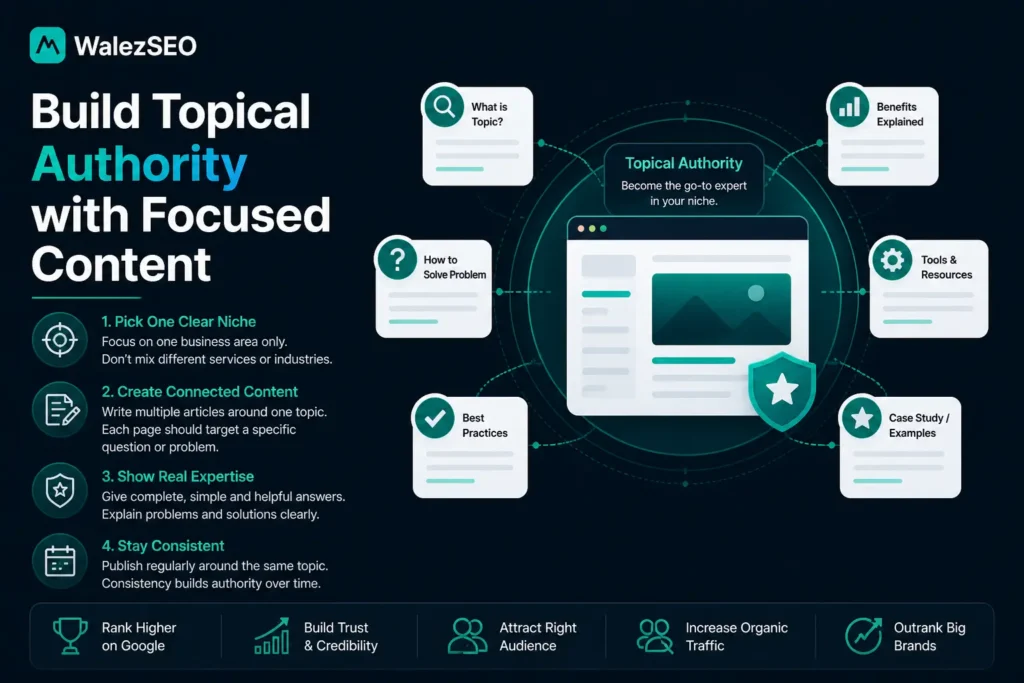
Topical authority means Google sees your website as an expert in one specific area. Instead of writing about many random topics, you focus on one clear niche. This helps you compete even against big brands.
When big brands cover many topics, their content is often general. You can win by going deeper and more detailed in one subject. Google rewards websites that fully cover a topic.
Pick one clear niche first. Do not mix different services or industries. Focus on one business area only. For example, cleaning, SEO, or local services.
Create connected content around one topic Write multiple articles that support each other. Each page should target a specific question or problem. This builds strong internal relevance.
Show real expertise in content. Use simple language but give complete answers. Explain problems and solutions clearly. This builds trust with users and search engines.
Stay consistent over time. Do not publish randomly. Keep building content around the same topic. Consistency builds authority slowly but strongly.
Use long tail keywords for faster ranking
Long tail keywords are longer and more specific search phrases. They are easier to rank compared to short competitive keywords. They also bring users who are ready to take action.
Big brands usually focus on broad keywords. This gives small businesses an opportunity to target specific searches. That is where you can win traffic faster.
Here are examples of strong long tail keywords:
- How small businesses can compete with big brands on Google search
- Best SEO strategy for small local business growth
- Why my small business is not ranking on Google
- How to get more customers from Google search locally
- Low cost SEO tips for small business owners
These keywords match real user questions. They show clear intent and problem-solving needs. That makes them powerful for ranking and conversions.
Content clusters (topical authority building system)
A content cluster has one main page and several supporting pages. The main page covers the core topic. Supporting pages explain smaller related questions in detail.
Create a strong main topic page This page should target your main keyword idea. It acts as the central hub of your content. It gives a full overview of the topic.
Add supporting articles around it Each supporting page should answer one specific question. For example tips, guides, or problem-solving posts. All pages should link back to the main page.
Connect everything with internal links Link related articles to each other naturally. This helps users move between helpful content. It also improves Google understanding of your site.
Focus on one topic family Do not mix unrelated subjects. Stay within one niche or industry. This builds strong topical authority over time.
Keep updating your cluster Add new content as new questions appear. Improve old articles when needed. Fresh and updated content performs better.
Want to understand the strategy behind these results and apply them to your own website? Explore these next:
- what is on-page SEO
- technical SEO fundamentals
- UX and SEO improvements
- why white hat SEO matters
- SEO pricing explained in the UK
FAQs
Why do big brands rank higher than small businesses?
Big brands don’t just rank because they’re “big” they’ve built strong signals over time. They usually have more backlinks, higher brand recognition, and consistent traffic. People search for them directly, mention them online, and interact with their content more often. All of this builds trust in the eyes of Google.
That doesn’t mean small businesses can’t compete, it just means they need to be more focused and strategic.
What is the best SEO strategy for small businesses?
For most small businesses, the best approach is a mix of local SEO and helpful, targeted content. Instead of going after broad, competitive keywords, focus on specific searches your audience is actually making. Long-tail keywords and real user questions are easier to rank for and often bring better-quality traffic.
Consistency matters more than trying shortcuts. Small improvements over time lead to real growth.
How can a small business improve Google ranking fast?
“Fast” in SEO is relative but some actions do create quicker impact. Start by optimising your Google Business Profile so you appear in local searches. Then create content that answers specific queries your customers are searching for. Focus on local intent and clear user needs.
When your content matches what people are actively looking for, rankings improve more naturally.
Do small businesses need expensive SEO tools?
Not at the beginning. You can achieve a lot using basic SEO practices and free tools. What matters more is how well you understand your audience and how clearly your content solves their problems. Tools can help but they don’t replace strategy or execution.
What is the biggest SEO mistake small businesses make?
One of the biggest mistakes is targeting highly competitive keywords too early. These are usually dominated by large brands, making it difficult to rank. Another common mistake is ignoring local SEO, which is often the easiest and most effective way for small businesses to gain visibility.
Focusing on the wrong keywords and missing local opportunities can slow down growth significantly.