
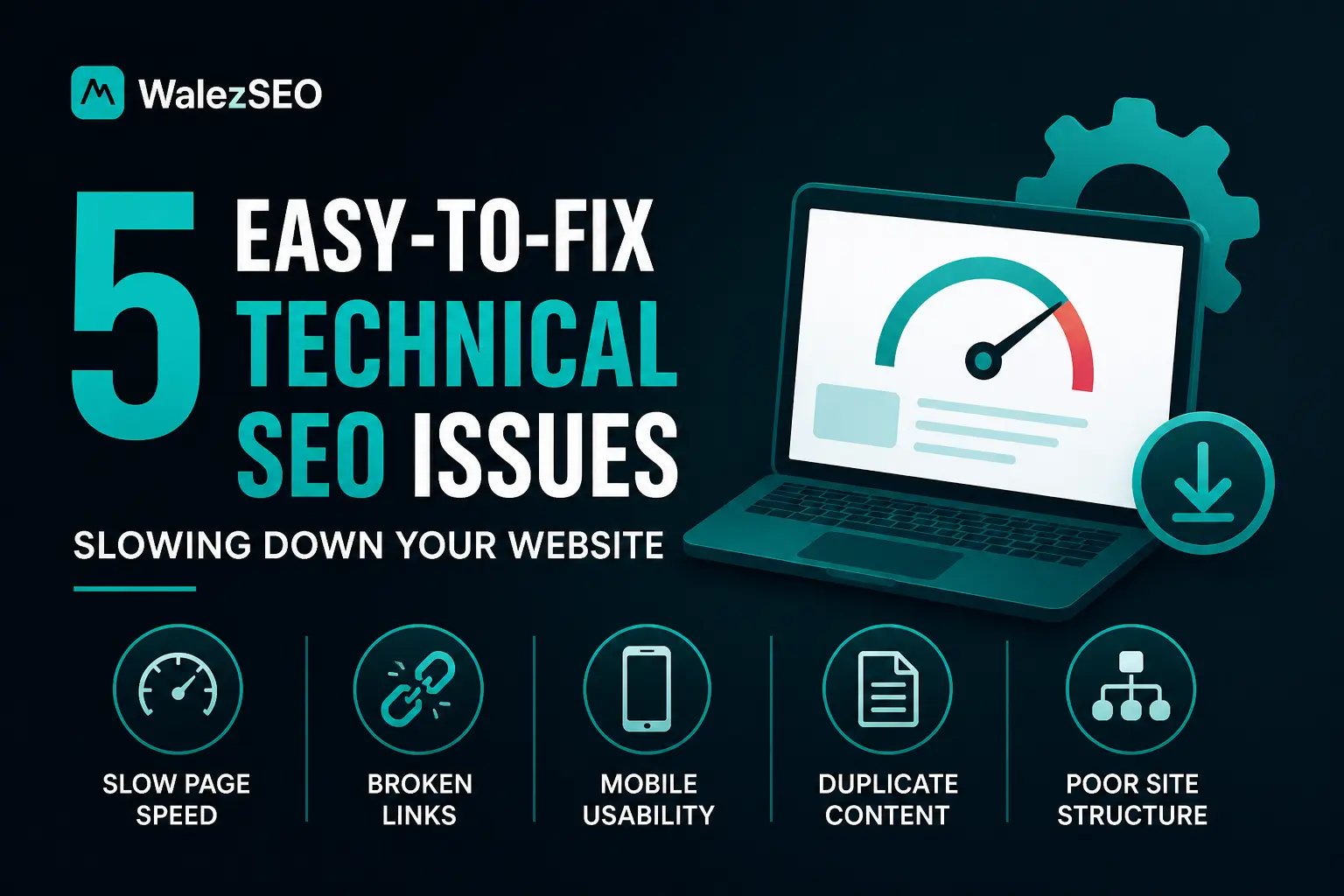
Fix common technical SEO problems that hurt your Google rankings, slow your website, and reduce your leads without needing advanced coding skills.
Most websites don’t have a traffic problem, they have a hidden technical problem. Everything looks fine on the surface. Your content is there. Keywords are in place. Maybe you’ve even invested in SEO before. But rankings still don’t move. Traffic stays flat. Leads feel inconsistent.
That’s where it gets frustrating. Because the real issue isn’t what you see, it’s what’s happening in the background. Slow loading pages. Broken links. Weak structure. Poor mobile experience.
These small issues don’t crash your site… but they quietly damage your performance every single day. And the worst part?
Most businesses don’t even realise it. In 2026, Google doesn’t just rank content it ranks experience. If your website is slow, confusing, or hard to use, you’re already behind your competitors.
This guide will walk you through the exact technical SEO issues that are holding your site back and how to fix them without needing advanced skills.
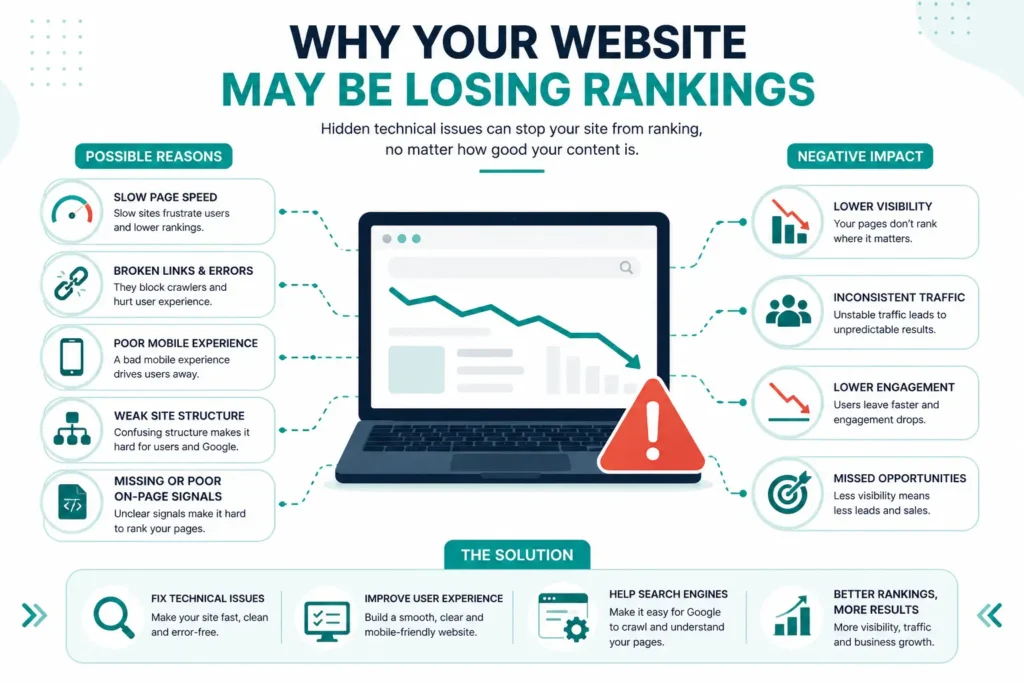
Why Your Website May Be Losing Rankings
If your website isn’t ranking well, it’s not always because of weak content or missing keywords. In many cases, the real issue sits behind the scenes technical gaps that stop your site from performing properly. Your pages might exist, but they’re slow, hard to navigate, or unclear for search engines to understand. And when that happens, Google struggles to trust and prioritise your site in search results. The result is simple: lower visibility, inconsistent traffic, and missed opportunities even if your content is actually good.
1. Slow Website Loading Speed
A slow website doesn’t just feel annoying, it quietly kills your rankings and conversions.
Here’s what usually happens. A user clicks your site from search. The page takes a few seconds to load. They wait… then leave. No interaction, no scroll, no action.
That single behaviour sends a strong signal to Google that your page isn’t delivering a good experience. Over time, that affects your rankings. And it’s more common than you think.
Most websites slow down because of small things adding up large images uploaded without compression, cheap hosting that can’t handle traffic, or too many unnecessary scripts running in the background. Individually, these don’t seem like a big deal. Together, they make your site heavy.
The tricky part is, many business owners don’t notice it. The site “works”… but not efficiently.
Fixing it doesn’t require advanced skills. Start simple. Optimise your images before uploading. Clean out plugins or scripts you’re not using. Make sure your hosting isn’t holding you back.
Even a 1–2 second improvement can change how users behave on your site. And once users stay longer, engage more, and interact with your pages your SEO starts improving naturally.
2. Poor Mobile Experience
Most people won’t visit your website on a laptop anymore. They’ll find you on their phone usually in a hurry, often on the go. And if your site doesn’t feel smooth on mobile, they won’t try to figure it out. They’ll just leave. That’s the real issue.
A poor mobile experience isn’t always obvious to the site owner. Everything might look “fine” on a desktop, but on a smaller screen it can fall apart, text becomes hard to read, buttons feel cramped, sections don’t align properly. It creates friction. And users don’t tolerate friction anymore.
From a ranking perspective, this matters a lot. Google now evaluates your site based on mobile performance first, not desktop. So if your mobile experience is weak, your rankings will struggle even if everything else looks good. The fix isn’t about making it perfect. It’s about making it usable.
Your site should load cleanly, text should be readable without zooming, and users should be able to navigate without thinking too much. Simple layouts work better. Clear buttons work better. Less clutter always wins on mobile.
When users can move through your site easily, they stay longer, explore more, and are far more likely to take action. And that’s exactly what search engines want to see.
3. Broken Links and Errors
Broken links are one of those issues that slowly damage your site without you noticing. Everything might look fine at first. Pages exist. Content is there. But underneath, links start breaking, old URLs change, pages get deleted, or internal links point to the wrong place.
For users, it’s frustrating. They click expecting an answer… and land on a dead page. Most don’t try again. They leave.
And that behaviour sends a negative signal to Google. From a technical side, it’s just as bad. When search engines crawl your site and keep hitting errors, it reduces trust. Important pages may not get indexed properly. Your overall site quality starts to drop.
This is why even a few broken links can have a bigger impact than expected. The good part? It’s fixable.
You don’t need complex tools. Just regular checks. Go through your key pages, test important links, and update anything outdated. If a page no longer exists, redirect it properly instead of leaving it broken. It’s a small habit but it keeps your site clean, reliable, and easier to rank.
4. Missing Meta Tags and Optimisation
Meta tags might look like a small detail, but they play a big role in how your pages perform in search. When someone searches on Google, the first thing they see is your page title and description. That’s your first impression. If it’s missing, duplicated, or unclear, your page either won’t rank properly or won’t get clicks even if it does.
A lot of websites ignore this. You’ll often see pages with:
- No proper title
- The same description repeated everywhere
- Generic text like “Home” or “Services”
This creates confusion. Google struggles to understand what the page is about, and users don’t feel confident clicking it. Good meta optimisation is simple but intentional.
Each page should have a clear focus. The title should reflect exactly what the page offers, using natural keywords (not forced ones). The description should give a quick, honest reason to click.
Nothing complicated. Just clarity. When this is done right, two things happen. Your pages become easier for search engines to understand, and more importantly, more people actually click on them. And that click-through behaviour is a strong ranking signal over time.
5. Poor Website Structure
This is one of those issues that doesn’t look serious… but affects everything. Your website might have good content, useful services, even decent design. But if the structure is messy, none of it performs the way it should.
Think of it like this. If a user lands on your site and can’t figure out where to go next, they won’t stay long. And if search engines can’t clearly understand how your pages are connected, they won’t rank them properly either.
That’s where structure matters. A poorly structured website usually looks like this: pages are scattered, there’s no clear hierarchy, and important pages aren’t connected properly. Blog posts sit on their own. Service pages don’t link anywhere. Everything exists but nothing supports each other.
For Google, this creates confusion. It becomes harder to understand which pages are important, what topics your site covers, and how everything fits together.
And when that clarity is missing, rankings suffer. The fix isn’t complicated but it needs to be intentional.
Your site should follow a clear flow. Main pages at the top, supporting pages underneath. Related content should be linked naturally. Headings (H1, H2, H3) should guide both users and search engines through the page.
Once your structure improves, everything starts working better together. Pages support each other, authority builds across the site, and search engines can finally “read” your website properly. And that’s when rankings start to move.
Why Technical SEO Matters for Small Businesses
For most small businesses, SEO feels like content and keywords. Write a few blogs, target some terms, and hope rankings improve. But without technical SEO, that effort doesn’t go far.
You might have the right content… but if your website is slow, hard to navigate, or poorly structured, it won’t perform the way it should. Search engines struggle to crawl it properly. Users don’t stay long enough to engage. And over time, rankings stay stuck.
That’s where technical SEO makes the difference. It acts as the foundation of your entire website. When it’s done right, everything else becomes easier, your pages load faster, your content is easier to understand, and your site feels smoother to use. These are exactly the signals Google looks for when deciding which sites to rank higher.
For small businesses especially, this is a big advantage. You don’t need a massive budget or hundreds of pages. You just need a website that works properly. Clean structure, fast speed, and a good user experience can outperform bigger competitors who ignore these basics.
And that’s the key point. Technical SEO isn’t complicated but it’s powerful. Once you fix it, everything else starts improving naturally.
Technical SEO is the backbone of your website, but to get real results, you need to combine it with the right strategy and services:
- affordable SEO pricing models
- SEO vs PPC for small businesses
- how to optimise your Google Business Profile
- multilingual SEO services
- international SEO services
FAQs
1. What is technical SEO?
Technical SEO is about improving how your website works behind the scenes so search engines can properly access, understand, and rank it. It includes things like page speed, mobile usability, site structure, and fixing errors. You might not always see it directly, but it plays a big role in how well your site performs on Google. Without it, even good content can struggle to rank.
2. Does website speed affect SEO?
Yes, and more than most people realise. A slow website doesn’t just frustrate users, it affects how long they stay, how they interact, and whether they come back. These behaviours are signals that search engines use to judge quality. If your site is slow, users leave quickly, and that can push your rankings down over time.
Speed isn’t just technical it directly impacts user experience and conversions too.
3. How often should I check technical SEO?
You don’t need to check it daily, but it shouldn’t be ignored either.
A good approach is reviewing your technical SEO every 1–2 months. Websites change constantly with new pages, updates, plugins so small issues can build up without you noticing. Regular checks help catch problems early before they affect your rankings. Think of it as maintenance, not a one-time fix.
4. Can I fix technical SEO myself?
For many basic issues, yes. Things like optimising images, fixing broken links, improving page structure, and writing better meta tags can be done without coding skills. There are also simple tools available that make the process easier. However, for more complex issues like server errors or advanced performance optimisation, you might need expert support.
5. What is the biggest technical SEO issue?
In most cases, it’s not just one thing, it’s a combination.
But if you had to narrow it down, slow loading speed and poor mobile experience are the most common and most damaging. These directly affect both user behaviour and how Google evaluates your site. Fixing these alone can already lead to noticeable improvements in rankings and performance.