
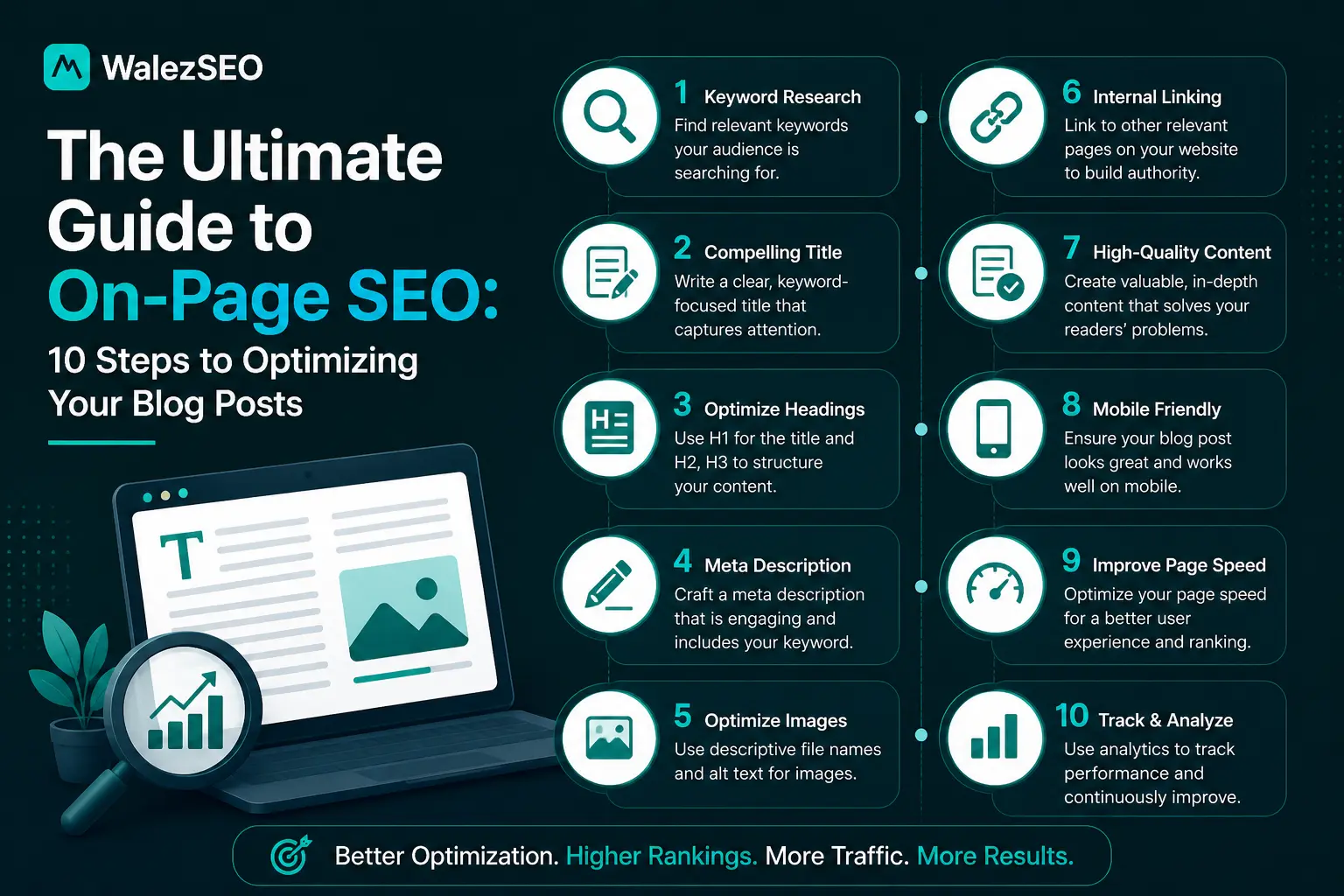
Learn how to optimize your blog posts step by step so they rank higher on Google, attract more traffic, and generate more leads for your UK business.
Why On-Page SEO Matters
On-page SEO is where most of your control actually is. You can’t control algorithms. You can’t control competitors. But you can control what’s on your website. And that’s exactly why it matters.
If your pages are not clearly telling search engines what they’re about, they won’t rank properly no matter how good your service is. At the same time, if users land on your page and don’t immediately understand what you offer, they won’t stay. That’s the gap on-page SEO fixes.
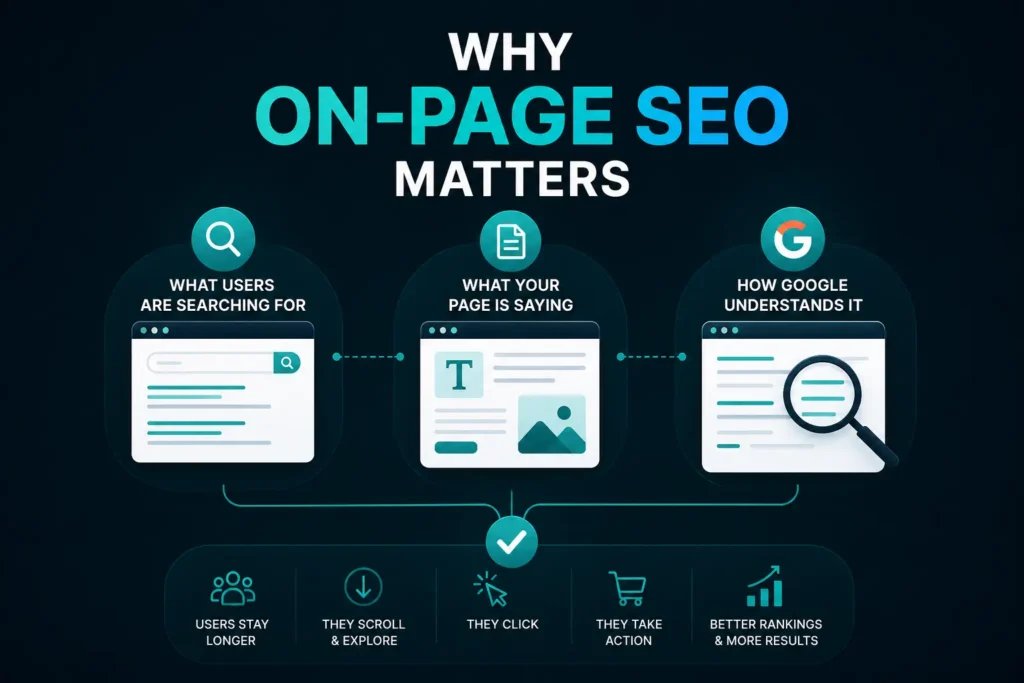
It aligns three things together:
- What users are searching for
- What your page is saying
- How Google understands it
When this alignment is clear, everything starts working better. Your headings guide the reader. Your content answers real questions. Your structure makes navigation easy.
Nothing feels confusing or forced. And that directly impacts performance. Users stay longer. They scroll. They click. They take action. Those behaviours signal quality.
That’s why on-page SEO isn’t just about adding keywords. It’s about making your page make sense both for the user and the search engine. Once that happens, rankings don’t feel random anymore.
Step 1 – Use a Clear and Focused Keyword
Everything starts with clarity. If your page is trying to rank for too many things at once, it usually ends up ranking for nothing. That’s because the message becomes unclear not just for users, but also for Google.
Each page should have one main keyword. One clear purpose. For example, a page targeting “SEO services UK” should stay focused on that. Not drift into web design, marketing tips, or unrelated topics. The more focused your page is, the easier it becomes for search engines to understand and rank.
You can still use variations and related terms, but they should support the main keyword, not compete with it.
Step 2 – Write a Strong SEO Title
Your title is the first thing people see in search results. So it needs to do two things at once: tell Google what the page is about, and convince users to click. A weak title might be technically correct… but if it’s boring or unclear, people skip it.
A strong title is simple, direct, and slightly compelling. For example: “Affordable SEO Services UK for Small Businesses (2026 Guide)”
It’s clear, keyword-focused, and gives a reason to click. Better titles = better click-through rates. And that alone can improve rankings over time.
Step 3 – Use Proper Heading Structure
Headings are not just for design they guide how your content is understood. When your page has a clear structure, both users and search engines can follow it easily. Your layout should feel natural:
The H1 introduces the main topic.
H2 sections break it into key parts.
H3s go deeper where needed.
Without structure, content feels messy. Hard to scan. Easy to leave. With structure, everything flows. And that improves both readability and SEO performance.
Step 4 – Write a Powerful Introduction
Your introduction decides whether someone stays… or leaves. If it’s generic or slow, users lose interest quickly. A strong intro gets straight to the point.
It shows you understand the problem. It builds a bit of trust. And it makes it clear what the reader will gain. No need for long explanations. Just make the reader feel:
“This is relevant to me.”
That’s enough to keep them scrolling.
Step 5 – Use Keywords Naturally
Keyword stuffing doesn’t work anymore. In fact, it does more harm than good. Search engines especially Google are now smart enough to understand context, not just exact words. So instead of forcing your keyword everywhere, focus on writing naturally.
Use it where it fits. Add variations. Use simple language. If your content sounds human, it usually performs better. Because that’s what users prefer too.
Step 6 – Optimise Meta Title & Description
Your meta title and description are like your page’s ad in search results. Even if you rank well, people won’t click if this part is weak. A good meta setup should be:
Clear. Relevant. Slightly engaging.
It should include your main keyword but still feel natural. More clicks better engagement signals. And over time, that can improve your rankings without changing your position.
Step 7 – Add Internal Links
Internal linking is simple but powerful.It connects your pages together and creates a clear path for both users and search engines. For example, a blog post can guide users to a service page. A service page can lead to a contact page.
This keeps users engaged longer. And helps Google understand your site structure. Without internal links, your pages feel isolated. With them, your site works like a system.
Step 8 – Optimise Images
Images can slow your site down if not handled properly. And speed directly affects SEO. Many websites upload large images without compression. Or forget to add alt text. That creates two problems: slow loading and missed SEO signals. Optimising images is simple:
Use compressed files.
Add descriptive alt text.
Keep sizes appropriate.
It’s a small fix but it improves both performance and accessibility.
Step 9 – Improve Readability
If your content is hard to read, people won’t read it. It doesn’t matter how valuable it is. Online users scan first. Then decide. So your content should feel easy:
Short paragraphs.
Simple sentences.
Clear spacing.
Avoid overcomplicating things.bThe easier it is to read, the longer users stay. And that directly impacts SEO performance.
Step 10 – Add a Strong Call-to-Action
Every page should lead somewhere. If users read your content and don’t know what to do next, they leave. That’s a lost opportunity. A good call-to-action is clear and direct. It tells the user exactly what step to take. For example:
Get a Free SEO Audit
Contact Us Today
Request a Quote
Nothing complicated. Just guidance. Because when your page not only informs but directs you start turning visitors into leads.
Want to improve rankings beyond basic on-page tweaks? Explore these next:
- Technical SEO fundamentals
- UX and SEO improvements
- On-page SEO services
- White hat SEO practices
- Free SEO audit
Why On-Page SEO Is Powerful
On-page SEO is powerful because it improves multiple parts of your website at the same time and you have full control over it. When your pages are properly optimised, they become easier for Google to understand. Your content is clear, your keywords are aligned with search intent, and your structure makes sense.
That clarity increases your chances of ranking higher because search engines can confidently match your page with the right queries. At the same time, it improves how users experience your website.
When someone lands on a well-optimised page, everything feels simple. The message is clear. The layout is easy to follow. The information answers their question without confusion. This keeps users engaged, reduces bounce rate, and encourages them to explore further.
And that naturally leads to better conversions. Because when users trust what they’re reading and find exactly what they need, they’re more likely to take action whether that’s contacting you, requesting a quote, or making a decision.
Over time, this consistency builds authority. Your website starts to look more reliable, more relevant, and more complete in the eyes of both users and search engines. And that’s what creates long-term growth.
That’s why on-page SEO is one of the fastest ways to improve overall website performance. It directly impacts rankings, user experience, and results all at once.
FAQs
1. What is on-page SEO?
On-page SEO is the process of improving the content and structure of your website so both users and search engines can clearly understand it. It includes things like using the right keywords, writing helpful content, organising headings properly, and making pages easy to navigate. When done right, it helps Google recognise what your page is about and show it to the right audience.
2. How important is on-page SEO?
It’s one of the most important parts of SEO. You can have backlinks and technical optimisation, but if your page itself is unclear or poorly structured, it won’t perform well. On-page SEO is what connects everything to your content, your keywords, and user experience. Without it, rankings usually stay inconsistent.
3. How long does on-page SEO take to work?
It depends on your niche and competition, but most websites start seeing changes within a few weeks.
In less competitive areas, improvements can show faster. In more competitive markets like the UK, it may take a few months for results to fully build. The key is consistency small improvements over time lead to stronger, more stable rankings.
4. Can I do on-page SEO myself?
Yes, most of it is beginner-friendly. You don’t need advanced technical skills to fix things like headings, content clarity, keyword usage, or internal linking. There are also many simple tools that can guide you. For more advanced optimisation, you might need expert help but the basics are definitely manageable on your own.
5. What is the most important on-page SEO factor?
High-quality, well-structured content. If your content clearly answers what users are searching for, is easy to read, and is properly organised, you’re already ahead of many competitors. Keywords still matter but how naturally and effectively you use them matters even more.