
There’s a particular kind of frustration that comes with running an online store that isn’t growing the way it should.
You’ve built the site. Uploaded the products. Maybe you’re running some ads. But organic traffic is flat, the store isn’t ranking for the keywords that matter, and every month the sales target feels like it’s relying a little too heavily on paid spend to hit.
The problem is almost never the products. In most cases, it’s a handful of specific, fixable SEO mistakes that are quietly suppressing the store’s visibility and therefore its revenue every single day.
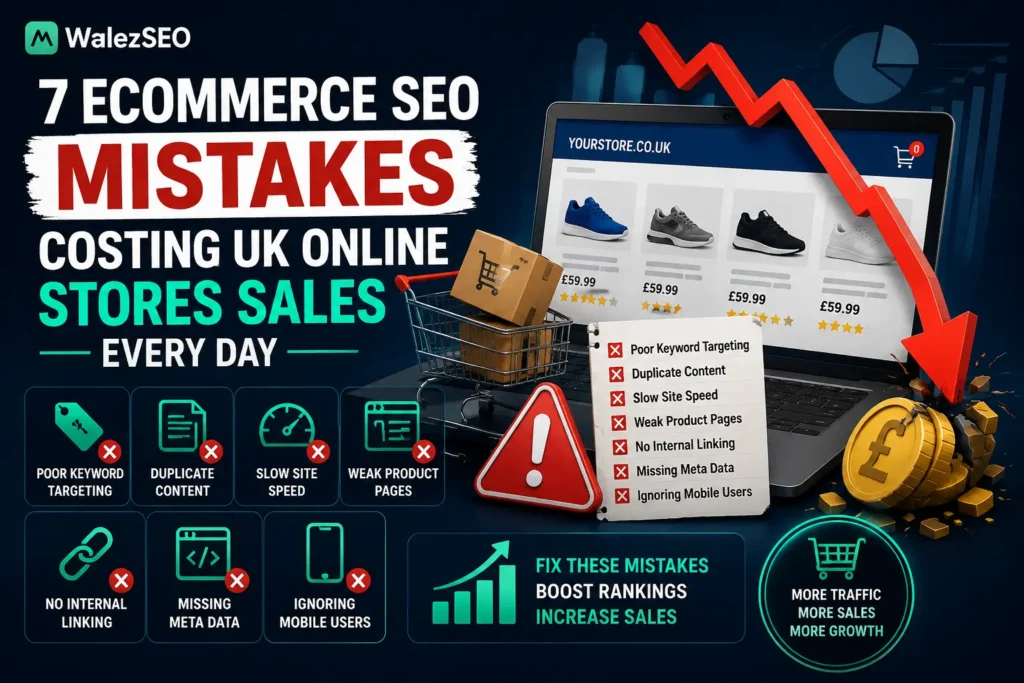
Here are the seven most common ones UK online stores make in 2026, and exactly what to do about each.
Mistake 1: Manufacturer Descriptions on Every Product Page
This is the most widespread ecommerce SEO mistake in the UK and one of the most damaging. A store imports a product catalogue, uses the manufacturer’s copy for every description, and wonders why the pages don’t rank.
Google has seen the manufacturer’s description on dozens or hundreds of other retailers’ sites. It treats it as duplicate content — and typically suppresses all but the most authoritative domain ranking for it. That almost certainly isn’t yours.
High-quality content and authoritative backlinks increase visibility across competitive and long-tail search queries. Unique product descriptions are the content foundation that everything else builds on. Without them, product pages compete poorly regardless of how good the technical SEO is.
The fix: Start with your top twenty bestselling products. Rewrite each description from scratch not paraphrasing the manufacturer’s copy but genuinely rewriting for the buyer. Open with the problem the product solves or the desire it fulfils. Explain benefits rather than just listing specifications. Include your target keyword naturally in the first paragraph. 300 to 500 words minimum. Then work through the rest of the catalogue systematically.
Mistake 2: No Content on Category Pages
Category pages drive long-term growth when built around buyer-intent keywords, clear site architecture, and strong internal linking.
Yet the vast majority of UK ecommerce category pages are just grids of products with no text. From Google’s perspective, there’s almost nothing to evaluate no content demonstrating relevance to the target keyword, no signals about who the category is for or what it contains.
This is why stores often rank better for individual product pages than for their category pages even though category pages should be the highest-traffic pages on the entire site.
The fix: Add 150 to 300 words of introductory content above the product grid on each category page. Include the target keyword in the H1 and naturally within the first paragraph. Explain what the category covers, who the products are best for, and what buyers should consider when choosing. This alone can produce significant category ranking improvements within two to three months.
Mistake 3: Ignoring Faceted Navigation
Most ecommerce platforms generate filter URLs automatically. Every combination of filters colour, size, price, brand creates a new URL. For a store with 500 products and ten filter options, this can generate tens of thousands of near-duplicate pages in Google’s index.
The consequences: crawl budget waste (Google spends time crawling useless filter pages instead of your real content), duplicate content issues across filtered and non-filtered versions of the same pages, and index bloat that dilutes the authority of your real category and product pages.
If your site has technical issues, even the best content will not rank. Faceted navigation is one of the most common technical issues that suppresses ecommerce rankings silently.
The fix: Use canonical tags to point filter URL variations back to the base category page. For filters that have genuine search value “red running shoes UK” as a specific search query build dedicated landing pages rather than relying on auto-generated filter URLs. Implement this with a developer or an SEO specialist familiar with your platform it’s technical work but the ranking impact is often significant.
Mistake 4: Missing or Incomplete Product Schema
Rich results achieve 82% higher CTR compared to non-rich results. Product schema specifically delivers 4.2x higher Google Shopping visibility.
Schema markup is code that explicitly tells Google what type of content is on your page. For product pages, it unlocks rich results your listing in Google shows the price, availability, and star rating directly in the search results, rather than just a title and meta description.
Most UK online stores either have no schema, basic schema missing critical fields, or schema that isn’t being read correctly by Google. All three situations mean missing out on significantly higher click-through rates for rankings you’ve already earned.
The fix: Use Google’s Rich Results Test (search.google.com/test/rich-results) to check whether your product pages are generating rich results. If not, check which schema fields are missing. At minimum, product schema should include: name, description, image, price, currency, availability, and aggregate rating. On Shopify, verify your theme’s schema output. On WooCommerce, install Yoast SEO or Rank Math and configure product schema properly.
Mistake 5: Targeting the Wrong Keywords
93% of online experiences begin with a search engine. But the searches that drive revenue are specific. Stores that target broad, high-competition keywords “shoes,” “furniture,” “skincare” compete against national and international retailers with years of authority. Stores that target specific, buyer-intent long-tail keywords win traffic they can actually compete for.
“Shoes” is unwinnable for most UK online stores. “Vegan leather ankle boots UK wide fit” is a different situation entirely lower competition, higher purchase intent, and buyers who have already decided what they want.
The fix: Review your current target keywords and categorise them honestly: are they winnable given your domain authority? Are they transactional searched by people ready to buy or informational? Replace broad unwinnable terms with specific long-tail alternatives. Use Google’s autocomplete, People Also Ask, and Related Searches to find the specific language your buyers use. One well-targeted long-tail keyword per product page beats ten generic ones.
Mistake 6: No Internal Linking Strategy
Internal links do two jobs simultaneously they help Google understand which pages are most important, and they guide buyers naturally through your store.
Most UK ecommerce stores have weak internal linking: products link to nothing, categories don’t cross-link to related categories, and the blog (if it exists) never links to product pages. Strong internal linking is one of the core drivers of category page performance in ecommerce SEO.
Every product page should link to its parent category. Every category should link to related categories and featured products. Every blog post should link to two or three relevant products or categories naturally within the content. Your homepage should link prominently to your most important category pages.
The fix: Audit your top twenty product pages and count how many internal links point to each one. Pages with few internal links are orphaned they exist but don’t benefit from the authority distributed across the rest of your site. Add contextual internal links from high-traffic pages to important products and categories. Use descriptive anchor text “waterproof walking boots” not “click here.”
Mistake 7: Treating SEO as a One-Time Task
Technical fundamentals including page speed, mobile optimisation, canonical tags, and clean URLs all directly impact rankings and revenue. And all of them degrade over time as your store grows.
New products get added without optimised descriptions. Categories expand without updated content. Site speed slips as more apps and plugins accumulate. Old pages that ranked well become outdated and begin losing position to fresher, more comprehensive competitors.
Ecommerce SEO isn’t a project with a completion date. It’s an ongoing programme and stores that treat it as one-time work consistently plateau while those investing in continuous optimisation compound their advantage month after month.
The fix: Build a monthly SEO maintenance routine. Check Google Search Console weekly for new errors. Audit your top-traffic pages quarterly for freshness are descriptions still accurate, are prices current, is the content still competitive? Add new blog content monthly. Review your category pages seasonally. SEO that compounds requires consistent attention the stores that treat it as infrastructure rather than a task list are the ones that keep growing.
Related Reading
Ecommerce SEO Guide UK 2026 The complete foundation guide what ecommerce SEO involves, how it differs from regular SEO, and the priority order for getting started. Read this alongside the mistakes guide for the full picture.
Ecommerce SEO Services London For online stores targeting the UK’s largest market what competitive ecommerce SEO looks like at London scale and what results UK stores typically achieve.
Shopify SEO Guide UK Shopify-specific SEO the platform quirks, duplicate URL issues, and optimisation approaches that are unique to Shopify stores and missing from generic ecommerce SEO guides.
On-Page SEO Services Product descriptions, category page content, meta titles, schema markup the on-page layer that determines whether your ecommerce pages rank and convert. See how professional on-page optimisation works.
Free SEO Audit Wondering which of these seven mistakes your store is making right now? A free audit identifies your specific technical issues, content gaps, and keyword targeting problems with a clear priority list for fixing them.
Frequently Asked Questions
Which ecommerce SEO mistake has the biggest impact to fix first?
For most UK online stores, unique product descriptions deliver the fastest and most significant improvement because duplicate manufacturer content is suppressing rankings across the entire catalogue simultaneously. Fix the top twenty products first and measure the impact before working through the rest.
How do I know if my store has a faceted navigation problem?
Check your Google Search Console Coverage report for the total number of indexed pages. If it’s significantly higher than the number of real product, category, and content pages on your site, filtered URLs are likely being indexed. A site with 500 products shouldn’t have 15,000 indexed pages.
Does blog content really help an ecommerce store rank?
SEO drives over 1,000% more traffic than organic social media. Blog content captures the informational and commercial investigation searches that product pages can’t rank for and each post builds topical authority that lifts the entire domain, including product and category pages.
How often should I update my ecommerce SEO?
Monthly at minimum checking Search Console for errors, updating any pages with outdated content, and publishing new blog content. Quarterly auditing your top-traffic pages for freshness and competitive quality. Seasonally updating category content and creating seasonal buying guides before peak search periods.