
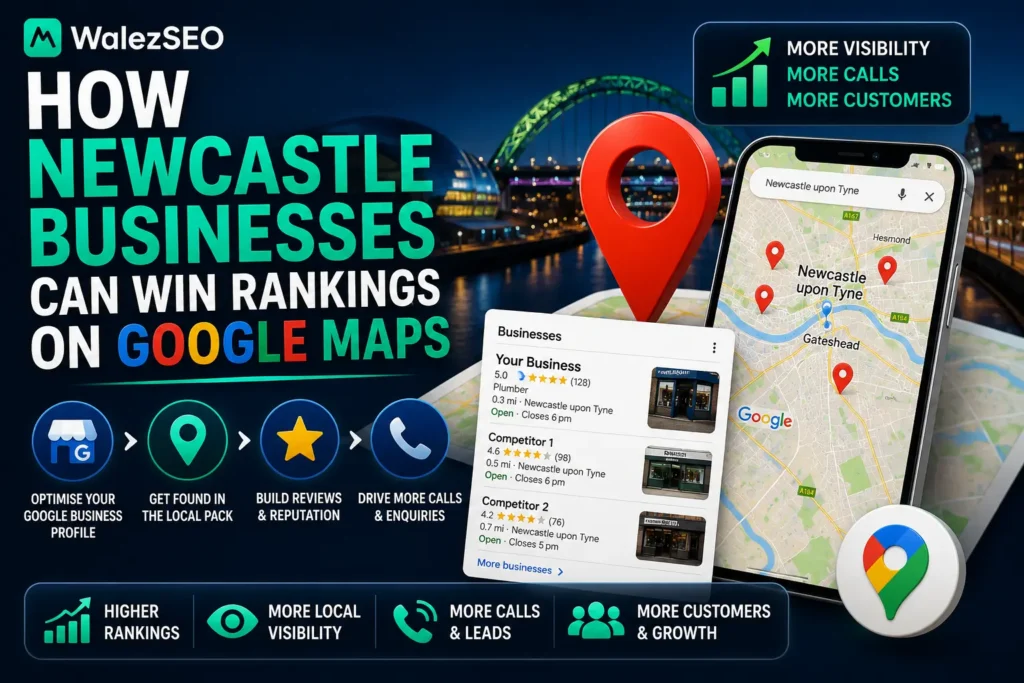
A straight-talking breakdown of the Local Pack, what Google looks for, and the practical steps that get you to the top
If you’ve ever Googled a service in Newcastle “dentist in Jesmond,” “best pizza Quayside,” “boiler repair Gosforth” you’ve seen it.
Before the regular website results, before the ads, there’s a map with three business listings pinned on it. Those three results get the lion’s share of clicks. They get the calls. They get the customers.
That’s called the Google Local Pack. And if your business isn’t in it, you’re leaving a significant chunk of your potential revenue on the table every single day.
The good news? Unlike paid advertising, where you pay for every click, getting into the Local Pack is an organic achievement. It’s earned, not bought. And once you’re there, you stay there working for you around the clock, driving calls and enquiries without ongoing ad spend.
The better news? Most Newcastle businesses have barely scratched the surface of what it takes to rank here. Which means the opportunity is very real, and very available if you understand how the system works.
Let’s break it down.
What Is the Google Local Pack and Why Does It Matter So Much?
The Local Pack is that cluster of three business results that appears with a Google Map when someone makes a location-based search. It shows up for searches like:
- “plumber Newcastle”
- “coffee shop near me”
- “hair salon Gosforth open now”
- “emergency electrician Newcastle upon Tyne”
The three businesses shown get dramatically more visibility than everyone below them. Studies consistently show that the top Local Pack result captures around 33% of all clicks on the page sometimes more. Combine all three positions, and you’re looking at well over half the available clicks going to just those businesses.
For the average Newcastle business owner, that translates directly into phone calls, bookings, and foot traffic.
The Three Pillars Google Uses to Rank Local Businesses
Google uses three main factors to determine who appears in the Local Pack. Understanding these isn’t just academic every practical action you take should map back to improving one of these three things.
Pillar 1: Relevance
Relevance is about how well your business matches what someone is searching for.
Google needs to understand clearly what your business does, where you’re located, and who you serve. If that information is murky inconsistent, incomplete, or missing Google won’t confidently rank you for relevant searches.
Relevance signals include:
- Your primary and secondary business categories on Google Business Profile
- The keywords on your website, especially in headings, page titles, and meta descriptions
- The services you list on your Google Business Profile
- The language your customers use in their reviews (when reviews mention “boiler repair Newcastle,” that reinforces your relevance for that search)
A common mistake is being too vague. Listing your category as just “Contractor” when you’re specifically a plumber in Newcastle loses you relevance. Being specific primary category: “Plumber,” secondary category: “Emergency Plumber” tells Google exactly who to show you to.
Pillar 2: Distance
Distance is straightforward: Google gives preference to businesses that are physically closer to the person searching.
This is why you can’t cheat geography. A business in Gateshead won’t automatically rank for “café Newcastle City Centre” location matters.
But here’s what most people miss: when someone searches without specifying a location (“plumber near me”), Google uses their current device location. This means your ranking can shift depending on where the person is when they search. A business in Gosforth might rank first for someone searching in Gosforth, but fall to fifth for someone searching in Heaton.
This is why having strong local signals throughout your website and Google Business Profile including specific neighbourhood mentions, local landmark references, and area-specific content helps you remain relevant across a wider geographic footprint.
Pillar 3: Prominence
Prominence is Google’s way of measuring how well-known and trusted your business is both online and offline.
This is where local SEO gets interesting, because prominence is something you actively build over time. Key prominence signals include:
Reviews and ratings. More reviews, higher ratings, and active responses to reviews all boost prominence. Google explicitly states that “high-quality, positive reviews from your customers will improve your business’s visibility.”
Backlinks and mentions. When other websites local newspapers, Newcastle business directories, local bloggers, industry associations link to or mention your business, it boosts your prominence in Google’s eyes.
Website authority. A well-optimised website with strong content, clear local signals, and good technical health contributes significantly to prominence.
Consistency and activity. Businesses that regularly update their Google Business Profile adding photos, posting updates, responding to reviews signal to Google that they’re active and trustworthy.
Why Your Google Business Profile Is Your Most Valuable Local SEO Asset
If you only focus on one thing for your local SEO, make it your Google Business Profile (GBP). This free tool is the engine behind your Local Pack presence, and most Newcastle businesses are using it at maybe 20% of its potential.
Here’s what a fully optimised GBP looks like in practice:
Complete business information. Every field filled in: business name exactly as it appears on your signage and website, precise address, current phone number, accurate hours (including special hours for bank holidays), website URL, and a detailed business description that naturally includes your services and Newcastle location.
The right categories. Your primary category should be your most important service. You can add up to nine secondary categories use them to cover your full range of services. This directly affects which searches you appear for.
Photos and videos. Businesses with photos receive 42% more requests for directions and 35% more website clicks than those without. Add photos of your premises, your team, your work, your products. Update them regularly recent photos signal an active, legitimate business.
Regular posts. Google Business Profile has a posting feature that most businesses completely ignore. Regular posts offers, updates, events, new services keep your profile active and give Google fresh content to index.
A robust Q&A section. You can add your own questions and answers. Pre-empt what customers commonly ask: parking availability, whether you offer emergency callouts, your service areas. This both helps customers and reinforces your relevance for related searches.
The Citations Game: Why Consistency Across Directories Matters
Citations are online mentions of your business name, address, and phone number (NAP) typically in business directories, review sites, and local listings. Examples of key UK citation sources include:
- Yell.com
- Yelp UK
- Thomson Local
- FreeIndex
- Hotfrog
- Bark.com
- TrustATrader (for trades)
- Checkatrade
- Google Business Profile itself
Citations matter for two reasons. First, they’re a direct ranking signal more consistent citations from authoritative sources tell Google your business is legitimate and established. Second, they’re a source of direct traffic and enquiries from people browsing directories.
The critical word here is consistent. Your NAP must be exactly the same across every citation. If your business is “Smith’s Plumbing Services” on Google but “Smiths Plumbing” on Yell, and “Smith Plumbing Services Ltd” on Checkatrade — that inconsistency undermines your local SEO. Google treats these as potentially different businesses and loses confidence in your data.
Before building new citations, audit your existing ones. Search your business name and address across the major directories and correct any inconsistencies. This alone can have a meaningful impact on your rankings.
Reviews: The Ranking Factor Newcastle Businesses Consistently Undervalue
Let’s talk about reviews because this is where local SEO intersects directly with business reputation and where the opportunity is enormous.
The math is simple: businesses with more reviews, higher ratings, and actively managed review responses rank better in the Local Pack. Full stop.
But here’s the thing about Newcastle specifically. Reviews are a trust signal that local customers take seriously. Whether someone’s looking for a restaurant in the city centre or a trades service in Gateshead, they’ll read the reviews. The businesses with the most authentic, detailed reviews consistently win the click even when they’re not in the top position.
How to generate more reviews without being pushy:
The most effective method is the simplest just ask. At the end of a job, after a positive interaction, when a customer says “you’ve done brilliant work” that’s your moment. A simple “If you’re happy, a Google review would mean the world to us” works remarkably well.
For service businesses, a follow-up text or email with a direct link to your Google review page removes all friction. People often intend to leave a review but forget. A gentle reminder with a direct link converts at a much higher rate.
How to respond to reviews:
Every review should get a response positive and negative. For positive reviews, a genuine, personalised response (not a copy-paste template) reinforces the relationship and shows future readers that you care. For negative reviews, a calm, professional response that acknowledges the issue and offers resolution demonstrates maturity and actually increases trust in the long run.
Responding to reviews is also a keyword opportunity. Naturally mentioning your service and location in responses (“Thank you for choosing Smith’s Plumbing for your boiler repair in Gosforth”) reinforces your local relevance signals.
Local Link Building: How to Build Authority in the Newcastle Market
Links from other websites to yours remain one of the strongest ranking signals in SEO and local links carry specific weight for Local Pack rankings.
For Newcastle businesses, relevant local links include:
Newcastle business directories and local trade associations. Getting listed on the Newcastle Business Directory, local Chamber of Commerce websites, or area-specific trade listings builds both citations and links.
Local press and blogs. Newcastle has an active local media scene Chronicle Live, The Crack Magazine, and numerous local blogs. If you do something newsworthy a significant expansion, a charity project, a local initiative — a story in local media is excellent for both links and brand awareness.
Partnerships with complementary businesses. A café partnering with a local bakery, a gym recommending a local sports physio, a builder recommending a local architect these kinds of mutual references and website mentions build relevant local links naturally.
Sponsorships and community involvement. Sponsoring a local Newcastle sports team, contributing to a community event, or supporting a local charity often comes with a website mention. These links are highly relevant and carry real local authority.
The Most Common Mistakes Newcastle Businesses Make with Local SEO
Before we close, let’s talk about the traps to avoid:
Keyword stuffing on your Google Business Profile name. Adding keywords to your business name field (e.g., “Smith’s Plumbing | Plumber Newcastle | Boiler Repair Gosforth”) violates Google’s guidelines and can get your listing suspended. Your name should match your real business name.
Ignoring mobile optimisation. The vast majority of local searches happen on mobile. If your website is slow or difficult to navigate on a phone, you’ll lose customers even if you rank. Page speed and mobile usability are ranking factors.
Not tracking your results. If you don’t measure, you can’t improve. Google Business Profile Insights, Google Search Console, and Google Analytics all provide free data that tells you exactly how people are finding you and what they’re doing when they arrive.
Treating local SEO as a one-time project. Local SEO requires ongoing maintenance. Competitors are always improving. Reviews need management. Content needs updating. The businesses winning in Newcastle’s Local Pack are the ones treating local SEO as a continuous effort, not a set-and-forget task.
Putting It All Together
Getting into Newcastle’s Google Local Pack isn’t magic it’s methodology. It comes down to:
- A fully optimised, consistently updated Google Business Profile
- A website that clearly communicates your location, services, and the areas you serve
- Consistent NAP citations across authoritative UK directories
- A healthy, growing stream of genuine reviews with active responses
- Relevant local links from Newcastle websites, media, and associations
Each of these works together. You won’t reach the top three by excelling in just one area it’s the combination that earns and maintains a Local Pack position.
The businesses consistently at the top of Newcastle’s local searches haven’t found some secret hack. They’ve simply done the fundamentals well, kept at it, and built a genuine online presence that reflects the quality of their real-world business.
That’s achievable for any Newcastle business. It just requires knowing what to do and getting started.
WalezSEO specialises in local SEO for Newcastle businesses. From Google Business Profile optimisation to citation building and local link acquisition, we help you claim your place in the Local Pack. Request your free local SEO audit no commitment required.
Related Reading
Local SEO Services Newcastle
Our dedicated Newcastle local SEO service covering Google Business Profile optimisation, local landing pages, citation building, review strategy, and the exact local ranking signals that help Newcastle businesses generate more calls, enquiries, and map pack visibility.
SEO Services Newcastle
A broader Newcastle SEO strategy for businesses that want to grow beyond local maps including technical SEO, content strategy, on-page optimisation, and organic search growth across competitive Newcastle search terms.
Local SEO Services UK
Our nationwide local SEO service for UK businesses targeting multiple cities and service areas including multi-location landing pages, local entity optimisation, GBP management, and scalable local search growth across the UK.
International SEO Services
For businesses expanding beyond the UK covering multilingual SEO, international site architecture, hreflang implementation, country-specific keyword targeting, and global organic visibility strategies for international markets.