
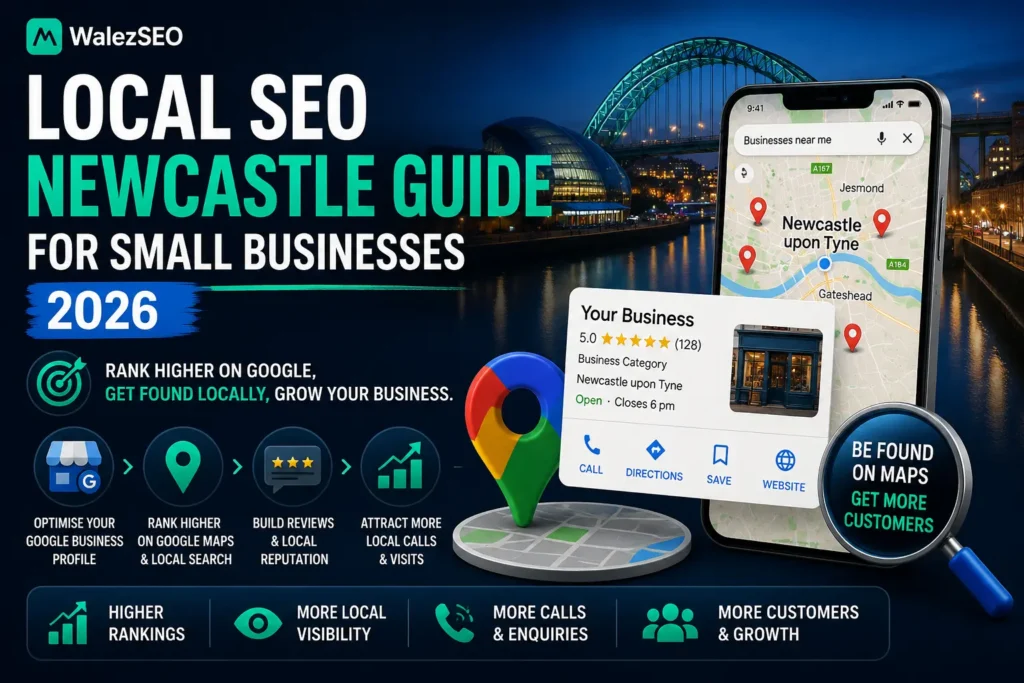
Everything you need to rank higher on Google, get found on Maps, and win more local customers without the jargon
You’ve probably heard the term “local SEO” thrown around plenty of times. Maybe a marketing agency pitched you. Maybe a fellow business owner mentioned it down the pub. Maybe you’ve Googled it yourself, only to end up more confused than when you started.
That’s frustrating and unfortunately common. Local SEO gets overcomplicated by people who have a vested interest in making it sound complicated.
So here’s a different approach. This guide is written for the Newcastle business owner who doesn’t have time for fluff. You run a real business. You need real results. What you’ll find here is a complete, practical breakdown of what local SEO actually involves in 2025, what’s working right now in the Newcastle market, and how to approach it in a way that’s sustainable and cost-effective.
By the end of this guide, you’ll understand exactly what needs to happen to get your business ranking higher on Google, appearing in the Local Pack, and attracting more of the local customers who are already out there searching for what you offer. Let’s get into it.
What Is Local SEO and Why Does It Specifically Matter in Newcastle?
Local SEO is the practice of optimising your online presence so your business appears prominently when people in your area search for your services on Google.
Unlike general SEO which is about ranking a website nationally or globally local SEO focuses specifically on geographic searches. The kind of searches that matter to you: “plumber Newcastle,” “best restaurant Quayside,” “accountant Gosforth,” “emergency locksmith near me.”
When someone in Newcastle searches for a service like yours, Google does three things:
- Checks its data to understand what businesses offer that service nearby
- Evaluates which businesses have the strongest signals of relevance, proximity, and trustworthiness
- Displays the top results in the Local Pack (the map with three listings) and the organic results below
Local SEO is the work you do to make sure Google picks your business for steps two and three.
Why Newcastle specifically? Because Newcastle is a competitive, geographically varied market with distinct neighbourhoods where customer behaviour differs. A general approach to local SEO doesn’t account for the difference between someone searching in Ponteland versus Byker, or Jesmond versus Gateshead. Getting specific about your location, your service areas, and your local community is what separates businesses that rank from businesses that don’t.
Part 1: Your Google Business Profile The Foundation of Everything
If you do nothing else after reading this guide, optimise your Google Business Profile. It is, without exaggeration, the single most important local SEO asset a Newcastle business has.
Setting Up Your Profile Correctly
First, claim your listing if you haven’t already. Go to business.google.com and search for your business. If it exists, claim it. If not, create it. You’ll need to verify your ownership usually via a postcode to your business address.
Once you’re in, go through every single field:
Business name. Use your real trading name exactly as it appears on your signage, website, and Companies House registration. Don’t stuff keywords in here Google will penalise you for it.
Primary category. This is the single most important category decision you’ll make. Choose the category that most precisely describes your core service. If you’re a plumber, select “Plumber” not “Contractor.” If you’re a coffee shop, choose “Coffee Shop” not “Restaurant.”
Secondary categories. You can add up to nine. Use them wisely to cover your additional services. A plumber might add “Heating Contractor,” “Boiler Service,” and “Emergency Plumber.” These secondary categories directly affect which additional searches you appear for.
Address. Your full, precise address including postcode. This must match exactly what’s on your website and every other directory.
Service area. If you serve customers at their location (trades, delivery, mobile services), add the areas you cover. Be specific list Newcastle, Gosforth, Jesmond, Gateshead, and any other areas you genuinely serve. Don’t add areas you don’t serve just to appear for more searches; it can actually hurt you.
Phone number. Use a local Newcastle number if possible. It adds a geographic trust signal.
Website. Link to your homepage, or a specific landing page for your Newcastle service if you serve multiple locations.
Hours. Keep these current and accurate. Include special hours for bank holidays. Nothing damages trust faster than a customer turning up when your Google listing says you’re open but you’re not.
Business description. You have 750 characters. Use them well. Naturally describe what you do, where you are, and what makes you different. Avoid keyword stuffing write for the person reading it, not the algorithm. Google shows the first 250 characters in the listing, so front-load your key information.
Making Your Profile Work Harder
Once the basics are in place, these are the elements that separate a good profile from a great one:
Photos. Upload at least 10 photos to start, and keep adding. Include your exterior (so customers can find you), your interior, your team, your work, and your products or menu. Real, authentic photos outperform stock images every time. Aim for at least one new photo per month.
Services. Add every service you offer with descriptions. This content is indexed by Google and contributes to your relevance for specific searches.
Products. If you sell products, list them. Each product listing is additional indexed content.
Google Posts. Use the posting feature like a social media feed for your business. Share offers, news, events, and updates. Posts show up in your profile and signal to Google that your business is active. Aim for at least two posts per month.
Questions & Answers. Proactively add your own FAQs. Answer common questions before customers have to ask. “Do you offer emergency callouts?” “Is there parking nearby?” “Do you serve the Gateshead area?” This content helps customers and reinforces your local relevance.
Part 2: Your Website Making It Speak Local SEO
Your Google Business Profile and your website work together. Google cross-references the two, so consistency and clear local signals across both is essential.
The Homepage
Your homepage should clearly state, within the first few paragraphs, that you are a [your service] in Newcastle. Don’t assume Google or your visitors will work it out from your address. Say it explicitly.
Your page title (the text that appears in the browser tab and in Google search results) should follow this format: [Service] Newcastle | [Your Business Name]. For example: “Plumbing Services Newcastle | Smith’s Plumbing.”
Your meta description the snippet of text that appears under your page title in Google results — should include your service, your location, and a compelling reason to click. Something like: “Reliable plumbing services across Newcastle and the North East. Emergency callouts available. Over 200 five-star reviews. Call today for a free quote.”
Location Pages
If you serve multiple areas across Newcastle and beyond, dedicated location pages are essential.
A well-built location page for, say, Gosforth should:
- Have a specific page title like “Plumbing Services Gosforth | Smith’s Plumbing”
- Mention Gosforth naturally throughout the content
- Reference local landmarks or context (near Gosforth High Street, serving the NE3 postcode area)
- Include a Google Map embed showing your service area
- Feature any local reviews or testimonials from Gosforth customers
- Have a clear call to action
These pages signal to Google that you genuinely serve those areas and they rank for searches specific to those neighbourhoods.
Service Pages
Each major service you offer should have its own page, not just a bullet point on a list. A dedicated page for “Boiler Installation Newcastle” will rank for that specific search in a way that a general “Services” page never will.
A strong service page for a Newcastle business includes:
- A clear H1 heading with the service and location
- An introduction that explains the service and why Newcastle customers need it
- Detailed information about how you deliver the service
- Local context (what’s specific about this service in Newcastle or your area)
- FAQs specific to that service
- Social proof — reviews or testimonials from Newcastle customers
- A clear, compelling call to action
Technical Basics That Matter
You don’t need to be a developer to understand these, but you need to make sure someone is paying attention to them:
Page speed. Slow websites lose customers and rank lower. Google’s Core Web Vitals measure loading performance, and slow scores directly impact your rankings. Test yours at PageSpeed Insights (free tool from Google).
Mobile optimisation. More than 60% of local searches happen on mobile. Your website must work flawlessly on a phone screen readable text, tappable buttons, no horizontal scrolling.
Schema markup (Local Business). This is a small piece of code that tells Google your business name, address, phone number, opening hours, and services in a format it can read directly. It’s not difficult to implement and it meaningfully helps your local search presence.
SSL certificate. Your website should begin with https:// not http://. If it doesn’t, that’s a security flag that affects both customer trust and Google rankings.
Part 3: Citations Building Your Business’s Footprint Across the Web
Citations are any online mention of your business’s name, address, and phone number (NAP). They exist on directories, review sites, local listings, and industry-specific platforms.
Why Citations Matter
Citations serve two purposes. First, they’re a ranking signal the more consistent, authoritative citations you have, the more confident Google is in your business’s legitimacy. Second, they’re a genuine source of direct traffic and enquiries from people browsing directories.
The Key UK Directories to Target
For Newcastle businesses, priority citation sources include:
National UK directories: Google Business Profile (already covered), Bing Places, Yell.com, Yelp UK, Thomson Local, FreeIndex, Hotfrog, Cylex UK
Trade-specific: Checkatrade, TrustATrader, Rated People, Bark.com, MyBuilder (trades); TripAdvisor, OpenTable (hospitality); Treatwell (beauty)
Social/reviews: Facebook Business Page, LinkedIn Company Page, Trustpilot
Local: Newcastle City Council business directories, North East Chamber of Commerce listings, local neighbourhood directories
The Golden Rule: NAP Consistency
Your business name, address, and phone number must be exactly the same on every citation. Exactly. Not “St.” on one and “Street” on another. Not “North East” on one and “NE” on another.
Inconsistencies confuse Google and dilute the trust signals your citations should be building. Before you add new citations, audit your existing ones and fix any discrepancies.
Part 4: Reviews Your Competitive Advantage in Newcastle
In a city like Newcastle, where word of mouth has always been powerful, reviews are simply the digital version of that same trust just visible to everyone, all the time.
How Reviews Affect Your Rankings
Google explicitly uses reviews as a Local Pack ranking signal. More reviews, higher average rating, and active management of your review profile all contribute positively.
But reviews also affect your click-through rate even if you rank in the top three, a business with 4 reviews and 3.8 stars will consistently lose clicks to a competitor with 60 reviews and 4.7 stars. So reviews matter both for ranking and for what happens after you rank.
Building a Review Generation System
The businesses with the most reviews aren’t the ones with the best luck they’re the ones with a system.
At the point of service completion: Train yourself and your team to ask. After a good piece of work, a satisfied meal, a successful appointment ask. “We’d really appreciate a Google review if you’re happy it makes a huge difference to a small business like ours.” Genuine, human, not salesy.
Via text follow-up: For service businesses, a follow-up text within 24 hours of job completion works extremely well. Include a direct link to your Google review page. Something like: “Hi [name], thank you for choosing Smith’s Plumbing today. If you’re happy with the work, a quick Google review would be fantastic: [link]. It really helps us keep growing.”
Via email for regular customers: For businesses with repeat customers, a quarterly email to your customer list acknowledging them and including a review link is low-effort and high-return.
Responding to Reviews The Part Most Businesses Skip
Every review deserves a response. Every single one.
For positive reviews: personalise your response. Mention something specific from their review. Thank them genuinely. You can naturally include your service and location: “So glad we could help with the boiler installation — thanks for choosing us for your Gosforth property.”
For negative reviews: stay calm. Don’t get defensive. Acknowledge the issue, apologise for the experience, and offer to resolve it offline. A well-handled negative review actually builds trust with readers it shows you’re human, accountable, and care about your customers.
Part 5: Local Content How to Build Topical Authority in Newcastle
Content is where many Newcastle businesses stop short, and where real differentiation is possible.
What Is Topical Authority?
Topical authority means being the go-to resource in your niche for your local area. When Google sees that your website consistently covers topics related to your service and location with depth, accuracy, and genuine usefulness it treats your site as an authority and rewards it with higher rankings.
Local Content Ideas That Actually Work
Neighbourhood guides. “Best coffee shops in Jesmond,” “The homeowner’s guide to choosing a plumber in Gosforth,” “What to look for when hiring an electrician in Gateshead.” These rank for searches, demonstrate local knowledge, and build trust with people who recognise the specific neighbourhood context.
Service area content. “Why businesses in Newcastle City Centre struggle with X and how to fix it.” Location-specific content that addresses real problems your customers face.
Q&A content. Answer the questions your customers actually ask you. “How much does a boiler replacement cost in Newcastle?” “Do I need planning permission for a loft conversion in Newcastle?” These rank directly for conversational and voice searches.
Local case studies. Real examples of work you’ve done for Newcastle customers. “How we helped a Quayside restaurant improve their extraction system.” Real stories build genuine trust in a way that generic testimonials can’t.
Seasonal content. “Getting your boiler ready for a Newcastle winter,” “Summer garden landscaping in the North East.” Timely content that’s relevant to your customers’ lives and search patterns.
Part 6: Tracking Your Progress What to Measure and How
You can’t improve what you don’t measure. These are the core metrics every Newcastle business doing local SEO should track:
Google Business Profile Insights: How many people searched for your business, how many saw it in Maps vs. Search, how many called, clicked to your website, or requested directions. Check this monthly.
Local Pack rankings: Track your ranking position for your most important search terms (e.g., “plumber Newcastle,” “boiler repair Gosforth”). Tools like BrightLocal offer affordable rank tracking specifically for local searches.
Website traffic from organic search: Google Analytics (free) shows you how much traffic comes from organic search, which pages people visit, and how long they stay.
Conversion tracking: Phone calls, contact form submissions, appointment bookings these are what actually matter. Set up tracking so you know which SEO efforts are generating real business.
Review velocity: How many new reviews are you getting per month? Is your average rating trending up or down?
How Long Does Local SEO Take to Work in Newcastle?
Honest answer: it depends but you should expect to see meaningful movement within 3 to 6 months of consistent, well-executed work.
Quick wins (improved Google Business Profile, citation consistency fixes, initial review generation) can show results in 4 to 8 weeks. Ranking improvements for competitive keywords in Newcastle’s busier markets (hospitality, trades, professional services) typically take 3 to 6 months.
The important thing is that local SEO is cumulative. Every piece of work you do every citation, every review, every piece of content, every link builds on what came before. The results compound over time. Businesses that commit to 12 months of consistent local SEO almost always see dramatic improvement in their visibility and lead volume.
Your Action Plan: Where to Start
Don’t try to do everything at once. Here’s a prioritised starting point:
Week 1–2: Foundations
- Claim and fully complete your Google Business Profile
- Audit your NAP consistency across all existing citations
- Ensure your website has local keywords, a clear service area, and is mobile-friendly
Month 1–2: Build the Base
- Fix any citation inconsistencies
- Build 20–30 quality citations across UK directories
- Start asking customers for Google reviews aim for at least 5 new reviews in the first month
- Add schema markup to your website
Month 2–4: Create Authority
- Create or improve your key service pages with location-specific content
- Start building location pages for your key service areas in Newcastle
- Begin producing local content one solid blog post or article per month
- Start pursuing local links (directories, local press, community involvement)
Ongoing: Maintain and Grow
- Monitor and respond to all reviews
- Update your Google Business Profile monthly with posts and new photos
- Continue adding content and building links
- Track your rankings and adjust your strategy based on what’s working
Final Thoughts
Local SEO in Newcastle is not a dark art. It’s not reserved for big businesses with big budgets. It’s a set of practical, achievable actions that done consistently and done well compound into genuine competitive advantage.
The Newcastle businesses that rank consistently at the top of local searches in 2025 got there through fundamentals executed with patience and quality: a complete and active Google Business Profile, a properly optimised local website, consistent citations, a healthy review profile, and content that genuinely serves their local audience.
None of that is out of reach. It just requires knowing the path and taking it step by step.
Whether you’re a trades business in Gosforth, a hospitality venue on the Quayside, a retailer in the Grainger Market, or a professional services firm in the city centre the opportunity to win significantly more local business through search is there. The question is who claims it first: you, or your competitors.
WalezSEO is a specialist local SEO agency with deep experience in the Newcastle market. We offer full local SEO services from strategy and Google Business Profile optimisation to citation building, review management, and local content creation. Get your free, no-obligation local SEO audit today we’ll show you exactly where you stand and what it would take to get you to the top.
Related Reading
Whether you’re targeting local customers in Newcastle, expanding across multiple UK cities, or growing internationally, the right SEO strategy depends on how and where your customers search. These related SEO services cover the core strategies businesses use to improve Google visibility, generate qualified enquiries, and build long-term organic growth.
Local SEO Services Newcastle
Our dedicated Newcastle local SEO service covering Google Business Profile optimisation, local landing pages, citation building, review generation, and the exact local ranking factors that help Newcastle businesses appear higher in Google Maps and local search results.
SEO Services Newcastle
A broader SEO strategy for Newcastle businesses that want to improve rankings beyond local maps including technical SEO, content strategy, on-page optimisation, keyword targeting, and sustainable organic traffic growth across competitive Newcastle search terms.
Local SEO Services UK
Our nationwide local SEO service for UK businesses targeting multiple cities and service areas including multi-location SEO campaigns, local entity optimisation, Google Business Profile management, and scalable local visibility strategies across the UK.
International SEO Services
For businesses expanding into international markets covering multilingual SEO, hreflang implementation, international site structure, country-specific keyword targeting, and the technical SEO foundations required for global organic visibility.