
You’ve built the store. You’ve uploaded the products. You’re running ads to keep the sales coming in. But turn the ads off and everything stops.
The problem isn’t your products. It’s that your product pages aren’t pulling organic traffic from Google. And in a UK ecommerce market that’s only getting more competitive, that’s an expensive gap to leave unfilled.
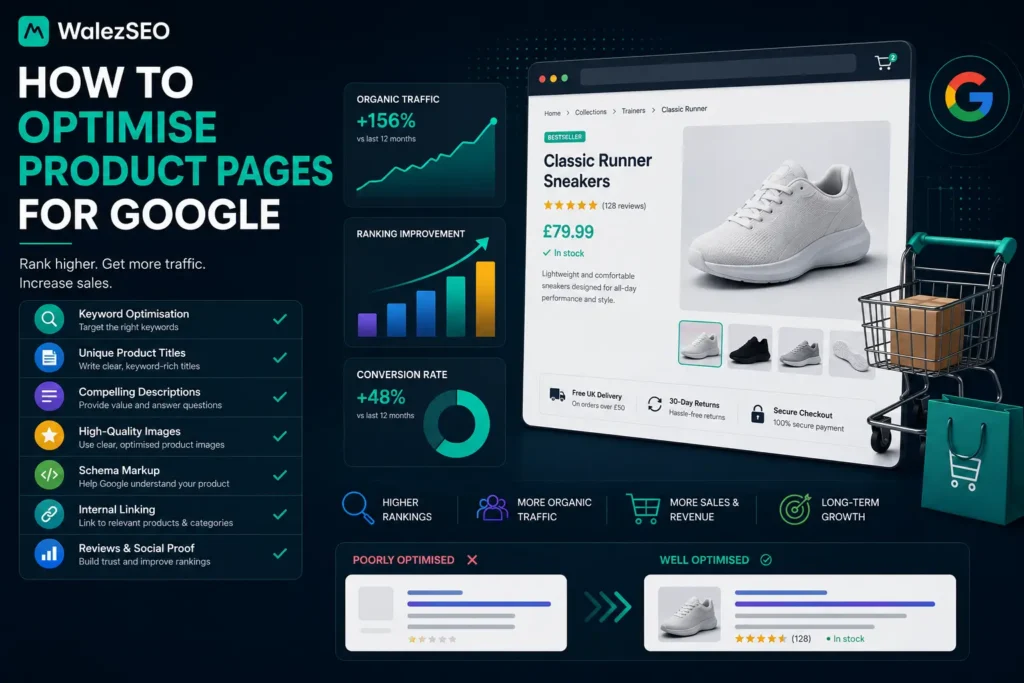
This guide covers everything you need to know about product page SEO, what works in 2026, what’s changed, and how to implement it properly so your pages rank, get clicked, and convert.
Why product page SEO matters more than ever in 2026
Google has become significantly harder on thin, templated, low-effort content over the past two years. Its Helpful Content system is specifically designed to identify pages that exist to rank rather than genuinely help buyers and ecommerce product pages are one of the most common offenders.
The good news is that most UK online stores are still doing product page SEO badly. Generic manufacturer descriptions. No schema markup. Title tags that are just the product name. Images with filenames like “IMG_4782.jpg.”
That’s your opportunity. A properly optimised product page in a competitive niche can outrank stores with far bigger budgets because bigger budgets don’t automatically mean better pages.
1. Keyword research for product pages target buyer intent, not just volume
The biggest mistake UK store owners make with product page keywords is chasing high-volume terms they have no realistic chance of ranking for. “Running shoes” gets 40,000 searches a month. It’s also dominated by Nike, Adidas, and Sports Direct with a combined century of domain authority behind them.
The smarter approach is long-tail keywords with transactional intent.
Someone searching “waterproof trail running shoes women UK size 7” is not browsing. They know what they want and they’re close to buying. That specificity is where product pages win.
How to find the right keywords:
- Type your product into Google and study the autocomplete suggestions these are real searches from real buyers
- Scroll to the bottom of the results page and check “Related searches”
- Look at the “People Also Ask” boxes these surface the questions buyers have before they purchase
- Use free tools like Google Keyword Planner or Ubersuggest to check monthly search volumes
- Target one primary keyword per product page don’t try to rank the same page for ten things
What good looks like: Instead of targeting “leather handbag,” target “tan leather crossbody bag UK” or “small leather handbag with zip compartment.” Lower volume, far lower competition, much higher purchase intent.
2. Title tags the single line that determines whether anyone clicks
Your title tag is what appears as the blue clickable headline in Google search results. It’s one of the most important on-page SEO elements on a product page and most stores get it wrong.
The formula that works:
[Primary Keyword] — [Key Benefit or Differentiator] | [Brand/Store Name]
For example:
- ❌ Product Page Title — “Leather Bag | My Store”
- ✅ Good Title — “Tan Leather Crossbody Bag Handmade in UK | Rosewood Goods”
Rules to follow:
- Keep title tags under 60 characters anything longer gets truncated in search results
- Put your primary keyword as close to the beginning as possible
- Include something that makes the result worth clicking handmade, free UK delivery, sale, award-winning
- Don’t keyword stuff “Leather Bag Leather Bags UK Buy Leather Bag” is a red flag to Google and looks terrible to buyers
3. Meta descriptions write for clicks, not rankings
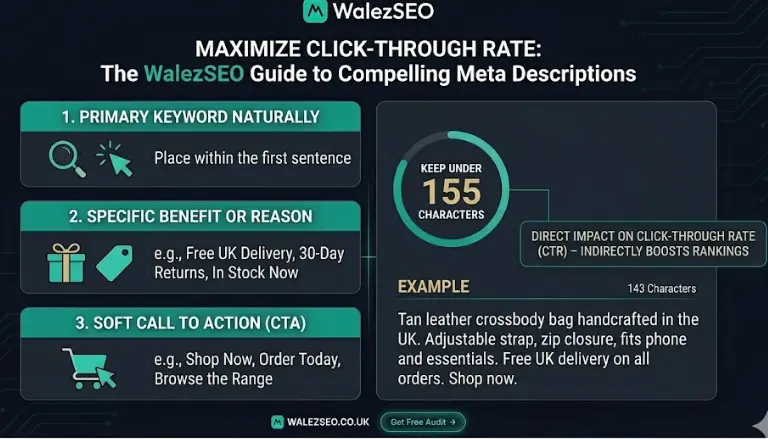
Meta descriptions don’t directly affect rankings. They do affect click-through rate which affects rankings indirectly. A well-written meta description is essentially free ad copy in Google’s search results.
What to include:
- Your primary keyword naturally within the first sentence
- A specific benefit or reason to buy free UK delivery, 30-day returns, in stock now
- A soft call to action “Shop now,” “Order today,” “Browse the full range”
- Keep it under 155 characters
Example:
Tan leather crossbody bag handcrafted in the UK. Adjustable strap, zip closure, fits phone and essentials. Free UK delivery on all orders. Shop now.
That’s 143 characters. It tells the buyer exactly what they’re getting and gives them a reason to click over the next result.
4. Product descriptions this is where most UK stores lose the ranking battle
Here’s the situation on most ecommerce sites: the product description is whatever the manufacturer provided, copy-pasted verbatim across every retailer selling the same product.
Google sees that. It compares your description to 47 other sites with identical text and decides none of them deserve to rank particularly well. You end up buried.
Unique, well-written product descriptions are one of the highest-ROI improvements you can make to an ecommerce store and one of the most consistently neglected.
What a good product description does:
- Opens by addressing the buyer’s problem or desire not with a list of specs
- Explains benefits, not just features. “Waterproof membrane keeps feet dry in wet conditions” is more useful than “waterproof”
- Uses the target keyword and natural semantic variations without forcing them
- Answers the questions a buyer would have before purchasing sizing, materials, care instructions, compatibility
- Includes a short FAQ section at the bottom covering common pre-purchase questions
Length: Aim for 300–600 words for standard products. Complex, high-ticket, or technical products benefit from longer descriptions. There is no magic word count to write what the buyer needs to make a confident decision.
5. Product schema markup the difference between a plain result and a rich one
Schema markup is structured data you add to your product pages that tells Google exactly what type of content it’s looking at. When implemented correctly, it unlocks rich results in search displaying your product’s price, star rating, availability, and review count directly in the search listing.
Rich results earn significantly more clicks than plain blue links. A product showing a 4.8-star rating and “In Stock — £49.99” in the search result will almost always outperform an identical product showing just a title and meta description.
Product schema should include:
- Product name
- Description
- Image
- Brand
- SKU
- Price and currency
- Availability (InStock / OutOfStock / PreOrder)
- Aggregate rating and review count
If you’re on Shopify, most themes include basic product schema automatically but it’s worth checking with Google’s Rich Results Test tool to confirm it’s working and complete. WooCommerce requires a plugin like Yoast or Rank Math to implement schema properly.
6. Product images an underrated source of organic traffic
Most UK store owners think of image optimisation as a speed issue. It’s also a traffic issue. Google Images drives a meaningful volume of ecommerce traffic particularly in fashion, homeware, and gifts and most stores aren’t optimised for it.
Image SEO checklist for product pages:
- Use descriptive filenames before uploading “tan-leather-crossbody-bag.jpg” not “IMG_4782.jpg”
- Write descriptive alt text for every image “tan leather crossbody bag with adjustable strap” this is what Google reads
- Compress images to WebP format for faster load times without quality loss
- Include multiple angles front, back, detail shots, lifestyle image of the product in use
- Ensure images are high resolution blurry or pixelated product photos tank conversion rates
7. URLs clean, simple, and keyword-rich
Your product page URL is a small but meaningful ranking signal and a significant trust signal for buyers deciding whether to click.
Good URL structure:
yourstorename.co.uk/bags/tan-leather-crossbody-bag/
Bad URL structure:
yourstorename.co.uk/product?id=4827&cat=3&ref=homepage
Rules:
- Use hyphens to separate words, not underscores
- Include your primary keyword in the URL
- Keep it short and readable
- Once a URL is set and indexed, avoid changing it redirects lose some link equity and can confuse Google temporarily
8. Internal linking connect your product pages to the rest of your store
Every product page you publish should be connected to the rest of your site through internal links and should link outward to related products and category pages. This passes authority around your domain and helps Google understand which pages are most important.
Internal linking from product pages:
- Link to the parent category page (“Back to Leather Bags”)
- Include a “You might also like” or “Related products” section with genuine topical relevance
- Link to any relevant blog posts if you’ve written a guide to caring for leather goods, link to it from your leather product pages
- Use descriptive anchor text not “click here”
Internal linking to product pages:
- Every blog post on your site about relevant topics should link to related products naturally within the content
- Your category pages should link to your top-performing and newly added products
- Your homepage should link to your most important category pages
9. Page speed on product pages buyers and Google both leave if you’re slow
Page speed is a confirmed ranking factor and a conversion killer. Research consistently shows that every additional second of load time reduces conversion rates on mobile especially, where most UK shoppers browse.
Product page speed checklist:
- Compress all images before uploading this is the single biggest win for most stores
- Defer loading of below-the-fold content (lazy loading)
- Remove unused apps, plugins, and scripts that add load time
- Use a Content Delivery Network (CDN) if your customer base is geographically spread
- Test your product pages in Google PageSpeed Insights and work through the recommendations
Target LCP (Largest Contentful Paint) under 2.5 seconds on mobile. Most UK ecommerce stores are nowhere near this which is exactly why fixing it gives you a competitive edge.
10. Reviews and social proof content that converts and ranks
Customer reviews do two jobs simultaneously. They build the trust that turns a browser into a buyer. And they add fresh, unique, keyword-rich content to your product pages that Google values.
What to do:
- Set up automated review request emails post-purchase most customers who had a good experience will leave a review if simply asked
- Display reviews visibly on product pages, not buried at the bottom
- Respond to negative reviews professionally Google and buyers both see how you handle problems
- Implement AggregateRating schema so your star ratings appear in search results
- Consider a third-party review platform like Trustpilot or Feefo independent reviews carry more credibility than on-site only
Pulling it all together
Product page SEO isn’t one thing, it’s ten things working together. A page with a great title tag but manufacturer copy and no schema will still struggle. A page with perfect schema but a slow load time and no reviews leaves clicks and conversions on the table.
The compounding effect kicks in when all of these elements are working simultaneously. That’s when product pages start ranking consistently, earning clicks over paid ads, and converting at rates that make organic traffic your most profitable channel.
Most UK online stores aren’t there yet. The ones that are didn’t get there by accident.
Need your product pages professionally optimized?
At WalezSEO, we work with UK ecommerce businesses to audit, rebuild, and optimize product pages that rank and convert. Whether you’re on Shopify, WooCommerce, or a custom platform and whether you have 50 products or 5,000 we build the kind of product page SEO that delivers sustainable organic growth.
Our ecommerce SEO services cover everything in this guide, implemented properly and tracked transparently.
If you’re running an online store in Derby or the East Midlands, our ecommerce SEO services in Derby are built for businesses exactly like yours.
Not sure where your product pages stand right now? Get a free SEO audit. We’ll review your store and tell you exactly what’s costing you rankings and sales.
- Strengthen online growth using ecommerce SEO services in Scotland
- Improve ecommerce performance with ecommerce SEO services in the East Midlands
- Discover scalable solutions with our AI SEO optimisation services
- Request a detailed free ecommerce SEO audit
- Explore our full-service UK SEO agency solutions
Frequently asked questions
What is product page SEO?
Product page SEO is the process of optimising individual product pages on an ecommerce store so they rank higher in Google search results, attract more organic traffic, and convert that traffic into sales. It covers keyword research, title tags, descriptions, schema markup, images, page speed, and internal linking.
How do I write product descriptions for SEO?
Write unique descriptions for every product and never use manufacturer copy. Open with the buyer’s problem or desire, explain benefits rather than just listing features, include your target keyword naturally, and add a short FAQ section covering common pre-purchase questions. Aim for 300–600 words minimum.
Does schema markup really make a difference for product pages?
Yes significantly. Product schema unlocks rich results in Google that display your price, availability, and star rating directly in the search listing. Rich results consistently earn higher click-through rates than plain text results, which means more traffic without improving your ranking position.
How many keywords should I target on one product page?
One primary keyword, with natural semantic variations throughout the page. Trying to rank a single product page for multiple unrelated keywords dilutes your focus and confuses Google about what the page is actually about.
How long does it take for product page SEO to work?
For new or low-authority stores, expect three to six months before meaningful ranking improvements appear. Established stores with decent domain authority often see movement faster. The timeline depends heavily on how competitive your product category is.
Can I do product page SEO myself?
Yes, for most of it keyword research, writing descriptions, adding alt text, and improving meta titles are all manageable without specialist knowledge. Schema markup and technical fixes benefit from professional help, especially at scale. If you have hundreds of product pages, the economics of hiring specialists usually stack up quickly.