
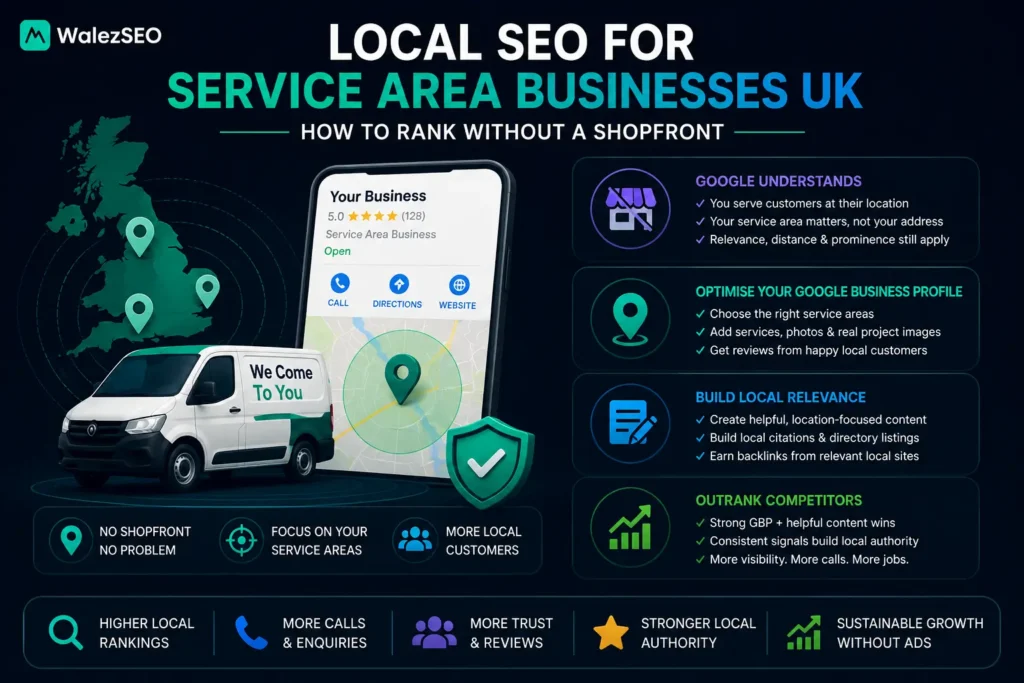
Something I want to be upfront about before this guide starts.
WalezSEO the agency writing this is itself a service area business. No high-street office, no reception desk, no postcode pinned to Google Maps. We serve clients across the UK and every strategy in this guide we apply to ourselves first.
Most local SEO guides are written by agencies with physical offices, for businesses with physical premises. The advice partly works for service businesses and partly misleads them. This one is written specifically for you: the plumber working from home, the mobile consultant, the cleaning company, the remote SEO agency that goes to its clients rather than the other way round.
What Google Actually Thinks of Your Business
You can rank in local search without publishing your street address as long as Google and real customers can clearly tell where you work and what you do.
That’s the good news. Here’s the honest part: a GBP service area listing will likely have lower visibility in local SEO results compared to competitors displaying a physical address, because a hidden address lacks a specific anchor point for determining proximity to the searcher.
You can’t fully overcome the proximity gap. What you can do is compensate for it through every other signal Google weighs and in some cases, compete past businesses with addresses through sheer content and authority. That’s exactly what this guide covers.
Step 1 Get Your GBP Setup Right From the Start
Your address must be a physical location where Google can verify your presence. Service area businesses without a storefront should hide their address and define a service area instead.
Enter your real home or business address during setup, then tick “I deliver goods and services to my customers” and hide the address from public view. Google uses your real address for verification and proximity calculations; it’s just not shown to anyone searching for you.
Do not use a virtual office address. Using a virtual office address on your GBP is against Google’s guidelines and puts your listing at risk of suspension. The temptation is understandable; a Manchester city centre address sounds credible. The risk isn’t worth it. Google cross-references addresses and receives reports from competitors. A suspended GBP is far more damaging than a hidden one.
Service areas are specific, not ambitious. You can influence distance-based rankings by creating dedicated service area pages, building citations in specific localities, and ensuring your address data is accurate and consistent everywhere it appears online. Claiming Birmingham, London, and Edinburgh simultaneously from a Derby base won’t make you rank in all three; it dilutes your relevance signal in each. Start with the cities nearest your actual location. Build authority there first. Expand as rankings and credibility grow.
Categories use all of them. Because proximity is already a weakness, every other GBP signal matters more for SABs. Select your primary category as specifically as possible. Then add every legitimate secondary category that applies to your services. More categories mean more search queries your profile is eligible to appear for without changing your address situation at all.
Step 2 Reviews Are Your Proximity Replacement
Here’s the practical reality of service area business SEO: in 2026, Google’s AI reads the actual text of your reviews to understand your business’s expertise. That means review quality matters as much as quantity and both matter more for SABs than for physical businesses.
When you have a weaker proximity signal, review volume, recency, and specificity carry extra weight in Google’s local ranking calculation. An SAB with 60 detailed, location-specific reviews will consistently outperform an SAB with 8 generic ones even if the 8-review business is physically closer to the searcher.
Don’t just ask for a review. Encourage customers to mention specific services and locations. If a customer says “best SEO in Leeds,” it sends a meaningful ranking signal to Google.
The simplest review system that actually works: send a WhatsApp message not email within 24 hours of completing a job. Keep it short and personal. Include a one-click direct link to your Google review page. That’s it. No complicated sequences, no incentives (against Google’s policy), no follow-up reminders that feel pushy.
When responding to reviews, mention details of the work without violating privacy. Saying “It was great helping you with your SEO audit in Birmingham” proves real-world experience in that location. This is a small but meaningful signal that your business genuinely operates in the areas you claim to serve.
Step 3 Location Landing Pages Are Your Biggest Weapon
This is where service area businesses can genuinely compete with and beat physical address businesses. Google does not require a physical address in a city to rank there; it requires demonstrated relevance to that location through signals across the page and the business’s broader online presence.
A location landing page is a dedicated page on your website targeting a specific city or area you serve. Not a “we also serve Manchester” mentioned in your footer. A proper page at least 600 to 800 words with content specific enough that it could only have been written by someone who genuinely serves businesses in that area.
The mistake almost every SAB makes: creating location pages by swapping the town name into a template. “WalezSEO provides expert SEO services in Manchester” and “WalezSEO provides expert SEO services in Birmingham” look identical except for the city name. A better approach is fewer pages with more depth. Only build a location page when you can make it real.
What makes a location page real:
- Specific local context: What’s the business landscape like in that city for your service? What kinds of local businesses tend to need what you offer? Reference real local characteristics, not generic claims.
- Local proof: Have you worked with clients in that area? Anonymised case details, local testimonials, or genuine references to working in that location build the authenticity Google rewards.
- Location-specific FAQs What do businesses in that specific area commonly ask? Answering local questions with local answers builds topical relevance that generic content can’t match.
- LocalBusiness schema and embedded map Location pages paired with local citations produce ranking results that neither tactic achieves alone. Schema markup tells Google precisely what this page is about. An embedded map connects your website content to your GBP listing.
- How many should you build? Only build a location page when you can make it genuinely useful. Ten credible pages beat forty thin ones. Start with your five closest target cities. Build those properly. Add more as your authority grows and as you can genuinely support the content quality.
Step 4 Citations That Match Your SAB Setup
Citations work differently for service area businesses. Because you’re hiding your address, your NAP data will look inconsistent if you’re not careful. Some directories show your address, others don’t.
Many directories allow you to list a service area instead of a physical address, mirroring your GBP setup. Use that option where available rather than listing a home address you don’t want public.
Your core NAP data business name, phone number, website URL must be absolutely identical across every platform. The address situation can vary depending on what the directory allows. But the three core elements need to match everywhere without exception. Even “Ltd” versus no “Ltd” creates a consistency gap that quietly suppresses local rankings.
For UK SABs specifically: prioritise Yell, Trustpilot, Bark.com, Checkatrade, and FreeIndex in your first citation build. These are either high-authority UK directories or platforms specifically built for service businesses both relevant for your model. Clutch and DesignRush matter specifically for professional services and agencies.
Build citations in the cities you target, not just your home area. A Derby-based SEO agency serving Birmingham should have Birmingham-relevant listings, not just Derby ones. Chamber of commerce listings and local business directories in your target cities build the geographic authority signals that partly compensate for the proximity gap.
The Honest Picture What to Realistically Expect
For searches near your actual location: ranking in the map pack is absolutely achievable with a well-maintained GBP, strong reviews, and properly built location pages. Many UK SABs rank consistently in their local area without ever displaying an address.
For distant cities: organic search through location landing pages is often more realistic than map pack dominance. While you cannot change your physical address, you can influence distance-based rankings by creating dedicated service area pages, building citations in specific localities, and ensuring your address data is accurate and consistent everywhere it appears online.
The businesses that do SAB local SEO well treat map pack rankings as local wins and organic rankings as their wider reach strategy. Both channels generate leads — they just work differently depending on distance from your base.
For WalezSEO specifically: our content, our location pages, and our citation presence across UK cities does the work that a fixed address would do for a traditional agency. It takes more effort. It also means we’re not limited to one postcode.
The SAB Local SEO Checklist
GBP
- Real address entered, hidden from public view
- Service areas defined specific cities, not entire regions
- Primary category as specific as possible
- Secondary categories covering all legitimate services
- Profile 100% complete description, services, attributes, photos
Reviews
- Post-job WhatsApp review request system active
- Customers encouraged to mention specific services and locations
- Every review responded to including mentions of the location worked in
Location pages
- One genuine, in-depth page per priority city (not templates)
- LocalBusiness schema implemented
- Google Map embedded
- Location-specific FAQs included
Citations
- NAP consistent across all platforms name, phone, website identical
- Yell, Trustpilot, Bark, Checkatrade, FreeIndex completed
- City-specific directories built for each target location
Related Reading
Businesses looking to improve Google Maps visibility and generate more local leads may also explore:
- Local SEO Services Liverpool
- Local SEO Services London UK
- SEO Services Yorkshire
- SEO Services Leicester UK
Frequently Asked Questions
Can a service area business rank in Google Maps without an address?
Yes with more effort than businesses displaying a physical address. Map pack rankings are achievable, particularly for areas near your actual location, but require stronger reviews, more active GBP management, and better website authority to compensate for weaker proximity signals.
Should I use a virtual office to improve my local rankings?
No. Using a virtual office address on your GBP violates Google’s guidelines and risks listing suspension. Enter your real address and hide it Google needs it for verification, not publication.
How many location pages do I need?
Build only as many as you can genuinely make useful. Start with five priority cities, the ones nearest your base where you have the best chance of ranking. Build those properly with real local content. Add more as your authority grows.
What’s the fastest win for a UK service area business?
Reviews specifically, getting more of them and making sure they mention the specific services and locations you served. Review velocity and specificity carry disproportionate weight for SABs because they compensate for weaker proximity signals in Google’s local ranking calculation.