
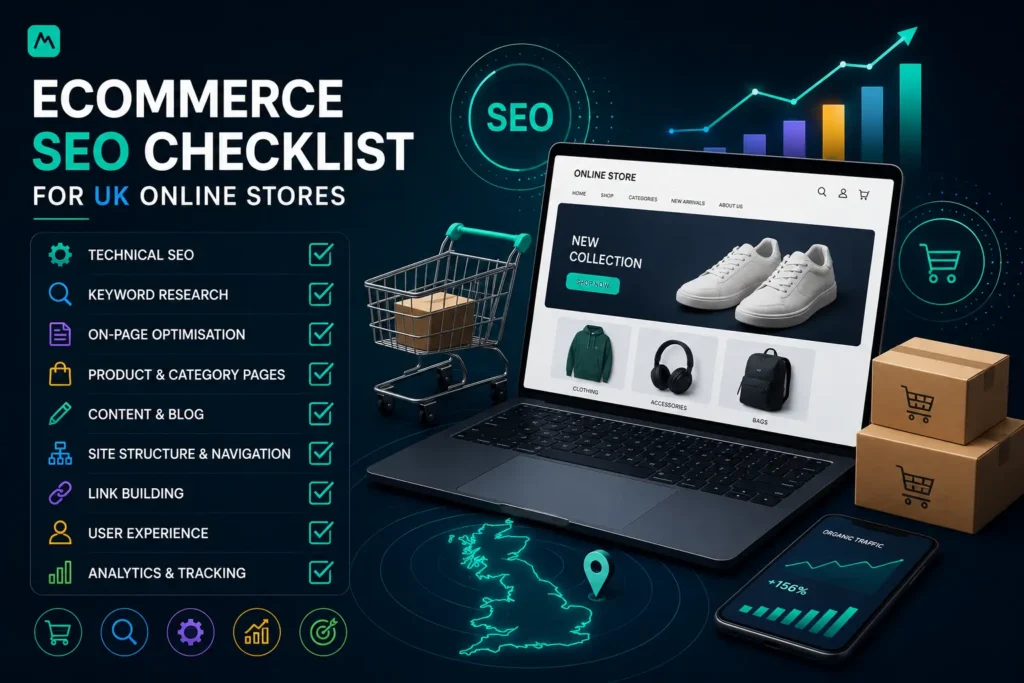
If you run an online store in the UK and your sales aren’t where they should be, there’s a good chance the problem isn’t your products, it’s your visibility.
Most ecommerce businesses invest in a website, upload their products, and wait. The traffic doesn’t come. The reason is almost always the same: no proper SEO foundation. Paid ads can paper over the cracks short-term, but the moment the budget stops, so does everything else.
This checklist covers everything your UK online store needs to rank on Google, attract consistent organic traffic, and turn that traffic into actual sales not just visitors. Work through it section by section. Every item you tick off compounds with the rest.
1. Technical SEO Get the foundations right first
Technical SEO is the one area most online store owners ignore completely and it’s the one that determines whether anything else you do actually works. If Google can’t crawl your site properly, your product pages won’t rank no matter how good the content is.
Crawlability and indexing
- Submit your XML sitemap to Google Search Console
- Check your robots.txt file make sure you haven’t accidentally blocked product or category pages
- Run a site crawl (Screaming Frog has a free version) and fix any broken links or redirect chains
- Make sure internal search result pages (/search?q=) are blocked from indexing they create crawl waste
- Block cart, checkout, and account pages from being indexed
Site speed and Core Web Vitals
- Aim for LCP (Largest Contentful Paint) under 2.5 seconds this is the single biggest speed metric Google measures
- Compress all product images without losing quality (use WebP format where possible)
- Eliminate unnecessary scripts and plugins that slow load time
- Test your store on mobile — most UK shoppers browse and buy on their phones, and Google indexes mobile-first
HTTPS and security
- Confirm every page across your store runs on HTTPS — Google has confirmed it as a ranking factor, and customers won’t trust an unsecured checkout
Duplicate content
- Use canonical tags on product pages with multiple variants (size, colour) to tell Google which version is the “master” page
- Handle faceted navigation carefully filter URLs like /shoes?colour=black&size=7 can generate thousands of duplicate pages that bloat your index and kill rankings
2. Site architecture Structure your store so Google (and shoppers) can navigate it
The way your store is built matters more than most people realise. A flat, logical structure helps Google understand what your store is about and which pages matter most.
- Every product should be reachable within three clicks from your homepage
- Your URL structure should be clean and descriptive: /category/product-name/ not /p?id=4782
- Category pages should sit above product pages in your hierarchy they’re your highest-value ranking pages
- Make sure no page is “orphaned” (sitting with no internal links pointing to it)
- Build breadcrumb navigation into your site and implement BreadcrumbList schema this also helps you win enhanced results in Google
3. Keyword research Target what buyers actually search for
Generic keyword tools will point you toward high-volume terms your store has no chance of ranking for. Ecommerce keyword research works differently.
Focus on three types of search intent:
- Transactional “buy men’s running shoes UK,” “WooCommerce hosting UK cheapest” people ready to purchase
- Commercial investigation “best noise cancelling headphones under £200 UK” people comparing options before buying
- Informational “how to choose a standing desk” people earlier in the journey, but prime candidates for your blog content
How to find the right keywords:
- Use Google’s autocomplete and “People Also Ask” boxes for free keyword ideas
- Look at what category pages your competitors rank for using Ahrefs or Semrush
- Target long-tail keywords on product pages they have lower competition and higher purchase intent
- Don’t target the same keyword on multiple pages pick one page per keyword and build that page to win it
4. Category page SEO Your most important ranking pages
Most ecommerce stores obsess over product pages. The smarter move is to focus on category pages first. These rank for broader, higher-volume keywords and send the most organic traffic.
- Write at least 150–300 words of unique, helpful introductory content at the top of each category page explain what the category covers and who it’s for
- Include your primary category keyword naturally in the H1, first paragraph, and meta title
- Add internal links from category pages down to individual product pages
- Implement schema markup for product listings on category pages so Google can display rich results
5. Product page optimisation | Where traffic converts into revenue
- Write unique product descriptions for every SKU never use manufacturer copy. Google suppresses duplicate content and so do buyers who’ve read the same description on three other sites
- Include your target keyword in the page title, H1, and first paragraph naturally
- Format your meta title as: [Product Name] | [Key Benefit] | [Brand/Store Name]
- Add product schema markup covering price, availability, SKU, and review rating this unlocks rich snippets in search results
- Include high-quality images with descriptive alt text Google Images drives meaningful traffic to ecommerce stores
- Add a FAQ section to each product page covering common questions this captures People Also Ask placements and reduces pre-purchase friction
6. Content and blogging | Build topical authority and capture top-of-funnel traffic
A product-only ecommerce store has limited ranking potential. Brands that blog intelligently build topical authority which lifts the entire domain, including product and category pages.
- Target informational keywords your buyers search before they’re ready to purchase
- Link every blog post to relevant category or product pages with contextual anchor text
- Focus on evergreen topics guides and how-tos that stay relevant year after year
- Aim for 1,500 words minimum on competitive topics; shorter posts rarely rank against established competitors
- Update older posts regularly Google rewards freshness on evergreen content
7. Internal linking | The most underused ranking tool in ecommerce
Internal links pass authority around your site and tell Google which pages matter. Most stores do this badly.
- Link from blog posts to relevant product and category pages every time it’s natural to do so
- Link between related product pages (“You might also like…”)
- Link from your homepage to your most important category pages
- Use descriptive anchor text “men’s waterproof walking boots” beats “click here” every time
- Audit for orphaned pages quarterly and add internal links to anything sitting without them
8. Link building | Earn the authority your competitors already have
Backlinks remain one of Google’s strongest ranking signals. Ecommerce stores that outrank well-funded competitors almost always have better link profiles.
- Write genuinely useful guides and resources that other sites in your industry will link to naturally
- Use digital PR original research, data, or a newsworthy story to earn coverage in UK publications
- Get listed in relevant UK directories and trade associations
- Reach out to bloggers and review sites in your niche for product coverage
- Never buy links a toxic backlink profile is expensive to clean up and can trigger a Google penalty
9. User experience and CRO | Turn your rankings into revenue
SEO gets people to your store. UX determines whether they buy.
- Ensure your checkout process is three steps or fewer research consistently shows cart abandonment spikes with every additional step
- Display trust signals clearly SSL badge, accepted payment methods, returns policy, reviews
- Make your search functionality fast and accurate shoppers who use on-site search convert at significantly higher rates
- Test your store on multiple devices a broken mobile experience kills both conversions and rankings
- Add customer reviews to product pages they build trust and naturally add keyword-rich content Google values
10. Tracking and reporting | Know what’s working
You can’t improve what you don’t measure.
- Set up Google Search Console and check it weekly it surfaces indexing issues, ranking keywords, and manual penalties
- Connect Google Analytics 4 and configure ecommerce tracking so you can see exactly which organic landing pages drive revenue
- Track keyword rankings for your priority product and category pages monthly
- Run a technical SEO audit every three to six months site health deteriorates as products are added, removed, and updated
The honest truth about ecommerce SEO
This checklist works. But it takes time, consistency, and someone who knows what they’re doing to implement it properly. Most UK online store owners either don’t have the time or don’t have the technical knowledge to execute all of this alongside running their business.
That’s exactly where we come in.
At WalezSEO, we work with UK ecommerce businesses to build the kind of organic presence that delivers consistent traffic and sales without relying on paid ads to keep the lights on. If you’re based in Derby or the East Midlands, our ecommerce SEO services in Derby are built specifically for online stores like yours.
Not sure where your store stands right now? Get a free SEO audit and we’ll show you exactly what’s holding your rankings back, no jargon, no obligation.
A well-optimised ecommerce website can help you increase product visibility, attract qualified traffic, and generate more online sales. From technical SEO improvements to category page optimisation, a strong ecommerce SEO strategy gives online stores a major competitive advantage in UK search results.Explore our related ecommerce and SEO services:
- Grow your store with ecommerce SEO services in London
- Improve rankings through ecommerce SEO services in Nottingham
- Expand visibility using ecommerce SEO services in Oxford
- Increase organic traffic with ecommerce SEO services in Derby
Frequently asked questions
How long does ecommerce SEO take to show results in the UK?
Most UK online stores start seeing meaningful ranking improvements between months three and six. Competitive product categories can take nine to twelve months. The key is consistency in SEO compounds, and every month of solid work builds on the last.
Do I need a blog for my ecommerce store?
Yes, if you want to maximize organic traffic. Blog content builds topical authority that lifts your entire domain, and it’s the primary way to capture buyers earlier in their journey before they’re ready to search for a specific product.
What’s the most important thing to fix first on an ecommerce site?
Technical SEO foundation specifically crawlability and indexing. If Google can’t access your pages correctly, nothing else you do will have its full effect. Run a crawl audit first, fix what’s broken, then move to content and links.
How much does ecommerce SEO cost in the UK?
It depends on the size of your store and how competitive your product categories are. Most UK ecommerce businesses pay between £750 and £5,000 per month for professional SEO. For a realistic quote based on your store, contact us or request a free audit.
Can I do ecommerce SEO myself?
Some of it, yes. Technical fixes, content writing, and keyword research are all learnable. The harder parts link building, structured data implementation, and fixing complex crawl issues benefit significantly from specialist experience.