
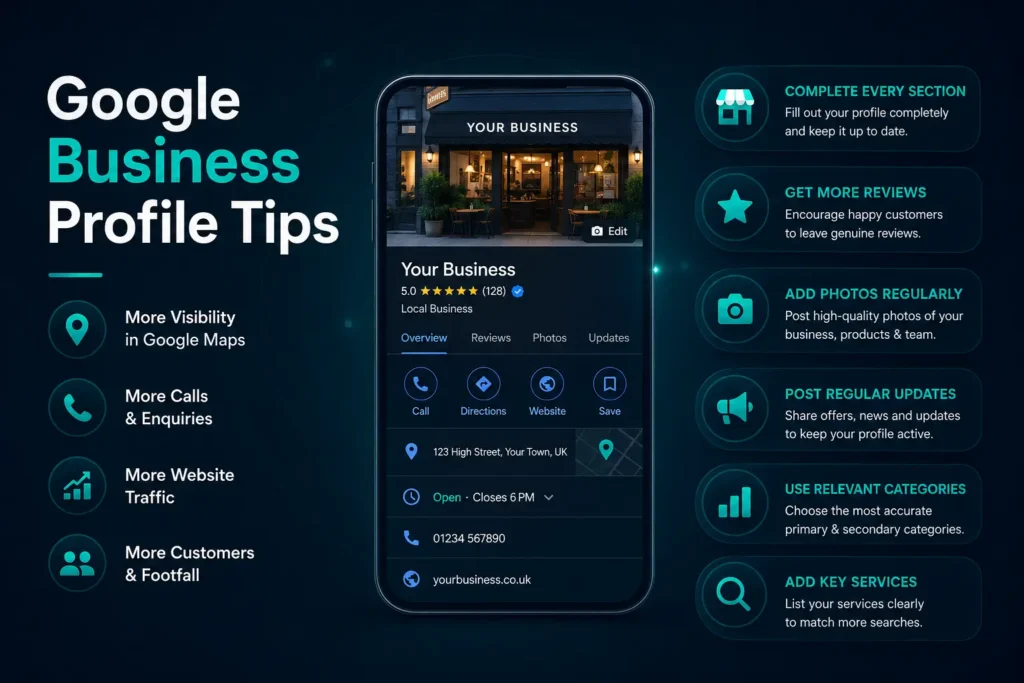
If you run a business that depends on local customers, your Google Business Profile is probably the first thing they see before deciding whether to contact you. It shows up in Maps, in local search results, and often before your actual website. First impressions happen there.
A complete, well-maintained profile helps you show up more often, for more relevant searches and it gives people the information they need to actually get in touch. Your hours, phone number, photos, reviews, services. All of it visible before someone’s clicked a single link.
What Is Google Business Profile?
It’s a free listing that controls how your business appears on Google Search and Maps. Think of it as your online shopfront, usually the first place a nearby customer looks before calling or visiting.
When it’s accurate and kept up to date, it builds trust, improves your visibility in local results, and puts you in front of people at the exact moment they’re searching for what you offer.
It’s free to use, and most competitors haven’t bothered optimising theirs properly. That gap is worth taking advantage of.
Why It Makes Such a Difference
Most local searches happen on a phone, often by someone who needs something fairly soon. They search, they see three businesses, and they pick one usually within minutes. If your profile is incomplete, outdated, or simply less impressive than the business next to you, that customer goes elsewhere.
An optimised Google Business Profile puts you in contention for those top three spots. And that matters because the businesses listed there capture the vast majority of calls, clicks and direction requests. Everything below gets a fraction of the attention.
It’s one of the highest-return things a local business can do and it doesn’t require an ad budget.
Google Business Profile Checklist
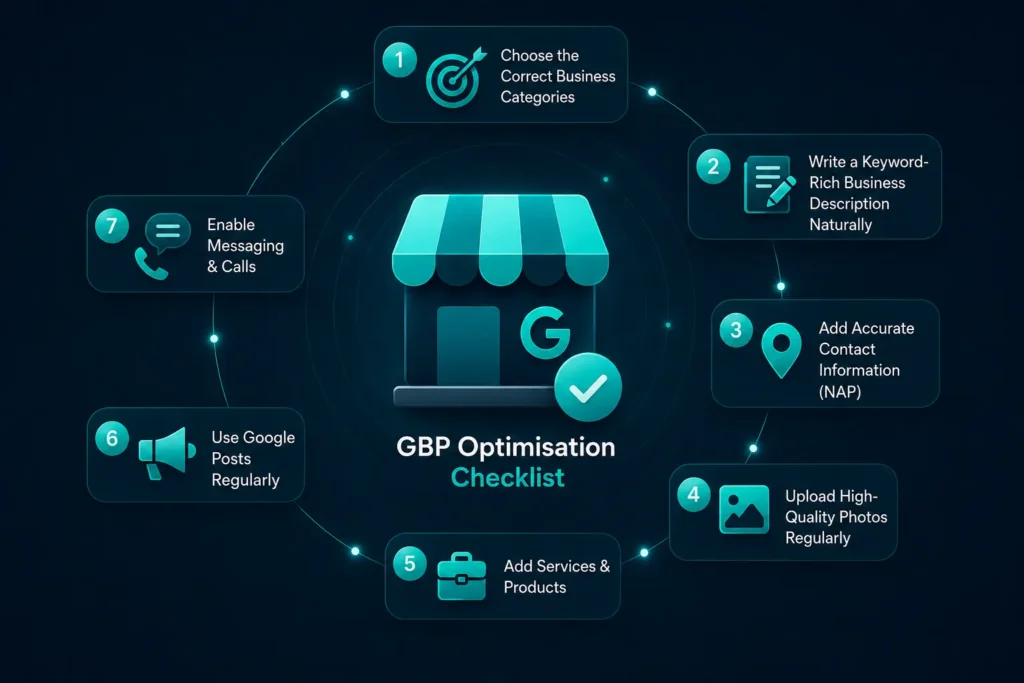
A quick reference to keep things on track — work through these and you’ll have covered the essentials.
- Pick the right primary category — it matters more than most people realise
- Write a business description that sounds human and tells customers what to expect
- Make sure your name, address and phone number match everywhere online
- Upload decent photos regularly, not just once when you first set up
- List your services and products properly, with real descriptions
- Post updates occasionally to show your profile is active
- Turn on messaging, booking links and click-to-call where relevant
- Ask happy customers for reviews, and respond to every one
- Build location-specific landing pages on your website
- Add LocalBusiness schema so Google can read your details accurately
- Check your site loads quickly and works properly on mobile
- Get listed consistently in key UK directories — Yell, Thomson Local, your local chamber
- Earn local links through community involvement, partnerships and local press
- Run a basic local SEO audit periodically to catch anything that’s slipped
None of this needs doing all at once. Tick off what you can, come back to the rest, and keep things updated as your business changes.
Google Business Profile Optimisation: What Actually Moves the Needle
Choose the Right Categories
Your primary category is one of the most influential settings on your entire profile. To be specific “Emergency Plumber” will outperform “Tradesperson” or anything vague. Look at what categories well-ranking local competitors are using, and revisit yours if your visibility plateaus.
Write a Description That Sounds Human
A good business description explains what you do, where you do it, and why someone should choose you in plain English. Mention locations naturally (“same-day boiler repair across Manchester”) but don’t force keywords in where they don’t belong. If it reads awkwardly, a real customer will notice, and so will Google.
Keep Your Contact Details Accurate
Name, address, phone number and website should be identical across your GBP, your website, and every directory you’re listed on. If you don’t have a fixed premises, add your service areas instead. Inconsistencies, even small ones erode trust with both Google and customers.
Upload Photos Regularly
Exterior shots help customers recognise you. Interior photos, team images, and examples of your work build confidence before anyone’s picked up the phone. Profiles with fresh, real images consistently get more engagement than those left empty or filled with stock photos.
List Your Services Properly
Add every service you offer, with clear descriptions. This helps Google match your profile to specific searches — someone looking for “drain unblocking” rather than just “plumber” is more likely to find you if that service is explicitly listed.
Post Updates Occasionally
Google Posts don’t need to be frequent, but an occasional offer, event or update signals that your profile is active. It also gives Google a little more relevant text to work with.
Make It Easy to Get in Touch
Enable messaging, click-to-call, and booking links where relevant. The easier you make it for someone to contact you, the more likely they will and those engagement signals quietly support your rankings too.
Your Website and GBP Work Better Together
Your Google Business Profile gets people’s attention. Your website is what convinces them to actually get in touch. The two reinforce each other — a strong, locally optimised website supports your Maps rankings, and a well-maintained profile drives traffic to your site.
Local Landing Pages Done Properly
If you serve multiple areas, each location deserves its own page — written specifically for that area, not copied and tweaked. A plumber covering Manchester, Salford and Stockport will do far better with three distinct pages than one generic page mentioning all three towns. Include local testimonials, your contact details, and a clear prompt to get in touch.
On-Page SEO That Feels Natural
Your page titles, headings and meta descriptions should reflect what local customers actually search for. “Boiler repairs in Sheffield” as a heading reads naturally and tells Google exactly what the page is about. Add descriptive alt text to images, link your pages together sensibly, and make sure your contact page is easy to find from everywhere on the site.
Add Local Business Schema
Schema markup is essentially a set of labels that helps Google read your business information accurately — your address, phone number, opening hours, coordinates. It’s not visible to visitors but makes a real difference to how reliably your details appear in search results. Worth adding properly once and leaving in place.
Mobile Experience Matters More Than Most Realise
Most people finding you through Maps are on their phone. Large, tappable phone number buttons, a clear directions link, and pages that load quickly without clutter — these details reduce friction at exactly the moment someone is deciding whether to contact you. A poor mobile experience at that stage loses customers you’ve already done the hard work of attracting.
Technical SEO: The Basics That Quietly Matter
Most people don’t think about technical SEO until something goes wrong — pages not showing up, a site that loads painfully slowly, or a layout that falls apart on mobile. Getting these fundamentals right won’t transform your rankings overnight, but ignoring them will hold everything else back.
Site Speed
A slow site loses people before they’ve read a single word. Compress your images, reduce unnecessary scripts, and make sure your hosting is reliable. If your site takes more than a few seconds to load on a phone, a meaningful chunk of visitors will simply leave.
Core Web Vitals
Google measures how your pages actually feel to use how quickly the main content loads, whether the layout jumps around while loading, and how responsive the page is when someone taps or clicks. These aren’t abstract metrics; they reflect real user experience. Poor scores won’t tank your rankings on their own, but they’re worth addressing, especially if competitors’ sites feel noticeably smoother.
Mobile Friendliness
If your site isn’t easy to use on a phone, you’re losing local customers at the final hurdle. Most people finding you through Maps or local search are on mobile. Navigation should be simple, text readable without zooming, and key information phone number, address, opening hours easy to find within a few seconds.
HTTPS
If your site still runs on HTTP, sort it. An SSL certificate is inexpensive, most hosts include it as standard, and it’s a basic trust signal for both Google and visitors. A “Not Secure” warning in the browser is enough to make some people leave immediately and that’s entirely avoidable.
Local Citations & Directory Listings
A citation is any mention of your business name, address and phone number on another website — a directory, a trade listing, a local business page. When these match up consistently, Google becomes more confident your business is legitimate and located where you say it is.
The trouble is they drift. An old address from when you moved premises, a slightly different phone format, an abbreviated street name on one site and the full version on another none of it seems serious, but collectively it creates doubt. Google doesn’t like doubt.
Do a proper audit every so often. Fix the mismatches, remove any duplicate listings, and make sure your details are formatted identically everywhere same abbreviations, same punctuation, same everything.
For UK businesses, focus on the directories that actually carry weight: Yell, Thomson Local, your local council’s business directory, and any reputable industry-specific listings relevant to your trade. Getting listed everywhere possible is less important than being listed accurately in the right places.
Building Local Links That Count
A backlink from a trusted local source carries real weight. A mention in a regional newspaper, a link from your local council’s business pages, or a feature on a well-known community site tells Google your business has a genuine presence — not just an optimised profile.
You don’t need many. A handful of relevant, locally recognised sources will do more for your rankings than dozens of low-quality directory links.
A few approaches that work well for UK businesses:
Pitch a story or comment to your local paper. Community journalists are often looking for local business angles, a new service, a charitable initiative, an interesting backstory. It costs nothing but a conversation.
Talk to your suppliers and business partners. If you have an existing relationship, asking for a mention or link on their website is entirely reasonable. Many will say yes without hesitation.
Sponsor something local. A grassroots sports team, a community event, a school fundraiser. The link back to your site is often a natural part of the arrangement, and it builds genuine goodwill alongside the SEO benefit.
Collaborate on useful content. A local guide, a case study, or a resource created with a nearby complementary business can earn links from both audiences — and tends to attract further mentions over time.
The common thread is relevance and genuine local connection. Links earned through real relationships and community involvement are exactly what Google’s algorithms are designed to reward — and they’re much harder for competitors to replicate.
GBP Mistakes That Quietly Hurt Your Rankings
Most of these are easy to fix — which makes it frustrating how often they’re left unaddressed.
Choosing the wrong category is one of the biggest. If Google doesn’t understand what your business does, it won’t show you to the right people. Stuffing keywords into your business name might seem clever, but it goes against Google’s guidelines and can get your listing suspended.
Inconsistent details across directories even something minor like an old phone number create confusion for both Google and customers.
And photos matter more than people realise. A profile with blurry or no images simply gets fewer clicks.
Respond to your reviews, fill in your services properly, and keep everything current. It takes less time than you’d think and makes a noticeable difference.
What Actually Influences Your Google Business Profile Ranking
Google is essentially asking three questions when deciding who to show: does this business match what the person searched for, how close are they, and how well-regarded is this business online?
The first two you have limited control over. The third one prominence is where your effort goes. Reviews, a well-built website, consistent directory listings, backlinks from local sources, and genuine engagement all contribute to it.
None of these factors work in isolation. A business with great reviews but a neglected website will only get so far. Get the full picture right profile, website, citations, reviews and the rankings tend to follow.
How AI Is Changing Local Search
Google is getting better at understanding context, not just keywords. It now reads your profile and website the way a person would — looking for clear, useful information about who you are, what you do, and where you do it. Voice searches and AI summaries favour businesses that communicate naturally and completely, so write for people first.
Managing Multiple Locations
Each location needs its own Google Business Profile and its own website page written specifically for that area, not copied from another branch with the town name changed.
Standardise how you collect reviews and manage citations across all locations. Consistency across every branch protects your reputation and your rankings.
Ready to Show Up Where It Matters?
Whether you’re trying to get noticed in one area or across several cities, a focused local SEO approach can make a genuine difference — more calls, more footfall, more customers finding you before they find a competitor.
We work with small businesses all over the UK, from independent traders to businesses running multiple locations. London, Manchester, Birmingham, Liverpool, Leeds, Bristol, Newcastle, Nottingham wherever you are, we know how to help you rank where your customers are searching.
If you’re not sure why your competitors are showing up and you’re not, let’s take a look. Sometimes it’s a quick fix. Either way, you’ll come away knowing exactly where you stand.
Whether you’re trying to generate more local enquiries, improve your Google Maps rankings, or attract customers in competitive areas, a strong local SEO strategy can make a significant difference to your visibility and long-term growth. Explore our local SEO services across the UK:
- Increase enquiries using trusted local SEO experts in Manchester
- Improve search rankings through local SEO services in Birmingham
- Generate more leads with reliable local SEO support in Liverpool
- Strengthen your online presence with our local SEO agency in Leeds
- Improve local search performance using local SEO services in Bristol
- Discover tailored local SEO services for Newcastle businesses
- Boost your local rankings through local SEO optimisation in Nottingham
Frequently Asked Questions
How does a Google Business Profile help with SEO?
It puts your business in front of people searching locally — on Maps, in the Local Pack, and increasingly in AI-generated summaries. A complete, active profile gives Google the structured information it needs to match you to the right searches.
How important are reviews?
Very. They influence whether people trust you enough to click, call or visit — and they’re a genuine ranking signal. Quantity matters, but so does recency and how you respond.
How often should I update my profile?
Regularly. Post updates, add fresh photos, and reply to reviews as they come in. An active profile signals to Google that your business is open, engaged and worth showing.
Does my website affect Google Maps rankings?
Yes — the two are connected. Local landing pages, structured data and strong on-site content all support your Maps visibility. Your profile and website work better together than either does alone.
Can I manage GBP myself?
Most of it, yes. Completing your profile, collecting reviews and keeping details accurate are all straightforward. Where businesses usually need help is with technical fixes, citation management and building local authority at scale.
How long does local SEO take?
It varies. Some improvements show results within weeks; meaningful ranking changes typically take a few months. Competitive city markets take longer than smaller towns.
How does AI affect local SEO?
It’s becoming more important to write clearly and naturally, cover topics thoroughly, and use structured data. AI summaries pull from well-organised, accurate information — businesses that provide that tend to surface more often.
Conclusion
Your Google Business Profile is one of the most valuable and most underused tools available to small businesses in the UK. It costs nothing to set up, and when it’s properly optimised and kept active, it works quietly in the background bringing in calls, footfall and enquiries.
But it works best as part of a bigger picture. A locally optimised website, consistent business details across directories, genuine reviews coming in regularly, and real engagement from nearby customers these things reinforce each other over time.