
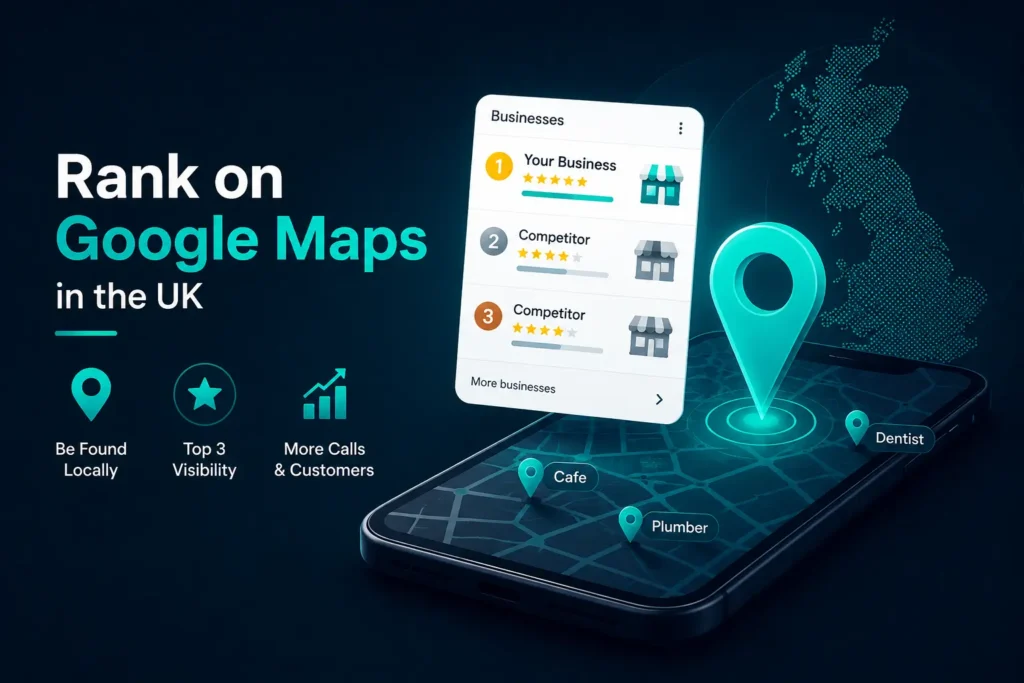
When someone searches for a local business on their phone, the map results are usually the first thing they see. Three businesses show up. Most people pick one of them. If you’re not in that top three, you’re largely invisible regardless of how good your service actually is.
That’s why Google Maps rankings matter, and why more UK businesses are paying attention to them.
What Is Google Maps SEO?
It’s the work you do to make your business show up prominently when someone searches locally whether that’s “plumber near me,” “hairdresser in Leeds,” or “best accountant Birmingham.” It’s not a single trick; it’s a combination of things working together: your Google Business Profile, your website, your reviews, and how consistently your business information appears across the web.
The goal is simply to be visible to the right people, in the right place, at the right moment.
Why It Matters for UK Businesses
Most customers have already made up their mind before they even contact you. They’ve searched, checked your reviews, looked at your photos, and compared you to two or three competitors all within a few minutes on their phone.
Businesses that rank well in Maps get more calls, more footfall and more enquiries from people who are genuinely ready to buy. It’s not passive traffic; these are local customers with real intent, searching for exactly what you offer.
The top three map results capture the vast majority of that attention. Everything below gets significantly less. Closing that gap through proper optimisation is one of the most practical things a small UK business can do right now.
How Google Decides Who Ranks on Maps
Google isn’t mysterious about this. It looks at three things: how relevant your business is to what someone searched, how close you are to them, and how well-known and trusted your business appears online.
You can’t move your physical location, but relevance and prominence can still help you show up ahead of competitors who are closer but less well-optimised. That’s worth knowing distance isn’t everything.
Your Google Business Profile Needs Ongoing Attention
Most businesses create their profile once, fill in the basics, and never touch it again. That’s a missed opportunity because the profiles that rank well are the ones that are kept accurate, complete and reasonably active.
Start with your categories. Your primary category should describe exactly what you do “Plumber” not “Home Services,” “Accountant” not “Professional Services.” The more specific, the better Google understands who to show you to.
Your business description is worth spending a few minutes on. Don’t stuff it with keywords just explain what you do, where you work, and why customers tend to choose you. Write it how you’d say it out loud.
Add your services properly, with real descriptions. This helps your profile show up for specific searches that go beyond your main category, someone searching “drain unblocking Manchester” rather than just “plumber.”
Photos matter more than most people realise. Real images of your premises, your team, and your work build trust before a customer has even spoken to you. Generic stock photos do the opposite.
Keep your contact details and opening hours accurate especially around bank holidays. And make sure your name, address and phone number are identical across your website and any directories you’re listed on. Even small inconsistencies can quietly work against you.
If something reads awkwardly, rewrite it. Google notices. So do customers.
Reviews, Your Website, and the Technical Stuff
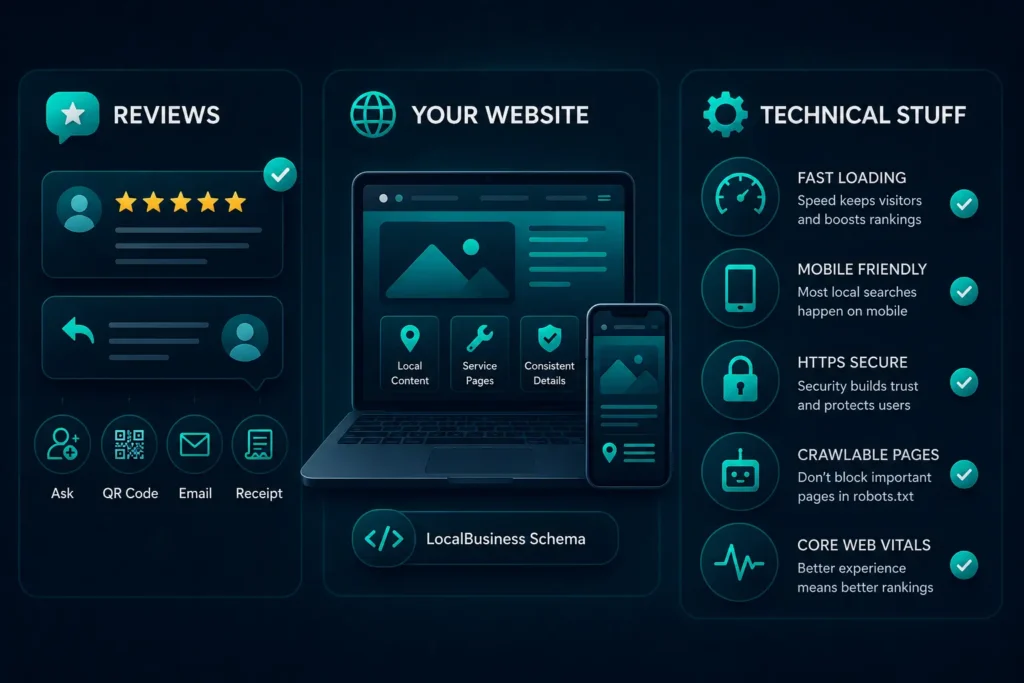
Reviews are one of the first things a potential customer looks at and one of the signals Google weighs most heavily for local rankings. Not just the star rating, but how recent they are, how many you have, and whether you’re actually responding to them.
The simplest way to get more reviews is to ask, at the right moment. Just after a job’s done well, in a follow-up email, on a receipt, or via a QR code on your counter. Make it one tap the easier you make it, the more people follow through.
Always respond to the good ones and the difficult ones. A thoughtful reply to a complaint often impresses new customers more than a string of five-stars. It shows you’re present and you care. And avoid anything that looks like a fake review Google’s getting better at spotting them, and the consequences aren’t worth it.
Your Website Still Plays a Big Role
Your GBP and your website work together. If your site backs up what your profile says with clear service pages, local content, and consistent contact details it reinforces your relevance and authority.
If you cover multiple areas, give each one its own page with genuinely useful content. “Boiler repair in Manchester” and “boiler repair in Salford” should say something different, not just swap the town name. Add LocalBusiness schema so Google can read your address, hours and services clearly. Publish the occasional local guide or case study demonstrates real presence, not just an optimised template.
Technical SEO: Get the Basics Solid
None of this needs to be complicated. Your site should load quickly, work properly on a phone, and be accessible over HTTPS. Most local searches happen on mobile, so if your site is slow or awkward on a small screen, you’re losing people before they’ve even read a word.
Make sure Google can actually crawl your local pages. A misconfigured robots.txt file can quietly block the very pages you want ranking. And keep an eye on Core Web Vitals; they’re Google’s way of measuring whether your site feels good to use. A smooth experience keeps people on the page, which matters.
Consistency, Links, and How People Interact With Your Listing
NAP consistency simply means your business name, address and phone number are identical everywhere they appear on your website, Google profile, Yell, Thomson Local, FreeIndex, your Facebook page, local chamber listing. Everywhere.
Small inconsistencies, an abbreviated street name here, an old phone number there seem minor but they create doubt, both for Google and for customers trying to contact you. Audit your listings occasionally and fix anything that’s drifted out of date.
Building Local Links Naturally
A mention in your local newspaper, a link from a charity you’ve supported, a reference on a supplier’s website these carry real weight. Sponsor a local sports team, collaborate with a nearby business, or contribute something genuinely useful to a community event. Links earned this way are far more valuable than anything you could buy.
Reviews, Your Website, and the Technical Stuff
Reviews are one of the first things a potential customer looks at and one of the signals Google weighs most heavily for local rankings. Not just the star rating, but how recent they are, how many you have, and whether you’re actually responding to them.
The simplest way to get more reviews is to ask, at the right moment. Just after a job’s done well, in a follow-up email, on a receipt, or via a QR code on your counter. Make it one tap the easier you make it, the more people follow through.
Always respond to the good ones and the difficult ones. A thoughtful reply to a complaint often impresses new customers more than a string of five-stars. It shows you’re present and you care. And avoid anything that looks like a fake review — Google’s getting better at spotting them, and the consequences aren’t worth it.
Your Website Still Plays a Big Role
Your GBP and your website work together. If your site backs up what your profile says — with clear service pages, local content, and consistent contact details — it reinforces your relevance and authority.
If you cover multiple areas, give each one its own page with genuinely useful content. “Boiler repair in Manchester” and “boiler repair in Salford” should say something different, not just swap the town name. Add LocalBusiness schema so Google can read your address, hours and services clearly. Publish the occasional local guide or case study demonstrates real presence, not just an optimised template.
Technical SEO: Get the Basics Solid
None of this needs to be complicated. Your site should load quickly, work properly on a phone, and be accessible over HTTPS. Most local searches happen on mobile, so if your site is slow or awkward on a small screen, you’re losing people before they’ve even read a word.
Make sure Google can actually crawl your local pages; a misconfigured robots.txt file can quietly block the very pages you want ranking. And keep an eye on Core Web Vitals; they’re Google’s way of measuring whether your site feels good to use. A smooth experience keeps people on the page, which matters.
Why Some Businesses Don’t Show Up
Usually it comes down to the same handful of issues — an incomplete profile, mismatched contact details across the web, too few reviews, a website that doesn’t support the listing, or a poor mobile experience.
Sometimes it’s simpler: someone tried to shortcut the process and Google quietly penalised them for it.
How Long Does It Take?
There’s no single answer, but most businesses start seeing meaningful movement within a few weeks to a few months. How quickly depends on how competitive your area is, how much optimization you put in place, how consistently reviews come in, and how strong your website already is.
Do the work steadily and the results follow. Rush it or ignore it, and they won’t.
Google Maps SEO Checklist
- Complete your GBP fully categories, description, services, photos, hours
- Keep contact details and opening hours accurate and up to date
- Collect genuine reviews and respond to all of them
- Build local landing pages with real, location-specific content
- Add LocalBusiness schema to your website
- Get listed consistently across reputable UK directories
- Build local backlinks through PR, partnerships and community presence
- Make sure your site loads quickly and works properly on mobile
Tick these off gradually and consistently that’s genuinely all it takes for most small businesses.
Is Google Maps SEO Worth It?
For most UK businesses, yes genuinely. Ranking well on Maps brings in a steady stream of local enquiries from people already looking for what you offer. Over time, that reduces how much you need to spend on ads to stay visible.
When It Makes Sense to Get Help
Local SEO takes consistent effort optimising your profile, building citations, managing reviews, fixing technical issues, creating location-specific content. Most business owners simply don’t have the time to do it properly alongside everything else.
A good local SEO agency handles all of it, and keeps things moving consistently month after month.
Our local SEO specialists help businesses increase visibility, attract nearby customers, and generate more enquiries through targeted local search optimisation strategies tailored to each location.
- Grow your visibility with our local SEO services in London
- Increase local traffic using proven local SEO experts in Manchester
- Improve Google rankings through local SEO services in Birmingham
- Generate more local leads with trusted local SEO support in Liverpool
- Strengthen your online presence with our local SEO agency in Leeds
- Improve local search performance using local SEO services in Bristol
- Boost your local visibility through local SEO optimisation in Nottingham
Conclusion
An accurate, complete Business Profile. A website that reflects where you are and what you do. Real reviews coming in regularly. Consistent details across directories. None of it is particularly complicated, but it does require attention over time. Businesses that show up well in Maps aren’t doing anything mysterious they’ve just made sure their online presence actually reflects their real-world business.
Get the basics right, keep things updated, and the visibility tends to follow.