
If you’ve searched “how much does SEO cost in the UK” you already know the problem. Every answer gives you a range from £300 to £20,000 with no real explanation of why.
Here’s the honest truth: what you pay depends on your goals, your industry, and the quality of work behind it. Cheap SEO usually fails. It looks like a bargain until your rankings drop and nothing’s moved in six months.
Done properly, SEO builds the kind of visibility, traffic, and leads that keep coming long after you’ve paid for them. The ROI compounds paid ads stop the moment your budget does.
In 2026, that also means AI search, semantic SEO, GEO, and AEO. This guide covers it all.
Why SEO pricing varies so much
The biggest reason people get confused by SEO quotes is that no two businesses need the same thing.
A local plumber in Leeds targeting “emergency plumber near me” needs a tightly focused local SEO strategy, a well-optimised Google Business Profile, consistent citations, and a handful of strong local pages. That’s a very different project from a national ecommerce brand competing for thousands of product and category keywords against established retailers with years of domain authority behind them.
Pricing reflects that difference.
When an agency quotes your SEO, they’re factoring in several things: how competitive your industry is, what location or locations you’re targeting, the current size and health of your website, your domain authority, and what you’re actually trying to achieve. A brand-new site with no backlinks in a competitive space needs far more groundwork than an established business with decent authority that just needs ongoing optimisation.
Goals matter too. Ranking for a few local keywords costs less than building topical authority across an entire sector. Dominating national search in finance, legal, or healthcare some of the most competitive verticals in the UK costs more than almost anything else in digital marketing.
None of this means expensive SEO is always better, or that cheaper means worse. It means pricing is contextual. The right question isn’t “how much does SEO cost?” it’s “how much does SEO cost for a business like mine, with these goals, in this market?”
Average SEO costs in the UK in 2026
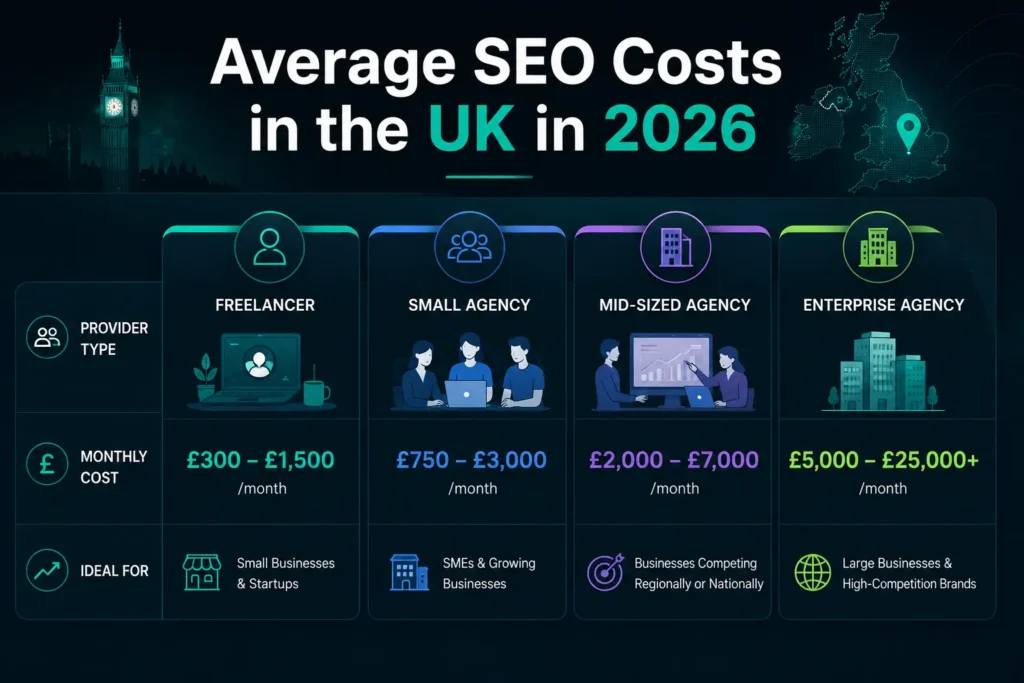
SEO in the UK costs anywhere from £300 to £25,000+ per month in 2026, depending on who you hire and what your business needs. Here’s what the market actually looks like across provider types:
Freelancer SEO — £300 to £1,500/month A good freelancer suits small businesses and startups with straightforward goals. You get focused, personal attention — but capacity is limited, and most freelancers specialise in one or two areas rather than covering technical SEO, content, and link building simultaneously.
Small agency SEO — £750 to £3,000/month The sweet spot for most UK SMEs. A small agency brings a small team with broader skills than a solo freelancer, usually covering strategy, on-page work, and some content. Expect a structured monthly process and regular reporting.
Mid-sized agency SEO — £2,000 to £7,000/month Built for businesses competing regionally or nationally. At this level you get dedicated account management, proactive content strategy, digital PR, and serious link acquisition, the kind of work that moves rankings in competitive industries.
Enterprise SEO £5,000 to £25,000+/month For large websites, multi-location businesses, or brands operating in high-competition verticals like finance, legal, or ecommerce at scale. Enterprise SEO involves large teams, technical depth, international strategies, and continuous optimisation across hundreds or thousands of pages.
UK SEO pricing by provider
| Provider type | Monthly cost |
| Freelancer | £300 – £1,500 |
| Small agency | £750 – £3,000 |
| Mid-sized agency | £2,000 – £7,000 |
| Enterprise agency | £5,000 – £25,000+ |
SEO pricing models explained
Before comparing quotes, understand how SEO is actually priced because the model matters as much as the number.
Monthly SEO retainers
The most common model, and the one that makes the most sense for sustained growth. A retainer keeps a team working on your site every month handling technical SEO, content, on-page optimisation, and backlink building continuously. Rankings compound over time. Most businesses see meaningful movement between months three and six, with stronger ROI at twelve months.
One-off SEO projects
Best for specific, defined problems. The most common are SEO audits, a full review of what’s holding your site back, delivered as a clear action plan. Site migrations are another major use case; a poorly handled move to a new domain can erase years of ranking progress overnight. Technical fixes, crawl errors, indexing issues, and broken structured data also fall here.
Project costs in the UK typically run from £1,000 for a basic audit to £15,000+ for a complex migration.
Hourly SEO consulting
Suits businesses with in-house capability that need expert input at key moments — a strategy session, a second opinion, or a focused audit. UK rates run from £75 to £150 per hour for experienced independents, up to £400 for senior specialists. Flexible, but rarely builds momentum on its own.
Performance-based SEO
Sounds attractive, pay only when results arrive. In practice, most reputable agencies avoid it. SEO outcomes depend on algorithm changes, competitor activity, and factors no agency fully controls. Chasing guaranteed rankings often pushes providers towards risky short-term tactics that don’t hold.
How much do local SEO services cost?
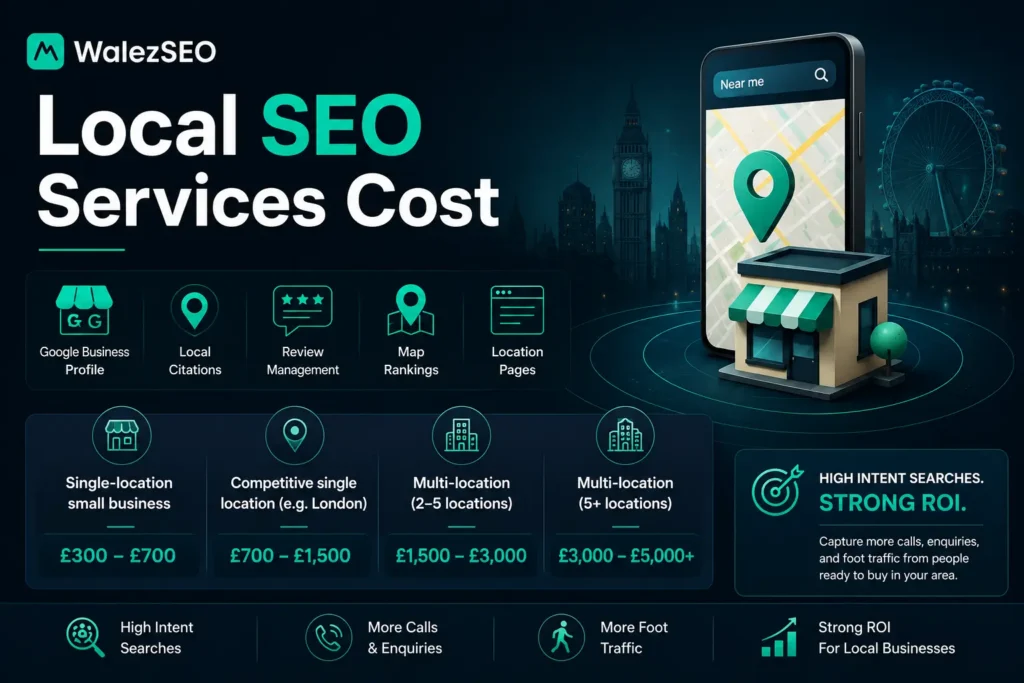
Local SEO is a more focused discipline than national SEO and generally more affordable. Rather than competing across the entire web, the goal is straightforward: appear when someone nearby searches for what you offer. That means showing up in Google Maps, ranking in the local pack, and being the obvious choice in your area.
The core work involved includes optimising your Google Business Profile, building consistent citations across UK directories, creating location-specific landing pages, managing and encouraging customer reviews, and improving your overall map rankings. Done well, this drives foot traffic, calls, and enquiries from people who are already ready to buy.
For a small business targeting a single location, a restaurant, a tradesperson, a dental practice, local SEO typically costs between £300 and £1,000 per month. That range covers the essentials: profile optimisation, citation building, review strategy, and basic on-page work for your location pages.
Multi-location businesses need more. Each location requires its own landing page, its own Google Business Profile, and its own citation presence. Costs scale accordingly, typically running from £1,500 to £5,000 per month depending on how many locations are involved and how competitive each area is.
| Business type | Monthly cost |
| Single-location small business | £300 – £700 |
| Competitive single location (e.g. London) | £700 – £1,500 |
| Multi-location (2–5 locations) | £1,500 – £3,000 |
| Multi-location (5+ locations) | £3,000 – £5,000+ |
Local SEO delivers some of the strongest ROI in digital marketing particularly for service businesses and bricks-and-mortar brands. The searches it targets (“plumber in Manchester,” “best accountant in Leeds”) come from people with high intent and low patience. Ranking well means capturing that demand before your competitors do.
Ecommerce SEO pricing
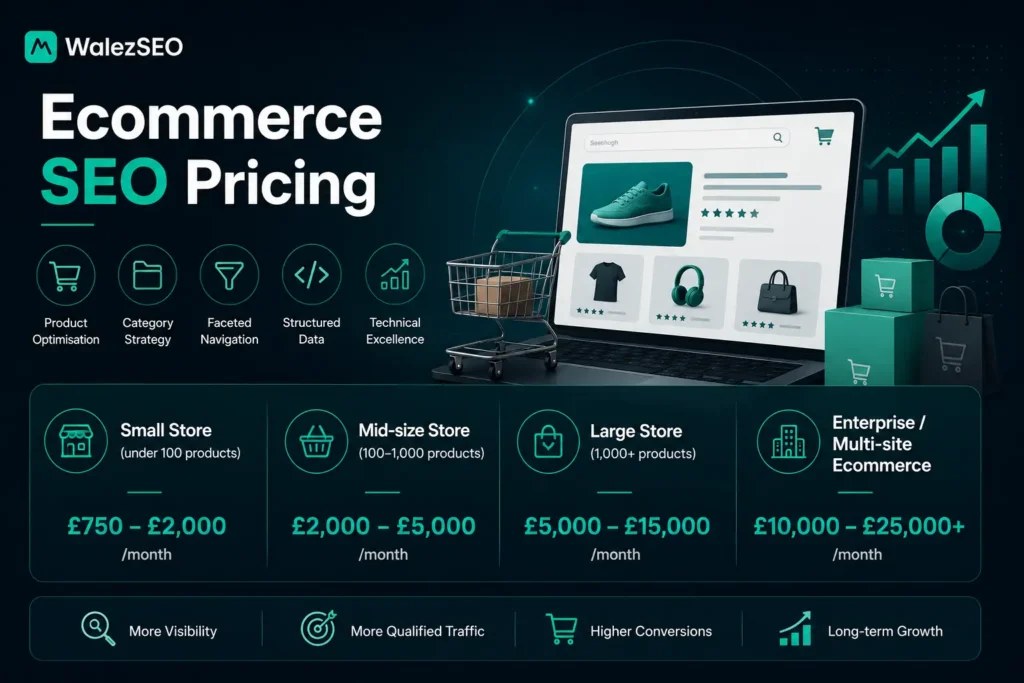
Ecommerce SEO is almost always more expensive than standard SEO and for good reason. Online stores present a scale of technical complexity that most websites simply don’t have.
Product pages need individual optimisation. Category pages require careful keyword targeting and content that ranks without cannibalising each other. Faceted navigation the filtering systems used for size, colour, price creates thousands of duplicate or thin URLs that need intelligent handling to avoid crawl waste and indexing problems. Structured data needs implementing across products, reviews, and breadcrumbs so Google can display rich results. And all of this sits on top of the usual technical SEO, content strategy, and link building.
For growing UK ecommerce brands, this isn’t optional work — it’s the foundation that determines whether your products get found or buried.
| Store size | Monthly cost |
| Small store (under 100 products) | £750 – £2,000 |
| Mid-size store (100–1,000 products) | £2,000 – £5,000 |
| Large store (1,000+ products) | £5,000 – £15,000 |
| Enterprise / multi-site ecommerce | £10,000 – £25,000+ |
The return on ecommerce SEO compounds harder than almost any other channel. Organic product and category rankings drive consistent revenue without ongoing ad spend — and unlike PPC, they don’t stop the moment your budget does.
Enterprise SEO costs
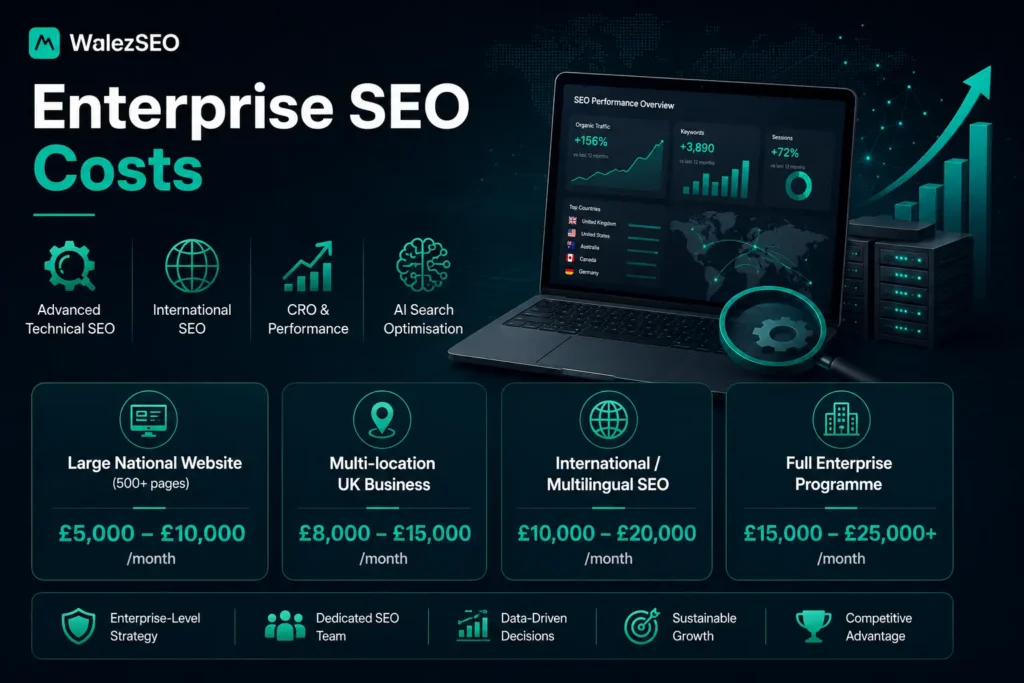
Enterprise SEO is a different beast entirely. Large websites with thousands of pages, multiple locations, or international markets need a level of strategic depth and technical resources that standard packages simply can’t cover.
At this scale, the work spans advanced technical SEO log file analysis, JavaScript rendering, crawl budget management alongside international SEO with hreflang implementation, CRO to convert the traffic you’re already earning, and increasingly, AI search optimisation to maintain visibility as platforms like ChatGPT and Perplexity reshape how buyers discover brands. For large UK businesses competing in high-value sectors, enterprise SEO isn’t a cost, it’s a competitive necessity.
| Business type | Monthly cost |
| Large national website (500+ pages) | £5,000 – £10,000 |
| Multi-location UK business | £8,000 – £15,000 |
| International / multilingual SEO | £10,000 – £20,000 |
| Full enterprise programme | £15,000 – £25,000+ |
SEO freelancer vs SEO agency pricing
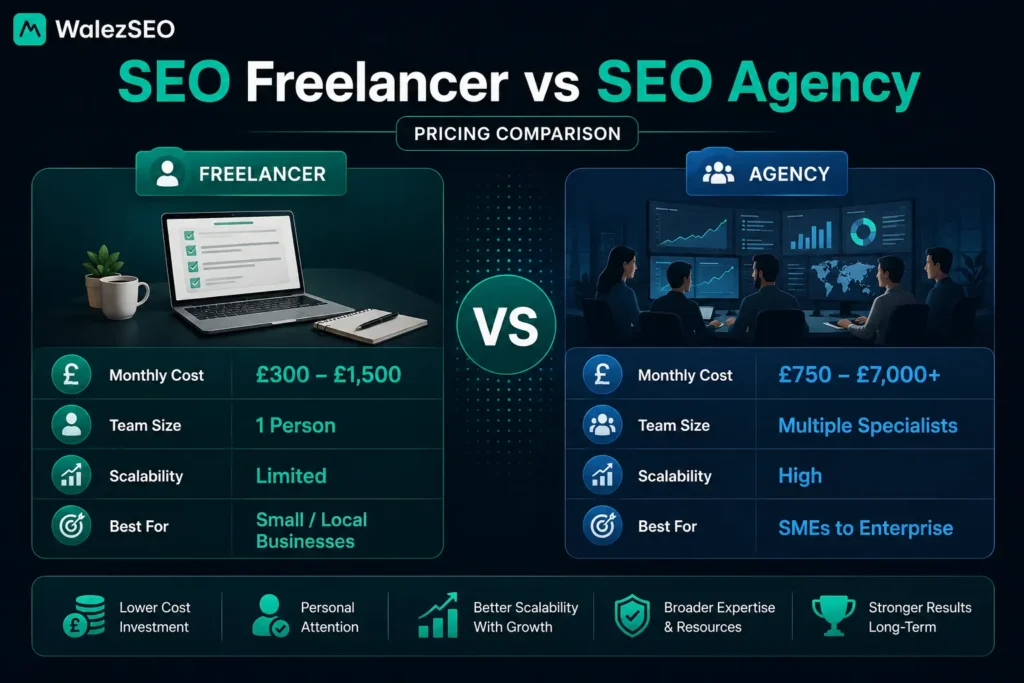
The choice usually comes down to budget and what you need done.
Freelancers are cheaper, typically £300 to £1,500 per month and work well for small businesses with focused, straightforward goals. The tradeoff is capacity. One person can only cover so much, and if your needs span technical SEO, content, and link building simultaneously, a solo freelancer will struggle to do all three well.
Agencies bring larger teams, broader expertise, and proper scalability. When your campaigns grow, your account grows with them. That comes at a higher price £750 to £7,000+ depending on size but for businesses with serious growth targets, the depth of resource is usually worth it.
| Freelancer | Agency | |
| Monthly cost | £300 – £1,500 | £750 – £7,000+ |
| Team size | 1 person | Multiple specialists |
| Scalability | Limited | High |
| Best for | Small / local businesses | SMEs to enterprise |
What’s usually included in SEO services?
Most monthly SEO packages cover the same core work though how deeply they cover it depends heavily on what you’re paying.
Keyword research comes first. Not just finding search terms, but understanding what your customers actually type, what they mean by it, and where realistic opportunities exist for your site right now.
From there, technical SEO keeps everything running cleanly: site speed, crawlability, indexing, Core Web Vitals. Content optimization makes sure your pages answer the right questions in the right way. Backlink building earns the trust signals that tell Google your site deserves to rank.
Better packages go further. Regular audits catch problems before they cost you rankings. CRO work turns the traffic you’re already getting into actual enquiries and sales. Semantic SEO builds genuine topical authority rather than just targeting isolated keywords. And increasingly, AI search optimization ensures your brand shows up in ChatGPT, Perplexity, and Google’s AI Overviews, not just traditional search results.
Good reporting ties it all together. You should always know what’s been done, what’s moved, and why.
What factors affect SEO costs?
Two businesses in completely different industries can get quotes that are worlds apart — even if their websites are roughly the same size. Here’s what’s actually driving that difference.
Competition and industry difficulty
This is the biggest cost driver. Ranking in finance, legal, insurance, or healthcare in the UK means competing against brands with years of authority, enormous content libraries, and serious link profiles. That takes more work, more time, and more budget. A niche B2B service with few direct competitors online is a fundamentally easier problem to solve.
Website condition
A well-built site with clean code, solid structure, and no technical baggage is far cheaper to work with than one carrying years of accumulated problems, broken redirects, duplicate content, indexing issues, slow load times. The worse the starting point, the more groundwork is needed before any growth work can begin.
Existing backlink profile
Authority isn’t built overnight. A brand-new domain with no backlinks needs significantly more link acquisition work than an established site that’s already earned trust. Your current authority level directly affects how long and how much it takes to compete for meaningful keywords.
Content needs
Some sites need a handful of pages optimized. Others need hundreds of pieces of content created from scratch. The volume of content required, and how competitive the topics are, shapes a significant portion of your monthly cost.
Technical SEO issues
Large websites, ecommerce stores, and sites built on complex CMS platforms often carry technical problems that take real time to resolve JavaScript rendering issues, crawl budget waste, faceted navigation problems, and poor site architecture. The more technical debt, the higher the early investment.
Business goals and geographic targeting
Targeting one town costs less than targeting a whole country. Ranking for local keywords costs less than dominating a national market. And a business that wants steady local leads has very different requirements from one building toward international expansion. Your goals set the scope and scope sets the price.
black-hat SEO Mention: Cheap SEO often creates long-term damage.
Why cheap SEO can hurt your website
It’s tempting to go with the cheapest quote, especially when every agency seems to be promising the same outcomes. But below a certain price point, the work changes and not in ways that are immediately visible.
Spam backlinks
Links from low-quality, irrelevant, or manipulative sources used to be a quick way to boost rankings. Google got wise to this years ago. Today, a backlink profile full of spammy links is more likely to trigger a penalty than a ranking improvement. Cleaning up a toxic link profile costs time and money often more than the cheap SEO package did in the first place.
AI-generated low-quality content
The rise of cheap content mills and automated writing tools has flooded the web with pages that say a lot but mean very little. Google’s Helpful Content system is specifically designed to identify and suppress this kind of material. Thin, generic, experience-free content doesn’t just fail to rank, it can drag down the performance of your entire site.
Keyword stuffing
Repeating target keywords unnaturally throughout a page is an old tactic that signals to Google exactly what you’re trying to do. It makes content harder to read, damages user experience, and actively works against you in modern search.
Black-hat SEO
Cloaking, hidden text, manipulative redirects, private blog networks these tactics exist because they sometimes produce short-term results. The problem is they always carry long-term risk. A manual penalty from Google can remove your site from search results entirely, sometimes for months. Recovering is slow, painful, and expensive.
Cheap SEO rarely just fails quietly. It often leaves behind damage that takes far longer to fix than it took to cause. The real cost of a £300-a-month package isn’t always visible on the invoice; it shows up six months later when rankings drop and nobody can explain why.
How long does SEO take to deliver ROI?
Most UK businesses start seeing meaningful movement between months three and six. The first few months are groundwork technical fixes, content, foundations. Not glamorous, but necessary.
After that, rankings build, traffic grows, and leads start coming through organically. Competitive industries like finance, legal, and ecommerce take longer sometimes twelve to eighteen months before results feel significant.
But here’s what makes SEO different from every other channel: it compounds. A page ranking well in month six doesn’t plateau; it keeps attracting traffic, earning links, and growing reach without proportionally increasing your costs. The longer you’re in it, the cheaper each lead becomes.
Is SEO worth the cost in 2026?
For most UK businesses, genuinely yes. Paid ads work but the moment you stop paying, everything stops with them. SEO builds something that stays. Rankings, authority, content none of that disappears when you pause a direct debit.
Long-term, organic traffic reduces what you spend acquiring customers. Brand visibility builds trust in a way ads simply don’t. And in 2026, strong SEO also means appearing in AI-generated answers on ChatGPT, Perplexity, and Google’s AI Overviews search real estate that didn’t even exist two years ago. The investment pays forward. That’s what makes it worth it.
SEO pricing by business type
Every business type has different SEO needs and different budgets that make sense. Here’s a realistic breakdown.
Small business SEO costs
Small businesses typically need focused, no-frills SEO, a solid technical foundation, a handful of well-optimised pages, and steady local or niche visibility. The goal is usually leads, not traffic volume.
Realistic budget: £300 to £1,500 per month. At the lower end you’re working with a freelancer on essentials. At the higher end, a small agency brings broader capability and a proper strategy.
Ecommerce SEO costs
Online stores are technically complex product pages, category structures, faceted navigation, structured data, and content all need attention simultaneously. Ecommerce SEO is almost always more expensive than service-based SEO for the same reason a shop floor is harder to manage than a single office.
Realistic budget: £750 to £15,000 per month depending on catalogue size, competition, and platform.
SaaS SEO costs
SaaS SEO is content-heavy and highly competitive. The strategy typically revolves around ranking for problem-aware keywords, building comparison and alternative pages, and establishing genuine topical authority in a space full of well-funded competitors.
Realistic budget: £2,000 to £8,000 per month. Content production and link building drive most of the cost.
Local SEO costs
Local SEO is the most accessible entry point and delivers some of the strongest ROI for service businesses. Google Business Profile optimisation, citations, local landing pages, and review management form the core of the work.
Realistic budget: £300 to £1,500 per month for a single location. Multi-location businesses should budget £1,500 to £5,000 depending on scale.
Enterprise SEO costs
Large websites, international markets, multiple locations, advanced technical complexity enterprise SEO requires dedicated teams, specialist expertise, and serious ongoing investment. At this level, SEO touches every part of the digital presence, from CRO and AI search optimisation to hreflang implementation and log file analysis.
Realistic budget: £5,000 to £25,000+ per month. For businesses at this scale, it’s not a marketing cost it’s infrastructure.
SEO vs PPC costs
Both work. The difference is what you’re buying.
PPC delivers instant traffic, your ads go live, clicks come in. But you’re renting that visibility. The moment your budget stops, the traffic stops with it. Every click costs money, every month, indefinitely.
SEO takes longer to build but creates something you own. Rankings, authority, content these compound over time and keep delivering traffic without a cost-per-click attached. A page that ranks well in month six can still be generating leads in year three.
Most businesses benefit from running both PPC for immediate results, SEO for long-term, sustainable growth that doesn’t rely on a media budget to survive.
The future of SEO pricing
SEO pricing will keep rising and the work will keep getting more complex.
As Google’s algorithm matures and AI search becomes mainstream, surface-level optimisation simply won’t cut it. The agencies charging more in 2026 are doing deeper semantic content, entity optimisation, structured data implementation, technical architecture work, and user experience improvements that traditional SEO never touched.
Content depth matters more than content volume now. One genuinely authoritative, well-structured piece outperforms ten thin pages every time.
Businesses that understand this are investing accordingly. Those still chasing cheap SEO are building on sand and Google’s direction of travel makes that increasingly expensive to fix.
How much does SEO cost per month in the UK? Most UK businesses pay between £300 and £5,000 per month depending on their size, goals, and competition. Freelancers start around £300, small agencies from £750, and mid-sized agencies from £2,000. Enterprise programmes run £5,000 to £25,000+.
Looking to improve your rankings, increase organic traffic, and generate more qualified leads? Explore our specialist SEO services designed to help businesses grow through long-term search visibility and strategic optimisation.
- Explore our complete digital marketing solutions on the SEO agency
- Request a detailed free website SEO audit
- Improve visibility with our local SEO optimisation services
- Fix website issues using advanced technical SEO services
- Boost rankings through professional on-page SEO services
Frequently asked questions
Is SEO worth paying for?
For most businesses, yes. SEO builds long-term organic traffic that compounds over time and doesn’t stop the moment you pause a payment unlike paid ads. The ROI typically becomes clear between months six and twelve.
Why is SEO expensive?
Because it requires genuine expertise across multiple disciplines: technical analysis, content strategy, link acquisition, semantic optimisation, and increasingly AI search. Good SEO is time-intensive, specialist work. The price reflects that.
Can cheap SEO work?
Rarely, and it often causes damage. Spam backlinks, thin AI-generated content, and black-hat tactics can trigger Google penalties that take months to recover from. The real cost of cheap SEO usually shows up later.
How long does SEO take?
Most businesses see meaningful movement between months three and six. Competitive industries can take nine to eighteen months. SEO compounds over time the longer you invest, the stronger the returns.
What is included in SEO pricing?
Most packages include keyword research, technical SEO, content optimisation, backlink building, and monthly reporting. Better packages add audits, CRO, semantic SEO, entity optimisation, and AI search optimisation.
Do SEO agencies guarantee rankings?
Reputable ones don’t. SEO outcomes depend on algorithm changes, competitor activity, and factors no agency fully controls. Any agency guaranteeing page-one rankings by a fixed date is a red flag.
How much should a small business spend on SEO?
A realistic starting budget for a small UK business is £500 to £1,000 per month. Below £300, the quality of work drops significantly. The right budget depends on your goals, competition, and how quickly you want results.
Is AI changing SEO pricing?
Yes. AI Overviews, GEO, AEO, and conversational search require deeper expertise and broader content strategies than traditional SEO. Agencies covering AI search optimization properly charge more and for businesses serious about long-term visibility, it’s a necessary investment.
What’s the difference between local SEO and ecommerce SEO pricing?
Local SEO focuses on Google Business Profile, citations, and location pages typically £300 to £1,500 per month for a single location. Ecommerce SEO is more technically complex, covering product pages, category SEO, faceted navigation, and structured data starting from £750 and scaling to £15,000+ for large stores.
Conclusion
SEO pricing isn’t arbitrary; it reflects the complexity of what’s actually required to move the needle in a competitive search landscape. What you pay depends on your goals, your industry, and where you’re starting from. A local business targeting one town has fundamentally different needs from a national ecommerce brand. Both can get strong returns from SEO but only if the work behind it is done properly.
Quality SEO requires real expertise. Technical depth, content strategy, link acquisition, semantic optimisation, AI search visibility none of this is automated or templated work. The agencies and consultants doing it well charge accordingly, because the work demands it.
Most importantly, SEO is a long-term investment. It doesn’t deliver overnight, and it shouldn’t be judged by month-two results. Businesses that commit to it consistently with realistic budgets and clear goals build organic visibility that compounds, reduces customer acquisition costs, and keeps delivering long after the initial investment.
Cheap SEO, on the other hand, rarely just underperforms. It leaves behind problems that cost more to fix than the original package ever cost to buy.