
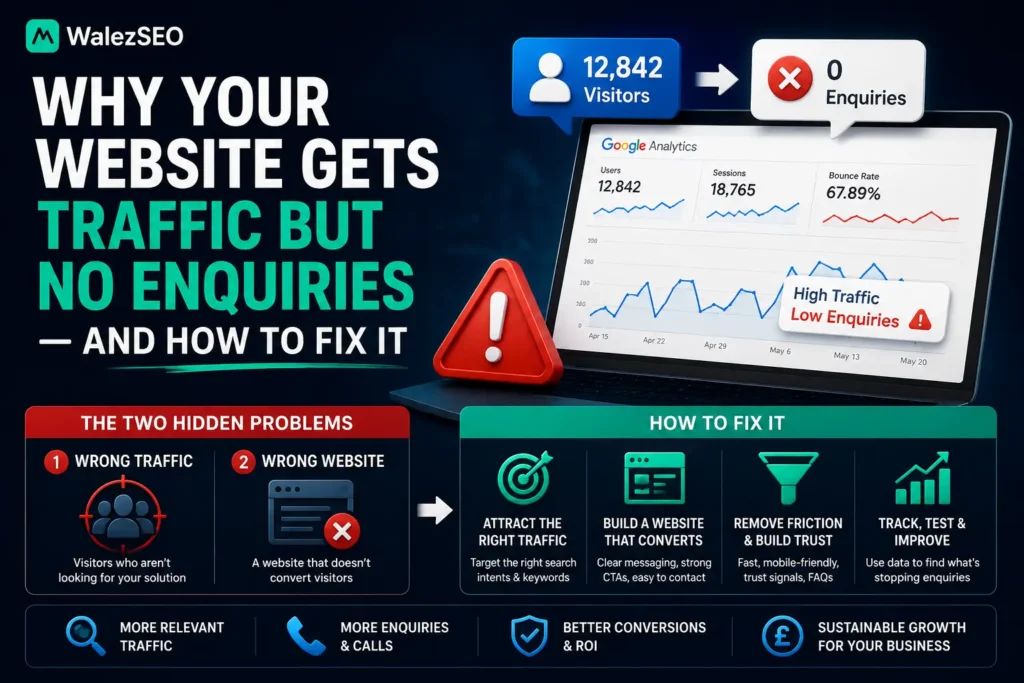
You open Google Analytics. Sessions are up. People are arriving. You check your inbox. Nothing.
The contact form sits empty. The phone doesn’t ring. And somewhere in the back of your mind, a quiet frustration builds — because you can see the visitors, you just can’t figure out why none of them are becoming customers.
This is one of the most common situations UK small business owners find themselves in and one of the most misdiagnosed. Most people assume it’s an SEO problem and go looking for more traffic. It almost never is. The problem is almost never the traffic itself. It is a conversion problem, and conversion problems are almost always fixable once you know where to look.
This guide covers exactly where to look.
Two Very Different Problems That Look Identical
Before fixing anything, it helps to diagnose which version of this problem you actually have. Because traffic-without-enquiries has two distinct root causes that need different solutions.
Problem 1 — Wrong traffic
You’re getting visitors, but they’re not the people who would ever buy from you. Your content is attracting researchers, browsers, and people at the very beginning of an awareness journey — not buyers. The traffic numbers look healthy but the intent behind them is all wrong.
Problem 2 — Right traffic, wrong website
The right people are finding you. They arrive on your site ready to consider hiring you or buying from you. And then something about the experience the messaging, the friction, the trust signals, the speed fails to convert that consideration into action.
If your analytics show high traffic but also high bounce rates, short session times, and limited engagement with deeper pages, the problem may be traffic quality you are attracting the wrong visitors. If traffic quality looks reasonable but conversions are still low, the problem is on your website.
Check your Google Analytics. Are people visiting one page and leaving immediately? That’s likely a traffic quality issue. Are people visiting multiple pages, spending time reading, but still not enquiring? That’s a conversion problem on your website. Both are fixable but they need different fixes.
Reason 1 — You’re Ranking for the Wrong Keywords
Ranking for broad informational keywords brings browsers, not buyers. Traffic quality beats traffic volume every time.
This is the most common cause of traffic-without-enquiries for UK small businesses that have invested in SEO. The agency or freelancer has successfully ranked your site but for keywords that attract people researching, not people buying.
“What is local SEO” attracts someone learning about SEO. “Local SEO agency Derby” attracts someone ready to hire one. Both might send traffic to your site. Only one sends people with genuine purchase intent.
Many websites rank well for informational searches. Guides, general advice, or broad topics bring in readers who are researching, not buying. They are interested, but not ready to act. The solution is not to remove informational content. It is to balance it.
The fix: Open Google Search Console and look at the queries driving traffic to your site. Are they informational (“how to,” “what is,” “tips for”) or transactional (“agency,” “services,” “near me,” “hire,” “cost”)? Informational traffic needs content that funnels readers toward a service page and a clear next step. Transactional traffic needs a high-converting landing page waiting for it. If your transactional keywords have no dedicated, well-optimised pages that’s where to start.
Reason 2 — Your Value Proposition Is Unclear in 5 Seconds
If a visitor can’t understand what you do and why it matters to them within 5 seconds, they leave. No second chances.
Most UK small business websites make visitors work too hard to answer three fundamental questions: What do you do? Who do you do it for? Why should I choose you over anyone else?
Most small business sites are polite to the point of useless. They say things like “Welcome to our website” and “We pride ourselves on customer satisfaction” which tells visitors absolutely nothing.
“Customer satisfaction” is what every business claims. It doesn’t differentiate you. It doesn’t address the visitor’s specific fear or desire. It’s filler that takes up the space where your actual value proposition should be.
The fix: Rewrite your homepage headline and the first paragraph of each service page to answer this sentence: “We help [specific type of customer] to [specific outcome] without [specific pain or risk].” Make it specific enough that a competitor couldn’t use the same sentence. Test it by asking someone unfamiliar with your business to read your homepage for five seconds and then tell you what you do. If they can’t answer confidently, your value proposition needs work.
Reason 3 — Your CTA Is Weak, Buried, or Missing Entirely
“Contact us” buried in the footer is not a CTA. Every page should tell visitors exactly what to do next, prominently.
This is where a surprising number of well-designed UK business websites lose enquiries they’ve genuinely earned. The visitor arrives, reads your content, decides they’re interested and then can’t easily figure out how to take the next step. So they don’t.
Put a proper call to action above the fold phone number and form, not one or the other. Make the CTA specific: “Request a callback” beats “Contact us” for most service businesses.
Specific CTAs outperform generic ones because they reduce the mental effort required to act. “Get a free SEO audit” tells the visitor exactly what they’re getting and that it’s free. “Contact us” tells them nothing and implies effort with uncertain outcome.
The fix: Every service page needs a CTA above the fold visible without scrolling on both desktop and mobile. Include your phone number as a tap-to-call link on mobile. Offer something specific and low-risk: a free audit, a free quote, a free 15-minute call. Remove any friction between “I’m interested” and “I’ve enquired” every additional step between those two moments loses a percentage of potential leads.
Reason 4 — Your Website Is Slow on Mobile
Research consistently shows that 53% of mobile users abandon websites that take longer than three seconds to load. You could be losing half your potential customers before they even see your services.
Most UK small business websites were built to look good on a desktop. The majority of their traffic arrives on a phone. These two facts sit in direct conflict and the consequences show up as traffic-without-enquiries almost every time.
A slow mobile site doesn’t just frustrate visitors. It signals unprofessionalism before a single word of your content has been read. If someone’s first experience of your business is waiting for a page to load, they’re already forming a negative impression and leaving before they’ve seen anything you offer.
If your site fails the mobile test, raise it with your web developer this week. This is not an optional improvement in 2026.
The fix: Test your site on Google PageSpeed Insights (pagespeed.web.dev) specifically on the mobile tab. Your score should be 70 or above. The most common culprits are uncompressed images, unnecessary plugins, and slow hosting. Compressing images alone — converting to WebP format before uploading typically delivers the biggest speed improvement for most small business sites and can be done without touching the code.
Reason 5 — You’re Offering One Way to Enquire
Different buyers convert differently. Some want to call immediately. Some want email. Some prefer a quick message. Some are early-stage and need reassurance before they’re ready to commit. If your site only caters to one behaviour type, you silently lose the others.
A contact form with six fields and a two-day response time converts very differently from a phone number and a WhatsApp link. Some visitors particularly older buyers or those with urgent needs — will not fill in a form. They want to call. Some younger visitors or those outside business hours won’t call — they’ll send a message if you make it easy.
Most UK small business websites offer one enquiry method. That means everyone who prefers a different method leaves without converting even though they were ready to buy.
The fix: Offer at least three ways to enquire: a phone number (click-to-call on mobile), a short contact form (name, email, what they need no more than three fields), and either a WhatsApp link or a live chat option. Each method captures a different buyer type. Adding even one additional enquiry method consistently increases conversion rates without changing a single word of your content.
Reason 6 — Your Trust Signals Are Weak or Missing
The average website converts at roughly 2–3%. For many small business websites, the real rate is far lower — sometimes under 0.5%.
The gap between 0.5% and 3% is almost always explained by trust. A visitor who trusts you will enquire. A visitor who isn’t sure will leave and check your competitors.
Trust signals for a UK small business website include: Google reviews with a star rating displayed prominently, case studies with specific results rather than generic testimonials, accreditations and memberships displayed in the header or footer, real photos of real people rather than stock images, a physical location or service area clearly stated, and response time commitments (“we reply within 2 hours on weekdays”).
Most small business websites have weak versions of some of these and are missing others entirely. A single five-star review quote buried at the bottom of a page does far less work than 47 Google reviews displayed with a 4.9-star rating next to your phone number.
The fix: Audit your homepage and top service pages specifically for trust signals. For each one, ask: would this make a first-time visitor confident enough to enquire? Add your Google review rating and count visibly near your CTA. Replace generic stock photos with real team or work photos. Add one specific case study a real client situation with a real measurable outcome to every major service page.
Reason 7 — Your Pages Have No Clear Purpose
Every page should have a purpose. If those pages don’t guide users towards a conversion, you’re missing a chance.
This is subtler than it sounds. A page can have a topic without having a purpose. An “about us” page that tells your company history has a topic. An “about us” page that builds trust, answers the most common pre-purchase concerns, and ends with a specific CTA has a purpose.
The question to ask of every page on your website: what action do I want a visitor to take after reading this? If the answer isn’t immediately clear from the page itself, the page has a topic but not a purpose. And a page without a clear purpose generates traffic without enquiries almost by definition.
The fix: Go through your five highest-traffic pages and identify the intended next action for each. Then check whether the page actually directs visitors toward that action with a visible CTA, a relevant offer, and a logical flow from the content to the conversion. Pages that inform without directing are content. Pages that inform and direct are lead generation assets.
The Fastest Fixes What to Do This Week
Simple changes like updating your CTA buttons, adding trust signals, and compressing images can be done in a single afternoon and show results within days.
In priority order:
Today: Test your site on mobile PageSpeed Insights. If it scores below 70, compress all images this is the single fastest performance improvement for most sites.
This week: Rewrite the headline on your homepage and top service page to clearly state what you do, who for, and why they should choose you. Add a specific, low-risk CTA above the fold on every service page.
This week: Add your Google review count and star rating prominently near your phone number or primary CTA. If you have fewer than ten reviews, start your review generation system today.
This month: Add a second or third enquiry method a WhatsApp link or a short three-field form if you only have one currently. Audit your five highest-traffic pages for a clear intended next action.
Larger changes like restructuring your service pages take a week or two. Do I need to rebuild? Rarely. The issues that stop most websites from generating enquiries are fixable without a redesign.
The Underlying Truth About Traffic Without Enquiries
Here’s what all of these reasons have in common.
Traffic is the easy part. Google will send people to your site if your SEO is working. But Google’s job ends when someone lands on your page. Everything that happens after that whether they stay, trust you, understand your offer, and decide to contact you is entirely your website’s job.
Most small business owners invest heavily in getting traffic and minimally in converting it. If you increased your conversion rate from 2% to 5%, you’d have 50 enquiries instead of 20 from the same traffic without spending an extra penny on advertising.
That’s the real opportunity. Not more traffic. Better conversion of the traffic you already have.
Related Reading
Why Local SEO Fails for UK Small Businesses If traffic quality is the issue rather than conversion, this guide covers the ten reasons local SEO produces visibility without leads — including the keyword intent problem in depth.
On-Page SEO Services How your pages are structured, written, and optimised directly determines whether traffic converts. On-page SEO covers the content and technical elements that make pages work as lead generation tools.
Is SEO Worth It for Small Businesses UK? If you’re questioning whether the traffic is worth building in the first place, this guide covers the honest ROI data and the conditions under which SEO genuinely pays for UK small businesses.
Local SEO Services London For London-based businesses where competition is highest and conversion optimisation matters most even a small improvement in enquiry rate produces significant revenue difference at London lead volumes.
Free SEO Audit Not sure whether your traffic problem is a targeting issue or a conversion issue? A free audit reviews both which queries are sending traffic, whether those queries have buyer intent, and what’s happening on the pages they land on. Specific recommendations, no obligation.
Frequently Asked Questions
Why does my website get traffic but no enquiries?
Traffic without enquiries usually points to one of two issues: either the visitors arriving are not the right audience a targeting problem or your site is not persuading them to act a conversion problem. Check your analytics: high bounce rates and short session times suggest wrong traffic. Multiple page visits with no enquiry suggests a conversion problem on your site.
What is a normal enquiry rate for a UK small business website?
The average website converts at roughly 2–3%, meaning the vast majority of visitors leave without taking any action. For many small business websites, the real rate is far lower sometimes under 0.5%. A well-optimised service page for a UK small business should convert at 3–5% of relevant traffic.
Do I need to rebuild my website to fix low enquiries?
Rarely. The issues that stop most websites from generating enquiries are fixable without a redesign. Rewriting headlines, strengthening CTAs, adding trust signals, and improving mobile speed are all page-level changes that can be made without rebuilding the entire site.
How quickly can conversion improvements show results?
Simple changes like updating CTA buttons, adding trust signals, and compressing images can be done in a single afternoon and show results within days. Bigger structural changes to service pages typically take one to two weeks to implement and one to four weeks to show measurable impact in your enquiry volume.
What’s the single most impactful change I can make today?
Add a specific, low-risk CTA above the fold on your highest-traffic service page
visible without scrolling on mobile. Make it specific: “Request a free callback” beats “Contact us” for most service businesses. This single change, on your single highest-traffic page, is the fastest route to turning existing traffic into enquiries.